

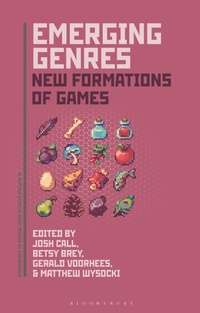
Emerging Genres
New Formations of Games
1st Edition
Published on 8. January 2026
344 pages
979-8-7651-2563-2 (ISBN)
Description

This collection expands the analytical framework of digital games by exploring them through the lens of genre analysis-the evaluation of the structural designs that provide the framework for the player's experience. Each chapter in this volume attends to a unique game genre that is newly emerged or revisited, and often new under-addressed in critical scholarship to theorize where games are situated currently and establish new ground in Game Studies for the future.
As video games continue to dominate the media landscape, understanding the structure and form of games is increasingly important. Despite the fluid nature of genre, there remains an intellectual and ideological power for understanding the connective tissue of game genres as creative artifacts through their relational iterations. This volume extends these ideas by considering the current framework for game genres, highlighting the additions and evolutions of the last decade. Each section in this collection revisits the idea of genre as a flexible dynamic to capture the iterative quality of the work by signaling things that exist currently, tracing their emergence and evolution, and theorizing what such affordances might mean for the future.
The first section considers emerging genres as a function of the material conditions of play, and the game experience. The second section examines many of the formal/mechanical elements used to identify genres, highlighting the emergence or evolution of forms that are unique to the current landscape of games. The final section explores the function and construction of genre as affective, highlighting the expressive and persuasive potential of games to shape the audience.
As video games continue to dominate the media landscape, understanding the structure and form of games is increasingly important. Despite the fluid nature of genre, there remains an intellectual and ideological power for understanding the connective tissue of game genres as creative artifacts through their relational iterations. This volume extends these ideas by considering the current framework for game genres, highlighting the additions and evolutions of the last decade. Each section in this collection revisits the idea of genre as a flexible dynamic to capture the iterative quality of the work by signaling things that exist currently, tracing their emergence and evolution, and theorizing what such affordances might mean for the future.
The first section considers emerging genres as a function of the material conditions of play, and the game experience. The second section examines many of the formal/mechanical elements used to identify genres, highlighting the emergence or evolution of forms that are unique to the current landscape of games. The final section explores the function and construction of genre as affective, highlighting the expressive and persuasive potential of games to shape the audience.
More details
Series
Edition
1. Auflage
Language
English
Place of publication
New York
United States
Publishing group
Bloomsbury Publishing Plc
Target group
Professional and scholarly
Illustrations
22 bw illus
ISBN-13
979-8-7651-2563-2 (9798765125632)
Copyright in bibliographic data and cover images is held by Nielsen Book Services Limited or by the publishers or by their respective licensors: all rights reserved.
Schweitzer Classification
Other editions
Additional editions
Book
approx. 01/2026
Bloomsbury Academic USA
€133.60
Not yet published
Persons
Josh Call is Professor of English at Grand View University, USA.
Betsy Brey is Instructor in Communication Arts at the University of Waterloo, Canada.
Gerald Voorhees is an Associate Professor of Communication Arts at the University of Waterloo, Canada.
Matthew Wysocki is Associate Professor at Flagler College, USA, where he is the Coordinator of Media Studies.
Betsy Brey is Instructor in Communication Arts at the University of Waterloo, Canada.
Gerald Voorhees is an Associate Professor of Communication Arts at the University of Waterloo, Canada.
Matthew Wysocki is Associate Professor at Flagler College, USA, where he is the Coordinator of Media Studies.
Content
Acknowledgements
Notes on Contributors
Introduction: Why Genres Matter
Josh Call (Grand View University, USA) and Betsy Brey (University of Waterloo, Canada)
I. Material Conditions
1. Nostalgic Enactment: The Genre of Home Arcade Cabinets
Brent Kice (University of Houston- Clear Lake, USA)
2. The FMV Game: A Genre that Never Existed, But Refuses to Die
Jakub Majewski (Kazimierz Wielki University, Poland) and Scott Knight (Bond University, Australia)
3. Game Modification As Genre-Bending Media
AleS Ceh (University of Maribor, Slovenia)
4. Teachable Games: Genre Conventions for the University Classroom
Rebecca S. Richards (University of Massachusetts Lowell, USA)
5. Press [space] to Honk, Press [x] to Think: Avatars and Environments in Nonhuman Simulators
Spencer Myers (Bowling Green State University, USA) and Kari Hanlin (Bowling Green State University, USA)
II. Formal and Mechanical Dimensions
6. Questioning Genre Stability In The Current Generation Of Real-Time Strategy Games
Kacper Szozda (University of Western Australia)
7. Video Games of the Absurd
Anna Douglass (UNSW Sydney, Australia)
8. Dad Gaming and "Boomer Shooters:" Changing Demographics in a Shifting Gaming Landscape
Kyle Moody (Fitchburg State University, USA)
9. "You prepared the Great Transcendence for me": Exploring Inscryption as Meta-Horror
M. Landon (University of Illinois, USA)
10. Toward Eco Video Games
Connor Jackson (Liverpool Hope University, UK)
11. The Fallen Leaves Tell a Story: Elden Ring and the Emergence of the Soulslike Genre
DA Hall (University of North Carolina- Chapel Hill, USA)
III. Cultural Meanings
12. From the Cradle to the Game: Dysphoria and Rhetorical Listening in Trans Video Games
Casey O'Ceallaigh (University of Wisconsin- Milwaukee, USA)
13. Moral Combat: Metafictional Indie Games
Taylor Orgeron (Southwestern Oklahoma State University, USA)
14. Love and Other Terrors: Intimacy and Vulnerability in English-Language Dating Simulators and Romantic Games
Heather Blakey (University of Western Australia) and Sian Tomkinson (University of Western Australia)
15. Horror, But Make It Cozy: Beacon Pines' Use of Alternative Narrative and Design Strategies for Scary Video Games
Christine Tomlinson (University of California-Irvine, USA)
Index
Notes on Contributors
Introduction: Why Genres Matter
Josh Call (Grand View University, USA) and Betsy Brey (University of Waterloo, Canada)
I. Material Conditions
1. Nostalgic Enactment: The Genre of Home Arcade Cabinets
Brent Kice (University of Houston- Clear Lake, USA)
2. The FMV Game: A Genre that Never Existed, But Refuses to Die
Jakub Majewski (Kazimierz Wielki University, Poland) and Scott Knight (Bond University, Australia)
3. Game Modification As Genre-Bending Media
AleS Ceh (University of Maribor, Slovenia)
4. Teachable Games: Genre Conventions for the University Classroom
Rebecca S. Richards (University of Massachusetts Lowell, USA)
5. Press [space] to Honk, Press [x] to Think: Avatars and Environments in Nonhuman Simulators
Spencer Myers (Bowling Green State University, USA) and Kari Hanlin (Bowling Green State University, USA)
II. Formal and Mechanical Dimensions
6. Questioning Genre Stability In The Current Generation Of Real-Time Strategy Games
Kacper Szozda (University of Western Australia)
7. Video Games of the Absurd
Anna Douglass (UNSW Sydney, Australia)
8. Dad Gaming and "Boomer Shooters:" Changing Demographics in a Shifting Gaming Landscape
Kyle Moody (Fitchburg State University, USA)
9. "You prepared the Great Transcendence for me": Exploring Inscryption as Meta-Horror
M. Landon (University of Illinois, USA)
10. Toward Eco Video Games
Connor Jackson (Liverpool Hope University, UK)
11. The Fallen Leaves Tell a Story: Elden Ring and the Emergence of the Soulslike Genre
DA Hall (University of North Carolina- Chapel Hill, USA)
III. Cultural Meanings
12. From the Cradle to the Game: Dysphoria and Rhetorical Listening in Trans Video Games
Casey O'Ceallaigh (University of Wisconsin- Milwaukee, USA)
13. Moral Combat: Metafictional Indie Games
Taylor Orgeron (Southwestern Oklahoma State University, USA)
14. Love and Other Terrors: Intimacy and Vulnerability in English-Language Dating Simulators and Romantic Games
Heather Blakey (University of Western Australia) and Sian Tomkinson (University of Western Australia)
15. Horror, But Make It Cozy: Beacon Pines' Use of Alternative Narrative and Design Strategies for Scary Video Games
Christine Tomlinson (University of California-Irvine, USA)
Index
