

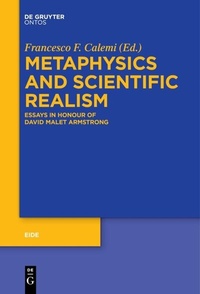
Metaphysics and Scientific Realism
Description

David Malet Armstrong (8 July 1926-13 May 2014) has been one of the most influential contemporary metaphysicians working in the analytic tradition and surely the greatest 20th century Australian philosopher. His main merit is to have reestablished metaphysics as a respectable branch of philosophy placing it at the centre of the philosophical debate, and giving it the status of an authoritative and competent interlocutor of both rational and empirical sciences. By means of a rigorously argumentative approach and a sharp prose, Armstrong has built a whole metaphysical system, that is, a comprehensive and unified picture of the fundamental structure of the world. The various chapters of the book address the key issues concerning Armstrong' view about the problem of universals, the nature of states of affairs, the ontological ground of possibility, nomic necessity, and dispositions, the truthmaker theory, and the theory of mind. This volume aims to celebrate Armstrong's memory bringing new understanding, and hopefully stimulating more work, on his philosophy, with the conviction that it constitutes an invaluable heritage for contemporary research in metaphysics.
More details
Other editions
Additional editions
Person
Content
- Intro
- Contents
- Introduction
- Mirage Realism Revisited
- 1 Introduction
- 2 The one over many problem
- 3 Devitt's charge of mirage realism
- 4 The one over many problem and Armstrong's world of states of affairs
- 5 Instantiation as partial identity
- 6 The one over many problem and the Platonic view of universals
- Ostrich Nominalism or Ostrich Platonism?
- 1 What is it like to be an ostrich?
- 2 The argument from gross facts
- 3 The harlot argument
- 4 The truthmaker argument
- 5 Sketch for a Platonic theory of predication
- 6 Concluding remarks
- In Defense of Transcendent Universals
- 1 Armstrong's ontological method
- 2 Armstrong's primary critique of transcendent realism
- 3 A reply to the primary critique
- 4 "How can distinct particulars have the same properties?"
- 5 Arguments, not explanations
- Armstrong and Tropes
- 1 Universals and tropes
- 2 Tropes and substances
- 3 Armstrong's objections to trope nominalism
- 4 Answers to the objections
- 5 Some advantages of trope nominalism
- 6 Remaining problems for the trope nominalist
- 7 Conclusion
- Tropes: For and Against
- 1 Introduction
- 2 Tropes and the one over many
- 3 Armstrong on what is the 'best' version of the trope view
- 4 Armstrong on why there are no tropes
- 5 Piling, swapping, and 'Hochberg's argument'
- 6 Laws of nature and resemblance
- Facts: An Essay in Aporetics
- 1 Introduction
- 2 Facts as contingently existing concreta
- 3 The truth-maker argument for facts
- 4 Butchvarov's objections to realism about facts
- 4.1 An argument from imperceivability
- 4.2 An argument from impossibility of reference
- 4.3 The Paradox of the Horse and the Paradox of Snow
- 5 Problems with the concretist conception of facts
- 5.1 The collision of the compositional and necessitarian models
- 5.2 Problems with the compositionalist model
- 5.3 Necessitarianism and the collapse of Armstrong's fact ontology
- 6 Facts as abstract objects: Reinhardt Grossmann
- 6.1 The localization argument against concrete facts
- 6.2 The 'bare particular' objection to abstract facts
- 7 Concluding aporetic postscript
- Armstrong's Hidden Substantialism
- 1 Introduction: Is Factualism a Truth of Armstrong's Ontology?
- 2 States of a airs and the problem of universals
- 3 States of a airs and the problem of truth
- 4 The categorial clash between factualism and the victory of particularity
- 5 Concluding remarks: the ontological consequences of the clash
- Persisting Particulars and their Properties
- 1 Introduction
- 2 Transdurantism
- 3 Objects as property bundles
- 4 Objects as substrata with properties
- 5 Location relations
- 6 Explanation and identity
- Armstrong on Dispositions and Laws of Nature
- 1 Dispositions, ontologically speaking
- 2 Was Armstrong's account su ciently realist?
- 3 Powers, actualism and degrees of being
- 4 Potency and act
- 5 Laws to the rescue?
- 6 Tendencies
- 7 Conclusion
- Recombination for Combinatorialists
- 1 Introduction
- 2 Constituents of states of a airs
- 3 Recombination for combinatorialists
- 4 Rebutting the trickle-down objection
- 5 Rebutting the objection from alien possibilities
- 6 Conclusions
- Who's Afraid of Non-Existent Manifestations?
- 1 Introduction
- 2 The argument
- 3 Armstrong vs. powers
- 4 Getting rid of non-existent manifestations
- 5 Some miscellaneous concerns about Meinongianism
- Armstrong on Truthmaking and Realism
- 1 Introduction
- 2 Truthmaking and realism
- 3 Truthmaking as ontologically neutral
- 4 Realism can stand on its own
- From Translations to Truthmakers
- 1 Translations
- 2 Truth conditions
- 3 Dispositions
- 4 Truthmakers
- 5 Functionalism
- 6 Physicalism
- 7 Beliefs and desires
- Armstrong's Supervenience and Ontological Dependence
- 1 Introduction
- 2 The basics of Armstrong's ontology
- 3 The no distinctness proposal
- 4 Supervenience and ontological dependence
- 5 Supervenience as neither su cient nor necessary for ontological dependence
- 6 Cases of asymmetric supervenience
- 7 Cases of symmetric supervenience
- 8 Instantiation and Bradley's regress
- Naturalism as a Background Metaphysics
- 1 Understanding Armstrong's naturalistic position
- 2 The under-determination of the thesis
- 3 The negative content
- 4 The positive content
- 5 Is the a priori back?
- Index
