

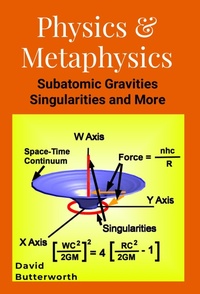
Physics and Metaphysics
Subatomic Gravities Singularities and more
Published on 12. July 2025
978-1-300-02756-0 (ISBN)
Description

An Attempt to Understand the Universe in Which We Live
This is an alternate approach to the current particle Standard Model. This theory uses singularity spaces to explain subatomic Gravity, Electromagnetic, and Nuclear Forces. It is the hard copy edition of the Theory of Amorphism and the Theory of Ubiquity of the Little Book Open Collection that has all philosophical discussions removed. This book is simply submitting a protoscience recommendation (the initial phase of the scientific method, involving hypothesis formulation, but not yet proven to be true or false). It has four parts. The first part is a philosophical Burden of Proof that explains the purpose of the singularity approach. The second part is the Theory of Amorphism, which explains subatomic matter and light. The third part is the Theory of Ubiquity that explains atomic life and awareness. The last part is the Philosophy of Morphism, which explores the reality behind everything.
This book does not have a heavy mathematical approach and is understandable by the general public; however, I recommend a high school level understanding of Physics and Calculus to understand the basic theory. I know that for the scientific community, this book is only covering the fundamentals, but it is doing it in an entirely different direction.
More details
Content
Copyright 2
Overview 3
Thanks and Acknowledgments 3
Abstract 4
Philosophical Burden of Proof 7
Reviewing the Basics 7
Theory of Amorphism 15
Synopsis 15
Amorphous Backdrop 15
Description of a Space Singularity 15
Subspace Universe 15
Singularity Interactions 16
Effects Upon the Subspace Universe 17
Seven Rules of Singularity Space Behavior: 18
Model of an Elementary Particle 19
Gravitation Space Time Curvature 24
Expansion of Particle Model 25
Electrostatic Forces 27
Electromagnetic Forces 28
Wave Particle Duality (Particles) 31
Model of Light 31
Compound Particle Models 33
Modeling Our Physical Universe 34
Neutrinos 37
Electron 38
Mesons 39
Baryons 39
Reviewing Existing Benchmarks 41
Newton's Laws: 41
Einstein's Theories: 43
Schrödinger's Equation: 44
Dirac's Equations: 44
Maxwell's Equations: 46
Electromagnetic: 46
The Essence of Light: 47
Electrical Field from a Charge: 47
Magnetic Field from a Mono-Pole: 47
Magnetic Field Generated by an Electrical Field: 48
Magnetic Field from a Current: 48
Electrical Field Generated by a Magnetic Field: 49
Electrical and Magnetic fields across Time and Space: 50
Thermodynamics: 52
In conclusion: 54
Theory of Ubiquity 55
Synopsis 55
Our Original Concepts 55
Space and Reality 56
Model of Life 57
The Nature of Space and Life 65
Awareness and Order 66
Elementary Particle Awareness 67
The Ordering of Life 67
Distributed Intelligence 69
Philosophy of Morphism 71
The Reality Within 71
The Truth
