

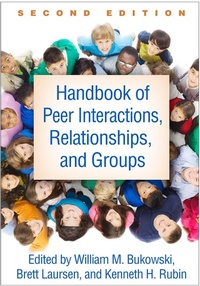
Handbook of Peer Interactions, Relationships, and Groups
2nd Edition
Published on 6. March 2018
748 pages
978-1-4625-3299-5 (ISBN)
Description

Researchers and students in developmental psychology; also of interest to clinical, school, and educational psychologists, educators, and sociologists. May serve as a text in graduate-level courses.
More details
Other editions
Additional editions
Kenneth H. Rubin | William M. Bukowski | Brett Laursen
Handbook of Peer Interactions, Relationships, and Groups, Second Edition
Book
10/2019
2nd Edition
Guilford Press
€71.00
Shipment within 15-20 days
Kenneth H. Rubin | William M. Bukowski | Brett Laursen
Handbook of Peer Interactions, Relationships, and Groups, Second Edition
Book
05/2018
2nd Edition
Guilford Press
€98.50
Shipment within 15-20 days
Persons
William M. Bukowski, PhD, is Professor in the Department of Psychology at Concordia University in Montreal, Quebec, Canada, and holds a University Research Chair in early adolescent development. From 2008-2016 he was Director of the Centre for Research in Human Development, a multidisciplinary and multi-university research center housed at Concordia. He is a recipient of the John P. Hill Memorial Award from the Society for Research in Adolescence and is a Charter Fellow of the International Society for the Study of Behavioral Development. Dr. Bukowski's research examines the features and effects of school-age children's and early adolescents' experiences with their peers.
Brett Laursen, PhD, is Professor of Psychology and Director of Graduate Training at Florida Atlantic University. He is also Docent Professor of Social Developmental Psychology at the University of Jyväskylä, Finland. Dr. Laursen is a Fellow of the American Psychological Association (Division 7, Developmental), a Fellow and Charter Member of the Association for Psychological Science, and the recipient of an Honorary Doctorate from Örebro University, Sweden. He is Editor-in-Chief of the International Journal of Behavioral Development. Dr. Laursen's research focuses on friendship and romantic relationships during childhood and adolescence and their influence on individual social and academic adjustment.
Kenneth H. Rubin, PhD, is Professor of Human Development and Quantitative Methodology and Founding Director of the Center for Children, Relationships, and Culture at the University of Maryland, College Park. He is a Fellow of the American and Canadian Psychological Associations, the Association for Psychological Science, and the International Society for the Study of Behavioral Development (ISSBD). Dr. Rubin is a recipient of Distinguished Contribution awards from the Society for Research in Child Development and the ISSBD, the Developmental Psychology Mentor Award from the American Psychological Association, and the Pickering Award for Outstanding Contribution to Developmental Psychology in Canada, among other honors. His research focuses on peer and parent-child relationships and the origins and developmental course of social and emotional adjustment and maladjustment in childhood and adolescence.
Content
I. Introduction
1. Peer Relations: Past, Present, and Promise, William M. Bukowski, Brett Laursen, & Kenneth H. Rubin
II. Conceptual Origins of Peer Research
2. Socioethological/Developmental Principles and Perspectives on Peer Interactions, Relationships, and Groups from Early Childhood through Adolescence, António J. Santos & Brian E. Vaughn
3. Pathways, Networks, and Norms. A Sociological Perspective on Peer Research, René Veenstra, Jan Kornelis Dijkstra, & Derek A. Kreager
4. Sociometric Perspectives, Antonius H. N. Cillessen & William M. Bukowski
5. The Peer Group: Linking Conceptualizations, Theories, and Methods, Thomas A. Kindermann & Scott D. Gest
6. Evolution and Peer Relations: Considering the Functional Roles of Aggression and Prosociality, Patricia H. Hawley & Andrew R. Bower
7. Peer Relations and Psychosocial Development: Perspectives from Genetic Approaches, Mara Brendgen, Isabelle Ouellet-Morin, & Michel Boivin
8. Peers and the Self, William M. Bukowski & Diana Raufelder
III. Individual Characteristics and Peer Interactions
9. Personality and Peer Relationships, Marcel A. G. van Aken & Jens B. Asendorpf
10. Neuroscience and Peer Relations, Amanda E. Guyer & Johanna M. Jarcho
11. The Beginnings of Peer Relations, Dale F. Hay, Marlene Caplan, & Alison Nash
12. Children's Play and Peer Relations, Nina Howe & Jamie Leach
13. Prosocial Behavior with Peers: Intentions, Outcomes, and Interpersonal Adjustment, Melanie A. Dirks, Kristen A. Dunfield, & Holly E. Recchia
14. Conflict between Peers, Brett Laursen & Ryan Adams
15. The Interface of Aggression and Peer Relations in Childhood and Adolescence, Frank Vitaro, Michel Boivin, & François Poulin
16. Bullying and Victimization, Christina Salmivalli & Kätlin Peets
17. Avoiding and Withdrawing from the Peer Group, Kenneth H. Rubin, Julie C. Bowker, Matthew G. Barstead, & Robert J. Coplan
IV. Dyads and Groups
18. Parent-Child Attachment and Peer Relations, Cathyrn Booth-LaForce, & Ashley M. Groh
19. Friendship in Childhood and Adolescence: Features, Effects, and Processes, Catherine L. Bagwell & William M. Bukowski
20. Differences and Similarities: The Dynamics of Same- and Other-Sex Peer Relationships, Carol Lynn Martin, Richard A. Fabes, & Laura D. Hanish
21. The Romantic Relationships of Youth, Wyndol Furman
22. Peer Acceptance, Peer Rejection, and Popularity: Social Cognitive and Behavioral Perspectives, Kristina L. McDonald & Steven R. Asher
23. Peer Influence, Brett Laursen
24. Intergroup Exclusion, Moral Judgments, and Social Cognition, Melanie Killen, Adam Rutland, Michael T. Rizzo, & Luke McGuire
V. Diversity in Peer Experience
25. The Potential of Schools to Facilitate and Constrain Peer Relationships, Jaana Juvonen
26. Inequality and Neighborhood Effects on Peer Relations, Adrienne Nishina & Amy Bellmore
27. Social Media and Peer Relationships, Marion K. Underwood, B. Bradford Brown, & Samuel E. Ehrenreich
28. Culture and Peer Relationships, Xinyin Chen, Jinsol Lee, & Lingjun Chen
29. Gender and Peer Relationships, Amanda J. Rose & Rhiannon L. Smith
30. Race and Ethnicity in Peer Relations Research, Sandra Graham & Leslie Echols
VI. Outcomes, Intervention, and Policy
31. Peer Status and Psychopathology, Mitchell J. Prinstein, Diana Rancourt, Caroline B. Adelman, Erica Ahlich, Jennifer Smith, & John D. Guerry
32. Peers, Academics and Teachers, Allison M. Ryan & Huiyoung Shin
33. Peer-Based Interventions for Behaviorally Inhibited, Socially Withdrawn, and Socially Anxious Children, Robert J. Coplan, Barry H. Schneider, Laura L. Ooi, & William E. Hipson
34. Youth Activity Participation: An Ecological Peer-Based Approach for Positive Youth Development, Linda Rose-Krasnor & Heather Ramey
35. Public Policy and Peer Relationships, Jennifer E. Lansford
