

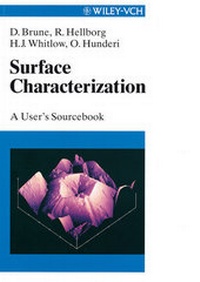
Surface Characterization
A User's Sourcebook
1st Edition
Published on 11. July 2008
XIII, 702 pages
978-3-527-61244-4 (ISBN)
Description

"Surface Characterization" provides an authoritative guide to the wide range of powerful techniques that are used to characterize the surfaces of materials. Practical in approach, it not only describes the major analytical techniques but emphasizes how they can be used to solve a multitude of chemical and physical problems. A special feature of the book is that the various techniques are grouped according to the material property under investigation. These parts are preceded by an overview comparing the capabilities of the characterization methods available.
Extensive data tables allow the reader to assess rapidly the strengths as well as the pitfalls inherent in each method.
Chapters on chemical composition, optical and crystallographic properties, microtopography, surface processes, tribological, electrical and magnetic properties of surface films are featured. In addition, chapters specializing on applications within the life sciences on the microscopic scale and chemometrics are included.
"Surface Characterization" is addressed to both academic and industrial audiences. Scientists and engineers working on the production and development of new materials will find it an invaluable reference source. Physicist, chemists, chemical engineers, material scientists and engineers from every area of materials research will benefit from the wealth of practical advice the book provides.
Extensive data tables allow the reader to assess rapidly the strengths as well as the pitfalls inherent in each method.
Chapters on chemical composition, optical and crystallographic properties, microtopography, surface processes, tribological, electrical and magnetic properties of surface films are featured. In addition, chapters specializing on applications within the life sciences on the microscopic scale and chemometrics are included.
"Surface Characterization" is addressed to both academic and industrial audiences. Scientists and engineers working on the production and development of new materials will find it an invaluable reference source. Physicist, chemists, chemical engineers, material scientists and engineers from every area of materials research will benefit from the wealth of practical advice the book provides.
Reviews / Votes
This new book is providing an authoritative guide to the wide range of powerful techniques that are used to characterize the surfaces of the materials. It can be used as a reference guide for scientists and engineers from a broad range of disciplines within the metallurgy as well as materials technologies.- Aluminium.
More details
Other editions
Additional editions
Book
11/1997
Wiley-VCH
€229.00
Article exhausted; check different version
Persons
Content
PART 1: MICROSTRUCTURE AND TOPOGRAPHY
Optical Microscopy
Scanning Tunneling and Microscopy
Surface Roughness and Microstructure
Preparation Technique
PART 2: ELEMENTAL COMPOSITION
Scanning Electron Microscope
X-Ray Fluorescence Techniques
Charged Particle Activation Analysis
Ion Scattering Spectroscopy
Nuclear Reaction Analysis
Auger electron Spectroscopy
PART 3: CHEMICAL BONDING
Surface Characterization with Synchrotron Light
Laser Microprobe Mass Spectrometry
Fourier Transform Infrared Spectroscopy
Mössbauer Spectroscopy
Chemometrics
PART 4: CRYSTALLOGRAPHY AND STRUCTURE
X-Ray Diffraction and Reflectometry
Transmission Electron Microscopy
Electrons for Surface Diffraction
Channeling
PART 5: SURFACE FILMS:
Optical Characterization of Surfaces by Linear Spectroscopy
Optical Second-Harmonic and Sum-Frequency Generation
Electrical and Magnetic Properties of Thin Films
PART 6: SURFACE PROCESSES/REACTIONS
Surface Reactivity
Emanation Method
Electrochemical Methods
Corrosion Measurements
Nuclear Based Corrosion Monitoring
PART 7: TRIBOSURFACE
Tribosurface Properties
Wear Measurements Using Thin Layer Activation
PART 8: LIFE SCIENCES
Biomaterials
Nuclear Microscopy
Optical Microscopy
Scanning Tunneling and Microscopy
Surface Roughness and Microstructure
Preparation Technique
PART 2: ELEMENTAL COMPOSITION
Scanning Electron Microscope
X-Ray Fluorescence Techniques
Charged Particle Activation Analysis
Ion Scattering Spectroscopy
Nuclear Reaction Analysis
Auger electron Spectroscopy
PART 3: CHEMICAL BONDING
Surface Characterization with Synchrotron Light
Laser Microprobe Mass Spectrometry
Fourier Transform Infrared Spectroscopy
Mössbauer Spectroscopy
Chemometrics
PART 4: CRYSTALLOGRAPHY AND STRUCTURE
X-Ray Diffraction and Reflectometry
Transmission Electron Microscopy
Electrons for Surface Diffraction
Channeling
PART 5: SURFACE FILMS:
Optical Characterization of Surfaces by Linear Spectroscopy
Optical Second-Harmonic and Sum-Frequency Generation
Electrical and Magnetic Properties of Thin Films
PART 6: SURFACE PROCESSES/REACTIONS
Surface Reactivity
Emanation Method
Electrochemical Methods
Corrosion Measurements
Nuclear Based Corrosion Monitoring
PART 7: TRIBOSURFACE
Tribosurface Properties
Wear Measurements Using Thin Layer Activation
PART 8: LIFE SCIENCES
Biomaterials
Nuclear Microscopy
