

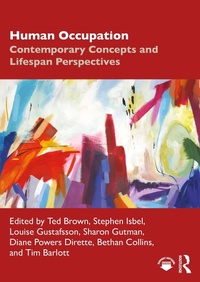
Human Occupation
Contemporary Concepts and Lifespan Perspectives
1st Edition
Published on 17. September 2024
676 pages
978-1-040-10334-0 (ISBN)
Description

This comprehensive textbook provides occupational therapy and science students and practitioners with a complete overview of the key human occupation concepts, as well as a range of perspectives through which occupational therapy and occupational science can be viewed and understood.
Comprising 40 chapters, the book is divided into five sections:
Section 1: Overview of Human Occupation. Introducing the occupational therapy field and its conceptual landscape, including different models of therapeutic practice and practice reasoning
Section 2: Contemporary Perspectives on Human Occupation. Including critical perspectives on disability and race and the philosophical foundations of occupational science
Section 3: Principal Concepts. Explaining the conceptual language of human occupation across key person, social, psychological, physical, performance, and environmental issues
Section 4: Human Occupation across the Lifespan and Life Course. Covers human occupation from infancy to later adulthood
Section 5: Domains/Types of Human Occupation. From sleep to play, sexuality to social participation, and education to work
Uniquely international in scope, each chapter in this edited book includes learning objectives, key terms, summary dot points, review questions, and a list of additional online resources for readers to refer to. This is a complete resource for anyone beginning an occupational therapy course, clinicians seeking an accessible reference work to support their practice, or occupational scientists needing to refer to contemporary occupation-related concepts.
Please note: Section 5 of this book can be accessed on the book's page on Routledge.com by clicking on 'Support Material', then the link to 'Routledge Resource Centre'.
For the PowerPoint slides, please click on 'Instructor and Student Resources'.
Comprising 40 chapters, the book is divided into five sections:
Section 1: Overview of Human Occupation. Introducing the occupational therapy field and its conceptual landscape, including different models of therapeutic practice and practice reasoning
Section 2: Contemporary Perspectives on Human Occupation. Including critical perspectives on disability and race and the philosophical foundations of occupational science
Section 3: Principal Concepts. Explaining the conceptual language of human occupation across key person, social, psychological, physical, performance, and environmental issues
Section 4: Human Occupation across the Lifespan and Life Course. Covers human occupation from infancy to later adulthood
Section 5: Domains/Types of Human Occupation. From sleep to play, sexuality to social participation, and education to work
Uniquely international in scope, each chapter in this edited book includes learning objectives, key terms, summary dot points, review questions, and a list of additional online resources for readers to refer to. This is a complete resource for anyone beginning an occupational therapy course, clinicians seeking an accessible reference work to support their practice, or occupational scientists needing to refer to contemporary occupation-related concepts.
Please note: Section 5 of this book can be accessed on the book's page on Routledge.com by clicking on 'Support Material', then the link to 'Routledge Resource Centre'.
For the PowerPoint slides, please click on 'Instructor and Student Resources'.
More details
Edition
1. Auflage
Language
English
Place of publication
London
United Kingdom
Publishing group
Taylor & Francis Ltd
Target group
College/higher education
Professional and scholarly
Illustrations
39 Tables, black and white; 17 Line drawings, black and white; 27 Halftones, black and white; 44 Illustrations, black and white
ISBN-13
978-1-040-10334-0 (9781040103340)
Copyright in bibliographic data and cover images is held by Nielsen Book Services Limited or by the publishers or by their respective licensors: all rights reserved.
Schweitzer Classification
Other editions
Additional editions
Ted Brown | Stephen Isbel | Louise Gustafsson
Human Occupation
Contemporary Concepts and Lifespan Perspectives
Book
09/2024
1st Edition
Routledge
€254.00
Shipment within 10-20 days
Ted Brown | Stephen Isbel | Louise Gustafsson
Human Occupation
Contemporary Concepts and Lifespan Perspectives
Book
09/2024
1st Edition
Routledge
€93.70
Shipment within 10-20 days
Persons
Ted Brown is Professor of Occupational Therapy and Undergraduate Course Director in the Department of Occupational Therapy at Monash University - Peninsula Campus, Australia. Prior to this, he worked as an occupational therapy clinician for 16 years in Canada and Australia, primarily in the area of pediatrics.
Stephen Isbel is Professor of Occupational Therapy at the University of Canberra, Australia. He has worked in the USA, the UK, and Australia, primarily in the areas of aged care, community care, and adult neurological rehabilitation.
Louise Gustafsson is Professor and Lead of the Occupational Therapy Program at Griffith University, Australia. Her research aims to address occupational issues of older adults and individuals with neurological conditions.
Sharon Gutman is a professor at Rutgers University in the Occupational Therapy Doctorate Program. Her body of work has primarily addressed the development and assessment of interventions designed to help sheltered homeless people transition from homelessness to supported housing.
Diane Powers Dirette is a professor in the Interdisciplinary Health Sciences PhD Program at Western Michigan University, and her research interests are focused on treatments for people with acquired brain injuries.
Bethan Collins is the Head of Occupational Therapy at the University of Salford, UK. Bethan completed her primary degree in Occupational Therapy and her PhD at Trinity College Dublin, Ireland.
Tim Barlott is an assistant professor in the Department of Occupational Therapy at the University of Alberta. His work pursues theory, practices, and collective processes that can be liberating for psychiatrized and other marginalized people.
Stephen Isbel is Professor of Occupational Therapy at the University of Canberra, Australia. He has worked in the USA, the UK, and Australia, primarily in the areas of aged care, community care, and adult neurological rehabilitation.
Louise Gustafsson is Professor and Lead of the Occupational Therapy Program at Griffith University, Australia. Her research aims to address occupational issues of older adults and individuals with neurological conditions.
Sharon Gutman is a professor at Rutgers University in the Occupational Therapy Doctorate Program. Her body of work has primarily addressed the development and assessment of interventions designed to help sheltered homeless people transition from homelessness to supported housing.
Diane Powers Dirette is a professor in the Interdisciplinary Health Sciences PhD Program at Western Michigan University, and her research interests are focused on treatments for people with acquired brain injuries.
Bethan Collins is the Head of Occupational Therapy at the University of Salford, UK. Bethan completed her primary degree in Occupational Therapy and her PhD at Trinity College Dublin, Ireland.
Tim Barlott is an assistant professor in the Department of Occupational Therapy at the University of Alberta. His work pursues theory, practices, and collective processes that can be liberating for psychiatrized and other marginalized people.
Content
Section One - Overview of Human Occupation Chapter One - Introduction to Human Occupation: Contemporary Concepts and Lifespan Perspectives Chapter Two - Overview of Human Occupation: Concepts and Principles Chapter Three - Overview of Occupation-centered Practice Chapter Four - Person-centered Care in Occupation-based Practice Chapter Five - Models of Practice that Focus on Human Occupation Chapter Six - Participation and (Human) Occupation Chapter Seven - Practice Reasoning in Occupational Therapy: Introducing the Model of Occupational Therapy Reasoning Section Two - Contemporary Perspectives on Human Occupation Chapter Eight - Bringing Critical Perspectives into Occupation-based Practices Chapter Nine - The Situated Nature of Human Occupation Chapter Ten - Equity, Disadvantage, Justice, and Human Occupation Chapter Eleven - Undoing Coloniality: An Indigenous Occupation-based Perspective Chapter Twelve - Critical Disability Studies Perspectives on Human Occupation Chapter Thirteen - Occupation and Social Sanctioning Chapter Fourteen - Creativity, Hope, and Collective Emancipatory Experimentation: Tools for Social Transformation through Occupational Therapy Chapter Fifteen - Social Occupational Therapy: Contributions to Design a Field of Knowledge and Practices Chapter Sixteen - Pragmatism: Current and Future Influence on Occupational Therapy and Occupational Science Chapter Seventeen - Gender and Human Occupation Chapter Eighteen - Technology and Human Occupation Chapter Nineteen - Human Occupation and Environmental Sustainability Section Three - Principal Concepts Chapter Twenty - Key Occupational Concepts: Occupational Engagement, Occupational Balance, Occupational Adaptation, and Participation Chapter Twenty-one - Person Factors: Values, Beliefs, Spirituality, Body Functions, and Body Structures Chapter Twenty-two - Performance Skills: Motor, Process, and Social Interaction Chapter Twenty-three - Performance Patterns: Habits, Routines, Rituals, and Roles Chapter Twenty-four - Evolving and Pluralistic: Understanding the Environment in Occupational Therapy Section Four - Human Occupation across the Lifespan and Life Course Chapter Twenty-five - Human Occupations of Infants, Toddlers, and Preschoolers Chapter Twenty-six - Occupations of School-aged Children Chapter Twenty-seven - Human Occupations of Adolescence and Youth Chapter Twenty-eight - Human Occupations of Early Adulthood Chapter Twenty-nine - Human Occupations of Middle Adulthood (Ages 40-65) Chapter Thirty - Human Occupations of Late Adulthood Chapter Thirty-one - Future Considerations and Conclusion Section Five - Domains/Types of Human Occupation Chapter Thirty-two - Activities of Daily Living and Self-Care as Human Occupation Chapter Thirty-three - Instrumental Activities of Daily Living and Health Management as Human Occupation Chapter Thirty-four - Work, Productivity, and Volunteering as Human Occupation Chapter Thirty-five - Education as Human Occupation Chapter Thirty-six - Play as Human Occupation Chapter Thirty-seven - Leisure and Recreation as Human Occupation Chapter Thirty-eight - Social Participation as Human Occupation Chapter Thirty-nine - Sleep and Rest as Human Occupation Chapter Forty - Sexuality as Human Occupation
