

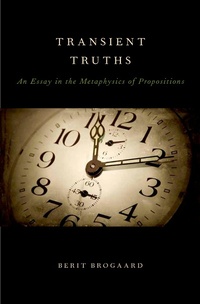
Transient Truths
An Essay in the Metaphysics of Propositions
1st Edition
Published on 1. September 2011
288 pages
978-0-19-979692-2 (ISBN)
Description

What are the things that we assert, believe, and desire? The orthodox view among philosophers is eternalism: these are contents that have their truth-values eternally. Transient Truths provides the first book-length exposition and defense of the opposing view, temporalism: these are contents that can change their truth-values along with changes in the world.
More details
Other editions
Additional editions
Book
05/2012
Oxford University Press Inc
€154.60
Shipment within 15-20 days
Content
- Cover
- Contents
- Acknowledgments
- Introduction
- 1. Characterizing Temporalism
- 1.1. Times in Propositions vs. Time Neutrality
- 1.2. Truth Conditions
- 1.3. Temporal Propositions Are Truth-Evaluable
- 1.4. Signpost
- 2. Reporting Belief
- 2.1. The Classic Objections
- 2.2. Recent Debate
- 2.3. Temporalism and Belief Reports
- 2.4. Temporalism and Belief Retention
- 2.5. Belief De Se
- 2.6. Eternalism and Belief Retention
- 2.7. The Accident
- 2.8. Signpost
- 3. Disagreeing Across Time
- 3.1. Passing on Information Across Time
- 3.2. Arguments from Disagreement Against Temporalism
- 3.3. Signpost
- 4. Representing Time
- 4.1. Temporalism and the Time Analysis
- 4.2. The Event Analysis
- 4.3. The Empirical Evidence Against Traditional Tense Logic
- 4.4. Time Adverbials
- 4.5. Composite Tense Operators
- 4.6. Span Operators
- 4.7. The Ellipsis Theory
- 4.8. The Temporal Anaphora Hypothesis
- 4.9. Explaining the Counterevidence
- 4.10. Signpost
- 5. Reviving Priorian Tense Logic
- 5.1. The SOT Rule
- 5.2. Later-than-Matrix Interpretations and Kamp/Vlach Sentences
- 5.3. The PTQ Fragment
- 5.4. Pragmatic Rules for Noun Denotation
- 5.5. Partee Sentences
- 5.6. Double-Access Sentences
- 5.7. Location Operators
- 5.8. Signpost
- 6. Embedding Under Tense Operators
- 6.1. Kaplan's Argument
- 6.2. Objections to Kaplan's Argument
- 6.3. The Redundancy of the Present Tense
- 6.4. Monsters
- 6.5. An Argument Against a Quantifier Analysis of the Tenses
- 6.6. Signpost
- 7. Representing Eternally
- 7.1. Two Kinds of Content
- 7.2. Past- and Future-Tensed Sentences
- 7.3. Conjoined Propositions
- 7.4. Two Kinds of Propositions
- 7.5. Eternal Propositions and Metaphysical Eternalism
- 7.6. Signpost
- 8. Representing the World Egocentrically
- 8.1. Cappelen and Hawthorne's Main Arguments Against Relativism
- 8.2. The Argument from Perception
- 8.3. Non-Indexical Contextualism
- 8.4. Temporalism Defended
- 8.5. Signpost
- Closing Remarks
- Bibliography
- Index
- A
- B
- C
- D
- E
- F
- H
- I
- J
- K
- L
- M
- N
- O
- P
- Q
- R
- S
- T
- V
- W
- Z
