

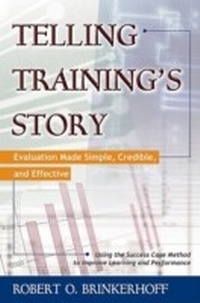
Telling Training's Story
Evaluation Made Simple, Credible, and Effective
1st Edition
Published on 1. March 2006
273 pages
978-1-60509-387-1 (ISBN)
Description

No matter how much trainers believe that their work is valuable, clients will always want solid, objective evidence that the training they're spending good money on is effective. ",Telling Training's Story", provides the tools to do just that, allowing anyone to measure a training regime's effectiveness and prove it to customers. The book's central tool is the Success Case Method (SCM), and although the SCM is rigorous enough to convince even the harshest skeptic, it's also easy to understand. The book first explains how the SCM works, and then lays out a five-step plan that shows how to perform an SCM evaluation. Later chapters elaborate on the SCM process, providing in-depth instructions and guidelines. There are also four case studies that show how SCM evaluations were performed by global organizations. Filled with examples and checklists, ",Telling Training's Story", levels the playing field by granting trainers the ability to prove what they know in their heart -- training works.
More details
Other editions
Additional editions
Robert Brinkerhoff
Telling Training's Story: Evaluation Made Simple, Credible, and Effective
Evaluation Made Simple, Credible, and Effective
Book
03/2006
Berrett-Koehler
€31.00
Shipment within 3-4 weeks
Content
- Intro
- Contents
- Preface
- Acknowledgements
- Part 1
- Chapter One: Getting to the Heart of Training Impact
- Can We "Prove" Training Impact?
- Chapter Two: How the Success Case Method Works: Two Basic Steps
- Training Evaluation Realities
- The Success Case Method: Step by Step
- Chapter Three: Success Case Method Strategy-Building Organizational Learning Capacity
- The Determinants of Training Impact
- Learning Alone Is Insufficient
- Risks of the Common Training Evaluation Strategy
- An Evaluation Strategy for Building Organizational Learning Competence
- A Fundamental Shift in Focus
- Redefining the Evaluation Process
- Implementing the Strategy to Drive Change
- Chapter Four: Focusing and Planning a Success Case Method Study
- 1. Clarifying the Purpose of the SCM Study
- 2. Meet with and Discuss the Study with Key Stakeholders
- 3. Define the Program That Is to Be Studied
- 4. Define the Population of Participants to Be Studied, and Identify Any Needed Sampling Parameters
- 5. How Soon After the Training to Conduct the Survey
- 6. Establishing a Schedule for the Study
- 7. Specify and Confirm the Resources Available for the Study
- 8. Finalize the Success Case Strategy
- Chapter Five: Constructing a Simple Training Impact Model
- Elements of the Impact Model
- Constructing an Impact Model
- Chapter Six: Fishing for Success Conducting the SCM Survey
- Defining the Survey Step
- Conducting the SCM Survey
- Chapter Seven: Sorting the "Catch"-Analyzing Survey Results
- Scoring and Sorting the Survey Response
- Choosing Interviewee Candidates
- Analyzing Data to Estimate Nature and Scope of Impact
- Chapter Eight: Digging Out and Telling the Stories-the SCM Interviews
- Resolving Causal Questions
- The SCM Interview Structure
- Preparing for the Interviews
- Chapter Nine: Drawing Compelling Conclusions
- The Eight Major SCM Conclusions
- Conclusion Type One: What, If Any, Impact Was Achieved?
- Conclusion Type Two: How Widespread Is Success?
- Summary of Final Conclusions
- Conclusion Type Three: Did the Training Work Better in Some Parts of the Organization, or with Some Types of Participants, Better than Others?
- Conclusion Type Four: Were Some Parts of the Training More Successfully Applied than Others?
- Conclusion Type 5: What Systemic Factors Were Associated with Success and a Lack of Success?
- Conclusion Type Six: What Is the Value of Outcomes Achieved?
- Conclusion Type Seven: What Is the Unrealized Value of the Training?
- Conclusion Type Eight: How Do the Benefits of the Training Compare with the Costs?
- Part II
- Chapter Ten: Sales Training at Grundfos
- The Setting
- Purposes of the SCM Study
- Organizing the Study
- Challenges and Constraints
- The SCM Chronology
- The Impact Model
- Survey
- Actions After the SCM Study
- Chapter Eleven: Service Technician Training at the Compaq Computer Corporation
- Other Important Factors
- Preparing for the Evaluation
- Evaluation Results
- The Rest of the Story
- Chapter Twelve: Coaching and Training at Coffee Bean and Tea Leaf®
- The Business Scenario
- The Training Intervention
- The Evaluation Purpose
- SCM Study Procedures
- Survey Results
- Interview Results
- Recommendations
- Challenges and Lessons Learned
- Chapter Thirteen: Executive Development at Allstate Insurance
- Evaluation Purposes
- The Evaluation Process
- Challenges and Constraints
- Results
- Conclusions
- Recommendations
- Lessons Learned
- References
- Success Case Method Assistance and Resources
- Index
- A
- B
- C
- D
- E
- F
- G
- H
- I
- J
- K
- L
- M
- N
- O
- P
- Q
- R
- S
- T
- U
- V
- W
- Y
- Z
- About the Author
- About Berrett-Koehler Publishers
