

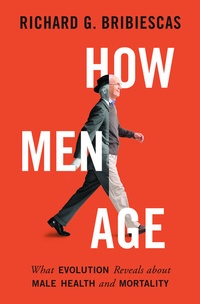
How Men Age
What Evolution Reveals about Male Health and Mortality
1st Edition
Published on 30. August 2016
192 pages
978-1-4008-8326-4 (ISBN)
Description

A groundbreaking book that examines all aspects of male aging through an evolutionary lens
While the health of aging men has been a focus of biomedical research for years, evolutionary biology has not been part of the conversation-until now. How Men Age is the first book to explore how natural selection has shaped male aging, how evolutionary theory can inform our understanding of male health and well-being, and how older men may have contributed to the evolution of some of the very traits that make us human.
In this informative and entertaining book, renowned biological anthropologist Richard Bribiescas looks at all aspects of male aging through an evolutionary lens. He describes how the challenges males faced in their evolutionary past influenced how they age today, and shows how this unique evolutionary history helps explain common aspects of male aging such as prostate disease, loss of muscle mass, changes in testosterone levels, increases in fat, erectile dysfunction, baldness, and shorter life spans than women. Bribiescas reveals how many of the physical and behavioral changes that we negatively associate with male aging may have actually facilitated the emergence of positive traits that have helped make humans so successful as a species, including parenting, long life spans, and high fertility.
Popular science at its most compelling, How Men Age provides new perspectives on the aging process in men and how we became human, and also explores future challenges for human evolution-and the important role older men might play in them.
While the health of aging men has been a focus of biomedical research for years, evolutionary biology has not been part of the conversation-until now. How Men Age is the first book to explore how natural selection has shaped male aging, how evolutionary theory can inform our understanding of male health and well-being, and how older men may have contributed to the evolution of some of the very traits that make us human.
In this informative and entertaining book, renowned biological anthropologist Richard Bribiescas looks at all aspects of male aging through an evolutionary lens. He describes how the challenges males faced in their evolutionary past influenced how they age today, and shows how this unique evolutionary history helps explain common aspects of male aging such as prostate disease, loss of muscle mass, changes in testosterone levels, increases in fat, erectile dysfunction, baldness, and shorter life spans than women. Bribiescas reveals how many of the physical and behavioral changes that we negatively associate with male aging may have actually facilitated the emergence of positive traits that have helped make humans so successful as a species, including parenting, long life spans, and high fertility.
Popular science at its most compelling, How Men Age provides new perspectives on the aging process in men and how we became human, and also explores future challenges for human evolution-and the important role older men might play in them.
All prices
More details
Language
English
Place of publication
Princeton, NJ
United States
Publishing group
De Gruyter
Target group
Professional and scholarly
Edition type
Digital original
Product notice
Reflowable
Illustrations
10 line illus.
File size
1,32 MB
ISBN-13
978-1-4008-8326-4 (9781400883264)
Schweitzer Classification
Other editions
Additional editions
Book
05/2018
Princeton University Press
€17.50
Shipment within 10-20 days
Book
09/2016
Princeton University Press
€24.76
Article not available at the moment
Person
Richard G. Bribiescas is professor of anthropology and ecology and evolutionary biology at Yale University, where he also serves as deputy provost for faculty development and diversity.
Content
Acknowledgments ix
Chapter 1 A Gray Evolutionary Lens 1
Chapter 2 Dead Man's Curve 17
Chapter 3 Getting a Handle on Love Handles 45
Chapter 4 Older Fathers, Longer Lives 70
Chapter 5 Dear Old Dad 88
Chapter 6 Darwinian Health and Other Contradictions 106
Chapter 7 Older Men and the Future of Human Evolution 133
Notes 145
Index 169
Chapter 1 A Gray Evolutionary Lens 1
Chapter 2 Dead Man's Curve 17
Chapter 3 Getting a Handle on Love Handles 45
Chapter 4 Older Fathers, Longer Lives 70
Chapter 5 Dear Old Dad 88
Chapter 6 Darwinian Health and Other Contradictions 106
Chapter 7 Older Men and the Future of Human Evolution 133
Notes 145
Index 169

