

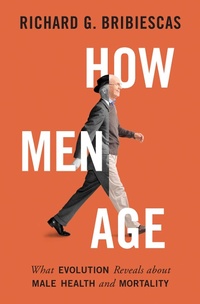
How Men Age
What Evolution Reveals about Male Health and Mortality
Published on 8. May 2018
Book
Paperback/Softback
192 pages
978-0-691-18091-5 (ISBN)
Description
A groundbreaking book that examines all aspects of male aging through an evolutionary lens
While the health of aging men has been a focus of biomedical research for years, evolutionary biology has not been part of the conversation-until now. How Men Age is the first book to explore how natural selection has shaped male aging, how evolutionary theory can inform our understanding of male health and well-being, and how older men may have contributed to the evolution of some of the very traits that make us human.
In this informative and entertaining book, renowned biological anthropologist Richard Bribiescas looks at all aspects of male aging through an evolutionary lens. He describes how the challenges males faced in their evolutionary past influenced how they age today, and shows how this unique evolutionary history helps explain common aspects of male aging such as prostate disease, loss of muscle mass, changes in testosterone levels, increases in fat, erectile dysfunction, baldness, and shorter life spans than women. Bribiescas reveals how many of the physical and behavioral changes that we negatively associate with male aging may have actually facilitated the emergence of positive traits that have helped make humans so successful as a species, including parenting, long life spans, and high fertility.
Popular science at its most compelling, How Men Age provides new perspectives on the aging process in men and how we became human, and also explores future challenges for human evolution-and the important role older men might play in them.
While the health of aging men has been a focus of biomedical research for years, evolutionary biology has not been part of the conversation-until now. How Men Age is the first book to explore how natural selection has shaped male aging, how evolutionary theory can inform our understanding of male health and well-being, and how older men may have contributed to the evolution of some of the very traits that make us human.
In this informative and entertaining book, renowned biological anthropologist Richard Bribiescas looks at all aspects of male aging through an evolutionary lens. He describes how the challenges males faced in their evolutionary past influenced how they age today, and shows how this unique evolutionary history helps explain common aspects of male aging such as prostate disease, loss of muscle mass, changes in testosterone levels, increases in fat, erectile dysfunction, baldness, and shorter life spans than women. Bribiescas reveals how many of the physical and behavioral changes that we negatively associate with male aging may have actually facilitated the emergence of positive traits that have helped make humans so successful as a species, including parenting, long life spans, and high fertility.
Popular science at its most compelling, How Men Age provides new perspectives on the aging process in men and how we became human, and also explores future challenges for human evolution-and the important role older men might play in them.
Reviews / Votes
"Winner of the W.W. Howells Book Award, Biological Anthropology Section of the American Anthropological Association" "2017 Regional Finalist in Science, ForeWord Reviews INDIEFAB Book of the Year Awards" "The best short summation I've seen of a massive body of research."---Michael Shermer, Wall Street Journal "How Men Age is wry, sly, informative, and provocative."---Glenn Altschuler, Psychology Today "Bribiescas makes a wonderful case for considering evolutionary ideas in human health, and provides a great introduction for anyone wishing to join the conversation."---Emily Gregg, Lateral magazine "Charming. . . . [A]n enjoyable and humane look at what could have been a bleak subject, spiced with just the right amounts of humour, anecdote and quirky personal perspective."---David Bainbridge, Literary Review "[T]he lens through which Bribiescas views [male aging], evolutionary biology, offers a nuanced explanation of why, during almost every phase of human life, men die at a higher rate than women."---Brian Bethune, Maclean's "[Richard Bribiescas] applies anthropological and evolutionary biological lenses to a sweeping, succinct review of the phenomenon [of how men age], and does so with good humor." * Harvard Magazine * "Richard Bribiescas covers some interesting uncharted territory. This is not a mere description of ageing. Instead, by considering male ageing in the light of natural selection, it aims to answer big questions. . . . Testosterone peaks in early adulthood, so that men are past their physical prime by the age of 30. It's tempting to see it as all downhill from there. But with wit and insight, Bribiescas shows convincingly that's not the case."---Kate Douglas, New Scientist "[How Men Age] certainly enriches our understanding of male health and well-being."---Wan Lixin, Shanghai DailyMore details
Language
English
Place of publication
New Jersey
United States
Product notice
Paperback (trade)
Illustrations
10 b/w illus.
Dimensions
Height: 226 mm
Width: 142 mm
Thickness: 18 mm
Weight
295 gr
ISBN-13
978-0-691-18091-5 (9780691180915)
Copyright in bibliographic data and cover images is held by Nielsen Book Services Limited or by the publishers or by their respective licensors: all rights reserved.
Schweitzer Classification
Other editions
Additional editions
E-Book
08/2016
1st Edition
Princeton University Press
from
€79.95
Available for download
Person
Richard G. Bribiescas is professor of anthropology and ecology and evolutionary biology at Yale University, where he also serves as deputy provost for faculty development and diversity.