

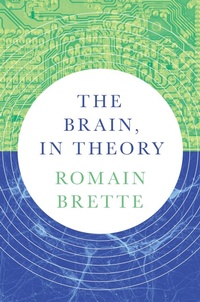
The Brain, In Theory
1st Edition
Published on 7. April 2026
304 pages
978-0-691-28139-1 (ISBN)
Description

Why engineering and computational analogies are poorly suited to the study of biological cognition
Mainstream theories of the brain are often expressed through engineering concepts-computation, code, control, reverse-engineering, optimization. These theories cast the living organism as a machine and the brain as a computer. The fact that cognition is a biological phenomenon seems merely anecdotal; biology is considered just "implementation." In The Brain, In Theory, Romain Brette argues that the brain is not a "biological computer" because living organisms are not engineered. Engineering is the use of knowledge to solve technical problems, to build an artifact with a plan. But, Brette reminds us, Darwin's insight is precisely that evolution is not a case of engineering. Unlike engineering, evolution has no predetermined goals, plans, or knowledge.
Brette reviews the main theoretical frameworks for thinking about the brain, including computation, neural representations, information, and prediction, and finds them poorly suited to the study of biological cognition. He proposes understanding the brain as a self-organized, developing community of living entities rather than an optimized assembly of machine components. With this new perspective, Brette brings life back to the study of the brain and cognition.
Mainstream theories of the brain are often expressed through engineering concepts-computation, code, control, reverse-engineering, optimization. These theories cast the living organism as a machine and the brain as a computer. The fact that cognition is a biological phenomenon seems merely anecdotal; biology is considered just "implementation." In The Brain, In Theory, Romain Brette argues that the brain is not a "biological computer" because living organisms are not engineered. Engineering is the use of knowledge to solve technical problems, to build an artifact with a plan. But, Brette reminds us, Darwin's insight is precisely that evolution is not a case of engineering. Unlike engineering, evolution has no predetermined goals, plans, or knowledge.
Brette reviews the main theoretical frameworks for thinking about the brain, including computation, neural representations, information, and prediction, and finds them poorly suited to the study of biological cognition. He proposes understanding the brain as a self-organized, developing community of living entities rather than an optimized assembly of machine components. With this new perspective, Brette brings life back to the study of the brain and cognition.
More details
Language
English
Place of publication
Princeton, NJ
United States
Publishing group
De Gruyter
Target group
Professional and scholarly
Edition type
Digital original
Product notice
Reflowable
Illustrations
70 b/w illus.
File size
15,09 MB
ISBN-13
978-0-691-28139-1 (9780691281391)
Schweitzer Classification
Other editions
Additional editions
Romain Brette
The Brain, In Theory
Book
04/2026
Princeton University Press
€129.99
Article not available at the moment
Romain Brette
The Brain, In Theory
Book
04/2026
Princeton University Press
€33.00
Article not available at the moment
Person
Romain Brette is a neuroscientist at the Institute of Intelligent Systems and Robotics, Paris. He has worked on neuronal biophysics, neuroinformatics, auditory neuroscience, philosophy of neuroscience, and recently on the behavior and physiology of protists.
