

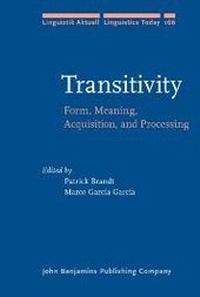
Transitivity
Form, Meaning, Acquisition, and Processing
1st Edition
Published on 17. November 2010
VII, 308 pages
978-90-272-8781-6 (ISBN)
Description

What happens when a canonically transitive form meets a canonically transitive meaning, and what happens when this doesn't happen? How do dyadic forms relate to monadic ones, and what are the entailments of the operations that the grammar uses to relate one to the other? Collecting original expert work from acquisition, processing, typological and theoretical syntax-semantics research, this volume provides a state of the art as well as cutting edge discussion of central issues in the realm of Transitivity. These include the definition and role of "Natural Transitivity", the interpretation and repercussions of valency changing operations and differential case marking, and the interactions between (in)transitive Gestalts in different categories and at different levels of representation.
More details
Other editions
Additional editions
Book
11/2010
John Benjamins Publishing Co
€104.94
Shipment within 10-15 days
Persons
Content
- Transitivity
- Editorial page
- Title page
- LCC data
- Table of contents
- Acknowledgments
- Trans-duction
- 1. Transitive ideals
- 1.1 One and two place predications and functions
- 1.2 Forms and meanings
- 1.3 Differentiating forms or not
- 2. Transience and perfecticism
- 2.1 The transitive pendulum
- 2.2 Ordinary and other individuals
- 2.3 Categories, syntax and lexicon
- References
- Part I Form and meaning
- Types of transitivity, intransitive objects, and untransitivity - and the logic of their structural designs
- 1. Introduction
- 2. Overview
- 2.1 Ergatives are perfective intransitives
- 2.2 The range of the discussion
- 3. Main tenets around verbal argumenthood and transitivity
- 3.1 Argument conditions
- 3.2 Aspect conditions on identifying iV as opposed to eV
- 3.3 Theta role related considerations and claims
- 3.4 Lexical and syntactic reflexivization - reflexive verbs and reflexive constructions
- 4. Direct object (DO) accusative retained with analytic and reflexive passives
- 4.1 Objects not promoting to subject: Object incorporation
- 4.2 Agreement and diathetic auxiliary alignment: The transitive object accusative and the Romance perfect
- 4.3 The radical proposal: Intransitives are in fact deeper transitives
- 4.4 The aspect condition
- 4.5 Nominal classifers
- 5. The emergence of cognate object constituents in the history of German
- 5.1 Active and passive cognate object constituents (Funktionsverbgefüge)
- 5.2 What is behind the grammaticalization of the German light verb constructions (Funktionsverbgefüge)?
- 5.3 Perfectivity as a dominant property - pseudo-transitivzation
- 6. Unaccusativity, perfectivity, and the Modist's assumptions about universal grammar
- 6.1 The Pre-Cartesian, Modistic - the 'Uncartesian' - concept of universal grammar
- 6.2 The deeper reason of vP vs. VP
- 6.3 What is behind the claim that all verbs should be transitives, in the first place? The argument beyond the empirical attestations
- 6.4 Secondary transitivity and covert transitivity: From intransitivity to secondary resultativity
- 7. Split auxiliary selection and the Unaccusative Hypothesis: Transitivity parameters
- 7.1 The search for a uniquely motivated auxiliary selection
- 7.2 Motion verbs: Exceptions to unaccusativity?
- 8. Summary and conclusion
- 8.1 Intransitives are deep transitives?
- 8.2 The derivative tasks of either lexicon or syntax
- References
- The interaction of transitivity features in the Sinhala involitive
- 1. Introduction
- 2. High and low transitivity
- 3. Volitive and involitive verbs - Syntax and semantics
- 4. The irrealis nature of involitive stems in Sinhala
- 5. Subject case and verb type
- 5.1 Dative vs. ati? subjects
- 5.2 Nominative vs. accusative subjects
- 5.3 The interaction of verb type, semantic case, and volitivity
- 6. Conclusion
- References
- Transitivity in Chinese experiencer object verbs
- 1. Introduction
- 2. Chinese experiential verbs and constructions
- 3. Semantic properties
- 3.1 Agentivity
- 3.2 Aktionsart
- 4. Syntactic properties
- 5. Summary
- References
- Non-zero/non-zero alternations in differential object marking
- 1. Introduction
- 2. Theoretical background
- 2.1 Harmonic alignment
- 2.2 Impoverishment
- 2.3 Iconicity
- 3. Proposal
- 4. Case studies
- 4.1 Object marking in Hindi
- 4.2 Differential encoding of objects in Mannheim German
- 4.3 Trumai
- 4.4 Cavineña
- 5. Summary
- References
- Part II Acquisition and processing
- Children and transitivity
- 1. Introduction
- 2. Prominence
- 3. Animacy
- 4. Definiteness
- 4.1 Corpus study definiteness
- 4.2 Corpus study locality
- 5. Conclusions
- References
- Grammatical transitivity vs. interpretive distinctness
- 1. Introduction
- 2. Transitivity in language comprehension
- 3. The present study
- 3.1 Experimental design and hypotheses
- 3.2 Participants
- 3.3 Materials
- 3.4 Procedure
- 3.5 EEG recording
- 3.6 Data analysis
- 3.7 Results - behavioral data
- 3.8 Results - ERP data
- 4. Discussion
- 4.1 Consequences for the language processing architecture
- Acknowledgements
- References
- Appendix A: ERPs at the positions of NP1 and NP2
- NP1
- NP2
- Appendix B: List of abbreviations
- Part III Transitivity and diathesis
- The space between one and two
- 1. Introduction
- 2. The pronominal stage
- 2.1 Referential
- 2.2 Reflexive
- 2.3 Reciprocal
- 3. The voice row
- 3.1 Autocausative
- 3.1.1 Inherently reflexive verbs
- 3.1.2 Inherently reciprocal verbs
- 3.2 Spontaneous
- 3.3 Passive
- 3.4 Two-participant events
- 4. Generic excursions
- 4.1 Facilitative
- 4.2 Deobjective
- 4.3 Arbitrary
- 5. Conclusions
- References
- Event-structure and individuation in impersonal passives
- 1. Introduction
- 2. The event-structural constraint under closer scrutiny
- 3. Event-structure and referential demotion
- 4. Summary
- References
- Part IV Crosslinguistic and crosscategorical considerations
- Lability and spontaneity
- 1. Introduction
- 2. Labile verbs
- 3. Labile verbs and spontaneity
- 3.1 Peaks of lability (situations frequently denoted by labile verbs)
- 3.2 Average numbers of labile lexemes in the spontaneous and the non-spontaneous zone
- 3.3 Lability in individual languages
- 4. Semantic classification
- 4.1 Lexical semantics and labile verbs in individual languages
- 4.2 Verbs with animate patients: Why are they so rare?
- 4.3 Motion and phasal verbs
- 5. Why are labile verbs so different from causatives and anticausatives?
- 6. Conclusions
- References
- Transitivity of deverbal nominals and aspectual modifiers of the verbal stem (evidence from Russian)
- 1. Problem and suffixes under discussion
- 1.1 Approaches and questions
- 1.2 Suffixes
- 2. Transitivity of the verbal stem
- 2.1 Types of deverbal nominals derived from transitive and intransitive stems
- 2.2 Suffixes and transitivity of the verbal stem
- 3. Aktionsart affixes and transitivity
- 3.1 Aspectual prefixes and suffixes in the verbal stem
- 3.2 Transitivity preferences and derivational morphemes in the stem
- 3.3 Why this correlation?
- 3.4 Verbal stem structure: Prefixes, suffixes, nominalizers
- 4. General consequences
- References
- Individuation and semantic role interpretation in the adpositional domain
- 1. Introduction
- 2. Animacy, core cases, and spatial cases
- 3. From cases to adpositions
- 4. A corpus study of Dutch Ps
- 4.1 The corpus
- 4.2 Results
- 4.2.1 Do Dutch adpositions show restrictions with respect to animacy?
- 4.2.2 Do Dutch adpositions show restrictions with respect to semantic role?
- 4.2.3 Can semantic role interpretation be modeled as a function of animacy?
- 5. Discussion
- 6. Conclusion
- References
- Appendix
- Language index
- Subject index
- The series Linguistik Aktuell/Linguistics Today
