

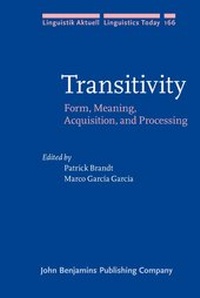
Transitivity
Form, Meaning, Acquisition, and Processing
Published on 17. November 2010
Book
Hardback
308 pages
978-90-272-5549-5 (ISBN)
Description
What happens when a canonically transitive form meets a canonically transitive meaning, and what happens when this doesn't happen? How do dyadic forms relate to monadic ones, and what are the entailments of the operations that the grammar uses to relate one to the other? Collecting original expert work from acquisition, processing, typological and theoretical syntax-semantics research, this volume provides a state of the art as well as cutting edge discussion of central issues in the realm of Transitivity. These include the definition and role of "Natural Transitivity", the interpretation and repercussions of valency changing operations and differential case marking, and the interactions between (in)transitive Gestalts in different categories and at different levels of representation.
More details
Series
Language
English
Place of publication
Amsterdam
Netherlands
Target group
Professional and scholarly
Dimensions
Height: 245 mm
Width: 164 mm
Weight
740 gr
ISBN-13
978-90-272-5549-5 (9789027255495)
Copyright in bibliographic data and cover images is held by Nielsen Book Services Limited or by the publishers or by their respective licensors: all rights reserved.
Schweitzer Classification
Other editions
Additional editions
E-Book
11/2010
1st Edition
John Benjamins Publishing Company
€123.99
Available for download
Persons
Content
1. Acknowledgments; 2. Trans-duction (by Brandt, Patrick); 3. Part I. Form and Meaning; 4. Types of transitivity, intransitive objects, and untransitivity - and the logic of their structural designs: Ways to keep apart derivation in syntax and in the lexicon (by Abraham, Werner); 5. The interaction of transitivity features in the sinhala involitive (by Beavers, John); 6. Transitivity in Chinese experiencer object verbs (by Verhoeven, Elisabeth); 7. Non-zero/non-zero alternations in differential object marking (by Keine, Stefan); 8. Part II. Acquisition and processing; 9. Children and transitivity: The subject-object asymmetry in a natural setting (by Hogeweg, Lotte); 10. Grammatical transitivity vs. interpretive distinctness: The case for a separation of two levels of representation that are often conflated (by Schlesewsky, Matthias); 11. Part III. Transitivity and diathesis; 12. The space between one and two: Transitives, intransitives and the middle voice (by Schepper, Kees de); 13. Event-structure and individuation in impersonal passives (by Primus, Beatrice); 14. Part IV. Crosslinguistic and crosscategorical considerations; 15. Lability and spontaneity (by Letuchiy, Alexander); 16. Transitivity of deverbal nominals and aspectual modifiers of the verbal stem (evidence from Russian) (by Pazelskaya, Anna); 17. Individuation and semantic role interpretation in the adpositional domain (by Lestrade, Sander); 18. Language index; 19. Subject index