

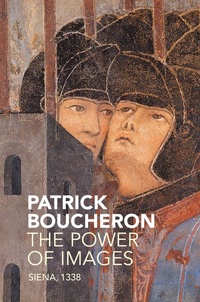
The Power of Images
Description

More details
Other editions
Additional editions
Content
* Preface: The site of an ancient urgency
* 1. 'I thought of these images, painted for you'
* 2. Nachleben. The watchful shadows
* 3. The Nine
* 4. Ambrogio Lorenzetti, famosissimo e singularissimo maestro
* 5. On each side: allegory, realism, resemblances
* 6. Esto visibile parlare: the walls speak to us
* 7. Guernica in the lands of Siena
* 8. The seductions of tyranny (what the image conceals)
* 9. Concord with its cords
* 10. With the common good as lord
* 11. What peace sees: narratives of spaces and talking bodies
* 12. Well, now you can dance
* Epilogue: Vanishing point
* Appendices
* The fresco of the Dala della Pace: silhouettes, inscriptions, identifications
* Inscriptions in the vernacular: transcription, edition and translation
* Notes
* Published sources
* Bibliography
* Picture credits
* Index
Prologue
The site of an ancient urgency
You may not know its name, but you've already seen it. It's known as the 'Fresco of Good Government'. People haven't always called it this; and in any case, it's not really a fresco. Ambrogio Lorenzetti painted it in the Palazzo Pubblico of Siena in 1338, ten years before his life was suddenly cut short by the Black Death, as were the lives of perhaps half the population of a city that did not know it was already declining - though it had in fact already declined, irremediably. You've already seen this painting, as it has been displayed in detail for over a hundred and fifty years - like a piece of meat on a butcher's slab - as an illustration of all that is most flattering about our modernity. Here is Justice, there is Equity, and further on, Concord: feminine allegories with fine, high-sounding names. And here, too, in strident contrast with these, is the hideous maw of tyranny: the ugly grimace of a divided society, the soldiers raping women . You've seen all this so many times: on the covers of books, for example, whenever unimaginative iconographers have to find some visible depiction of a rather vague abstraction, for a textbook on constitutional law, for example, or a treatise on ethics. But Lorenzetti's image also works very well for a book on agrarian history, city planning or urban sociology in the Middle Ages. His work swarms with a thousand singular details which for many people open an unexpected window on late mediaeval life.
So if you survey all the details of his work, you might feel a disagreeable sensation of déjà vu - the consequence of the omnipresence of advertising images. Are these images the icons of modernity? But if we say this, we are still falling prey to the tyranny of an impoverished language, for what we usually call an 'icon' in the modern sense is the complete opposite of religious imagery, marking as it does the loss of its aura. So it would be better to follow the great thinker of cinematographic imagery Serge Daney, and speak in terms of the visual. The visual replaces the image that you do not wish to see - and if you do not wish to see it, this is because it has become too similar to the world, a world that we can longer see in the form of a painting. The visual gives us something to look at, but it shows us nothing, because nothing escapes it: there is nothing outside its field; it provides no real experience, no otherness. To seek the image behind the visual is to try to allow this image to do its own work. It is an image in spite of everything, even if we try to force it to fade away. We need to allow it to make the most of its anachronistic qualities; we need to let it come to us (to each one of us) because it has come from very far away to gaze on us.
So do we need to embrace it in a single glance, abandoning any reassuring selection of mere details and instead surveying it as a whole? Perhaps we do need to accept its invitation to embark on what we sense will be a disquieting journey, as we will need to look on one side and then on the other, adjust our point of view, allow our gaze to roam over white walls where everything arrests and beguiles us, and where, too, the lines of a song painted in clearly legible letters cause us to linger: 'Turn your eyes to gaze, / you who rule, on the woman who is depicted here.'
But historians generally impose a method of descriptive neutrality on themselves: they describe before they interpret. This is a laudable effort, no doubt, but it is doomed to failure. To describe an image consists in putting it into words, and since these words have a history and a life of their own, since they think with and against us but most often behind our backs and without us, this apparently transparent operation is in fact an instrusive and a restrictive categorization that limits our reading. So no sooner has the first word been pronounced than it is already too late: you immediately hear the first cogs of the interpretive machine grinding away as it labours to reduce the meaning of images to texts already read, or texts we have just discovered for this occasion, when instead we ought to leave these images to come to us alone, in their own way and in their own time. But after all, we have to begin somewhere. So let's begin.
The paintings spread across three sides, the fourth (the south wall) being pierced by a window which comprises the sole source of light in the room.1 This light first strikes the north wall with its parade of what we now call the allegories of good government. On the left sits a woman enthroned, holding a pair of scales with other characters gesturing around her; on the right, six women surround a great bearded old man sitting in state. These figures are all perched on a platform which places them on an intermediate level between the heaven of ideas (inspired by three theological virtues) and the ground of political action (where several different groups can be made out). This small wall comes between two lateral and completely different visions. On the east wall, twice as long, the effects of good government are displayed. The wall of the enclosure cuts the scene into two equal parts: first the happy city, where people work, dance and trade freely, then its countryside (the contado), where the land spreads out, arranged in harmony with the ordering of the city, as befits it. Opposite, on the west, the wall is not bipartite but tripartite, and on it we see, in a closer formation, the figures of bad government forming a court of vices presented as the monstrous double of the characters on the north wall. The effects of bad government on the city at war and on the dead land of the contado shape a landscape that is the complete opposite of that which adorns the east wall.
Ambrogio Lorenzetti's fresco presents, with calm determination, nothing less than a political programme as it spreads over three of the four walls of the Sala della Pace (Hall of Peace) where the Nine (i.e. the nine magistrates who governed the commune) used to gather. It is a programme of breathtaking boldness, since it proclaims what is or ought to be the slogan of any republic: if this government is good, it is neither because it is inspired by some divine light, nor because it is embodied by men of quality; it is not even because it can draw on a more solid legitimacy or more eloquent justifications than other governments; it is simply because it produces beneficial effects on each person, benefits that are concrete and tangible, here and now - effects that everyone can see and everyone can benefit from, benefits that are, as it were, immanent to the order of the city.
Such is the nature of this capacious and extended narrative, this frieze now known as the 'Fresco of Good Government'. But herein lies precisely the problem: by flattening it out this way, like a Trajan's column whose ribbon we fictitiously unroll as it spirals upwards to the heavens, books (and this book too, inevitably, just like all the other books the fresco has inspired) fail to convey the physical effect it produces. For though this painting has unleashed a flood of words and a continuous torrent of bibliography, before becoming a commonplace topic for art historians or an obligatory stopping-off point for political historians, it is first and foremost a place - quite simply a place. Siena, Palazzo Pubblico, Sala della Pace: here it is. The work is intangible, inseparable from the place where it was born, like the tanned skin of some ancient building, a kind of great cadaver. To feel surrounded by colours and framed by signs: Daniel Arasse has described the suffocating beauty of these places of painting. When you first go to see the fresco, it is never in fact for the first time: you've seen so many reproductions of it. That is why, with art, we never get to our meetings on time: we always arrive too late. What is so striking when we do arrive is the paradoxical smallness of the site: just seven metres long for the north wall, and twice as long for the others. It is an imposing work: the figures are placed well above eye level, yet they seem well within our reach - and each of them remains modest in size. It's like going back to a childhood home which has grown bigger in our memories. You look around and you say to yourself: 'But it's so small!'
This is the image I'm going to be talking about: not so much to trace its history, or decipher it patiently like one of those rebuses on which the iconographical approach is so keen, but to understand the power with which it is actualized. And to seek to grasp that stupefying persuasive force that lays hold of you and latches onto you, 'definitely', as the preacher Bernardino of Siena would say in the fifteenth century, overflowing the intense context of its realization to fly straight towards the present day. There are many reasons that make it so profoundly modern: here I'll mention just one. The walls of the Palazzo Pubblico of Siena are darkened by a threat weighing over the whole communal regime. The citizens of Siena are proud of their republic, but this republic is in danger. It is haunted by the ghost of the signoria which the painter depicts (to frighten himself, or to reassure himself?) as a horned monster emerging from the bowels of hell - or, rather, returning from a past that everyone had thought was over and done with. These days, it is surely obvious that democracy has been undermined and that there is no point - except as a way of calming...
