

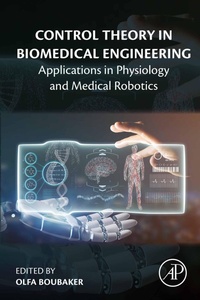
Control Theory in Biomedical Engineering
Applications in Physiology and Medical Robotics
Published on 30. June 2020
396 pages
978-0-12-822621-6 (ISBN)
Description

Control Theory in Biomedical Engineering: Applications in Physiology and Medical Robotics highlights the importance of control theory and feedback control in our lives and explains how this theory is central to future medical developments. Control theory is fundamental for understanding feedback paths in physiological systems (endocrine system, immune system, neurological system) and a concept for building artificial organs. The book is suitable for graduate students and researchers in the control engineering and biomedical engineering fields, and medical students and practitioners seeking to enhance their understanding of physiological processes, medical robotics (legs, hands, knees), and controlling artificial devices (pacemakers, insulin injection devices).Control theory profoundly impacts the everyday lives of a large part of the human population including the disabled and the elderly who use assistive and rehabilitation robots for improving the quality of their lives and increasing their independence.
- Gives an overview of state-of-the-art control theory in physiology, emphasizing the importance of this theory in the medical field through concrete examples, e.g., endocrine, immune, and neurological systems
- Takes a comprehensive look at advances in medical robotics and rehabilitation devices and presents case studies focusing on their feedback control
- Presents the significance of control theory in the pervasiveness of medical robots in surgery, exploration, diagnosis, therapy, and rehabilitation
More details
Other editions
Additional editions
Olfa Boubaker
Control Theory in Biomedical Engineering
Applications in Physiology and Medical Robotics
Book
06/2020
Academic Press
€125.50
Shipment within 15-20 days
Content
Part I. Applications in Physiology1. Modeling and Control in Physiology2. Mathematical Modeling of Cholesterol Homeostasis3. Adaptive Control of Artificial Pancreas Systems for Treatment of Type 1 Diabetes4. Modeling and Optimal Control of Cancer-immune System5. Genetic Fuzzy Logic based System for Arrhythmia Classification6. Modelling Simple and Complex Handwriting based on EMG SignalsPart II. Applications in Medical Robotics7. Medical Robotics8. Wearable Mechatronic Devices for Upper Limb Amputees9. Exoskeletons in Upper limb Rehabilitation: A Review to Find key Challenges to Improve Functionality10. A Double Pendulum Model for Human Walking Control on the Treadmill and Stride-to-stride Fluctuations: Control of Step Length, Time, Velocity and Position on the Treadmill11. Continuum NasoXplorer Manipulator with Shape Memory Actuators for Transnasal Exploration12. Tunable Stiffness using Negative Poisson's Ratio Towards Load-bearing Continuum Tubular Mechanisms in Medical Robotics
