

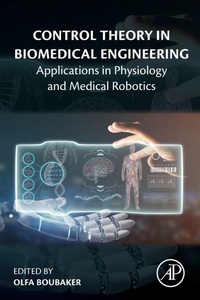
Control Theory in Biomedical Engineering
Applications in Physiology and Medical Robotics
Published on 29. June 2020
Book
Paperback/Softback
396 pages
978-0-12-821350-6 (ISBN)
Description
Control Theory in Biomedical Engineering: Applications in Physiology and Medical Robotics highlights the importance of control theory and feedback control in our lives and explains how this theory is central to future medical developments. Control theory is fundamental for understanding feedback paths in physiological systems (endocrine system, immune system, neurological system) and a concept for building artificial organs. The book is suitable for graduate students and researchers in the control engineering and biomedical engineering fields, and medical students and practitioners seeking to enhance their understanding of physiological processes, medical robotics (legs, hands, knees), and controlling artificial devices (pacemakers, insulin injection devices).
Control theory profoundly impacts the everyday lives of a large part of the human population including the disabled and the elderly who use assistive and rehabilitation robots for improving the quality of their lives and increasing their independence.
Control theory profoundly impacts the everyday lives of a large part of the human population including the disabled and the elderly who use assistive and rehabilitation robots for improving the quality of their lives and increasing their independence.
More details
Language
English
Place of publication
San Diego
United States
Publishing group
Elsevier Science Publishing Co Inc
Target group
College/higher education
Researchers and graduate students in both control engineering and biomedical engineering fields. Medical students and practitioners who want to enhance their understanding of physiological processes and medical robotics. Professionals in medical industries including those of industry of medical robotics, of artificial devices, of artificial organs and rehabilitation devices
Product notice
Paperback (trade)
Illustrations
Approx. 300 illustrations
Dimensions
Height: 229 mm
Width: 152 mm
Thickness: 21 mm
Weight
532 gr
ISBN-13
978-0-12-821350-6 (9780128213506)
Copyright in bibliographic data and cover images is held by Nielsen Book Services Limited or by the publishers or by their respective licensors: all rights reserved.
Schweitzer Classification
Other editions
Additional editions
Olfa Boubaker
Control Theory in Biomedical Engineering
Applications in Physiology and Medical Robotics
E-Book
06/2020
Academic Press
€113.00
Available for download
Person
Pr. Olfa Boubaker is a full professor at the National Institute of Applied Sciences and Technology (INSAT) at the University of Carthage, Tunisia, where she specializes in control theory, nonlinear systems, and robotics. She holds a Ph.D. in Electrical Engineering from the National Engineering School of Tunis and a Habilitation Universitaire in Control Engineering from the National Engineering School of Sfax. Prof. Boubaker is the series editor of the book series Medical Robots and Devices: New Developments and Advances."
Content
Part I. Applications in Physiology
1. Modeling and Control in Physiology
2. Mathematical Modeling of Cholesterol Homeostasis
3. Adaptive Control of Artificial Pancreas Systems for Treatment of Type 1 Diabetes
4. Modeling and Optimal Control of Cancer-immune System
5. Genetic Fuzzy Logic based System for Arrhythmia Classification
6. Modelling Simple and Complex Handwriting based on EMG Signals
Part II. Applications in Medical Robotics
7. Medical Robotics
8. Wearable Mechatronic Devices for Upper Limb Amputees
9. Exoskeletons in Upper limb Rehabilitation: A Review to Find key Challenges to Improve Functionality
10. A Double Pendulum Model for Human Walking Control on the Treadmill and Stride-to-stride Fluctuations: Control of Step Length, Time, Velocity and Position on the Treadmill
11. Continuum NasoXplorer Manipulator with Shape Memory Actuators for Transnasal Exploration
12. Tunable Stiffness using Negative Poisson's Ratio Towards Load-bearing Continuum Tubular Mechanisms in Medical Robotics
1. Modeling and Control in Physiology
2. Mathematical Modeling of Cholesterol Homeostasis
3. Adaptive Control of Artificial Pancreas Systems for Treatment of Type 1 Diabetes
4. Modeling and Optimal Control of Cancer-immune System
5. Genetic Fuzzy Logic based System for Arrhythmia Classification
6. Modelling Simple and Complex Handwriting based on EMG Signals
Part II. Applications in Medical Robotics
7. Medical Robotics
8. Wearable Mechatronic Devices for Upper Limb Amputees
9. Exoskeletons in Upper limb Rehabilitation: A Review to Find key Challenges to Improve Functionality
10. A Double Pendulum Model for Human Walking Control on the Treadmill and Stride-to-stride Fluctuations: Control of Step Length, Time, Velocity and Position on the Treadmill
11. Continuum NasoXplorer Manipulator with Shape Memory Actuators for Transnasal Exploration
12. Tunable Stiffness using Negative Poisson's Ratio Towards Load-bearing Continuum Tubular Mechanisms in Medical Robotics