

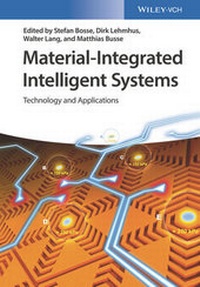
Material-Integrated Intelligent Systems
Description

The editors and authors are from academia and research institutions with close ties to industry, and are thus able to offer first-hand information here. They adopt a unique, three-tiered approach such that readers can gain basic, intermediate, and advanced topical knowledge. The technology section of the book is divided into chapters covering the basics of sensor integration in materials, the challenges associated with this approach, data processing, evaluation, and validation, as well as methods for achieving an autonomous energy supply. The applications part then goes on to showcase typical scenarios where material-integrated intelligent systems are already in use, such as for structural health monitoring and smart textiles.
More details
Other editions
Additional editions
Persons
Dirk Lehmhus joined the Fraunhofer Institute for Manufacturing Technology and Advanced Materials (IFAM) in Bremen, Germany, in 1998 and subsequently obtained a PhD in production technology from Bremen University for optimization studies of aluminium foam production processes and properties. Since May 2009 he is Managing Director at the University of Bremen's Scientific Centre ISIS dedicated to the development of sensorial materials and sensor-equipped structures.
Walter Lang joined the Fraunhofer Institute for Solid State Technology (EMFT) in Munich, Germany, in 1987 where he worked on microsystems technology. In 1995, he became Head of the Sensors Department in the Institute of Micromachining and Information Technology of the Hahn Schickard Society. In 2003, he joined the University of Bremen where he is currently heading the Institute for Microsensors, -actuators and -systems at the Microsystems Center Bremen.
Matthias Busse holds the chair for near net-shape manufacturing technology in the Faculty of Production Engineering at the University of Bremen since 2003. At the same time, he became Director of the Fraunhofer IFAM. After his PhD in mechanical engineering he worked in various positions at Volkswagen Central Research, ultimately as Head of Production Research. Matthias Busse represents the University of Bremen's Scientific Centre ISIS as speaker of the board of directors.
Content
Function Scale Integration - The Concept of Limiting Wounds to Materials Induced by Sensor Integration
Development of New Types of Sensors Specifically Addressing Host Material Integration Aspects
Compliant Sensor and Electronics Technology
Techniques for Integrating Sensors with Materials: Bulk and Surface Integration
INTERFACING TECHNOLOGIES
Electrical and Optical Connectivity
Bonding Techniques
Printing Techniques for Interfacing Structures
RELIABLE DATA PROCESSING PROVIDING ROBUSTNESS
AI Methods for Data Evaluation
Networking with Distributed Data Processing
Sensor Signal Processing: Sensor Data Fusion
RELIABLE COMMUNICATION PROVIDING ROBUSTNESS
Communication Protocols on Link and Application Layer: Hard- and Software Side
Communication on Physical Layer: Hardware Side, Physical Realization
ENERGY SUPPLY
Distribution, Management, Harvesting and Storage of Energy
Low-Power Electronics for Signal and Data Processing
APPLICATIONS
Smart Skin
Structural Health Monitoring
Body Area Networks
Smart Textiles
Casttronics
Metacomposites Programming
1
On Concepts and Challenges of Realizing Material-Integrated Intelligent Systems
Stefan Bosse1,2 and Dirk Lehmhus2
1University of Bremen, Department of Mathematics and Computer Science, Robert-Hooke-Str. 5, 28359 Bremen, Germany
2University of Bremen, ISIS Sensorial Materials Scientific Centre, Wiener Str. 12, 28359 Bremen, Germany
1.1 Introduction
Material-integrated intelligent systems constitute materials that are able to "feel." This is the shortest possible definition at hand for the subject of the present book. What it implies will be discussed below, while detailed descriptions of individual aspects and application scenarios will follow in its main parts.
As a concept, material-integrated intelligent systems have implicitly been around for quite some time. To a considerable degree, this is because the concept as such is not so much a human invention, but rather something that is deeply rooted in nature: The human skin and the human nervous system are the typical examples cited pertaining to material-integrated intelligent systems, such as sensorial materials [1-3], robotic materials [4], nervous materials [5], or sensor-array materials [6].
These natural models taken together nicely illustrate the differences between materials with integrated sensor(s) and material-integrated intelligent systems: For one thing, the skin contains a multitude of sensors which do not only capture force or pressure, but also additional aspects like the first and second derivative of pressure or temperature. At the same time, the impression we get when we touch an arbitrary surface is not that of a separate awareness of these factors, but a combined one that is derived from fusion of sensory information.
Besides, we do not base the decisions we make in response to a tactile sensation on quantitative values of pressure, temperature, and so on, and on a deterministic model that links these values to an intended action and its potential outcome. Instead, we rely on experience, that is, on a learned relationship between an action and its outcome in relation to the associated sensory information in one way or another. Translated to technical terms, we thus follow a model-free approach.
Having said this, we can derive a list of characteristics a material would need for us to concede that it can actually "feel." Such a material must be capable of
- capturing sensory data;
- aggregating data through some local preprocessing, performing data reduction of individual data points;
- further processing this data to derive some higher-level information, gaining knowledge;
- using this knowledge for decision-making, putting it to some internal/local use, or communicating it to higher system levels;
- coping with damage by being dynamic and reconfigurable; and
- achieving a state of awareness of host material and environment, that is, the derivation of a context knowledge.
If the above list represents a functionality-centered perspective, the question that immediately arises is how a technical implementation of this concept could be achieved, and which research domains would need to contribute to it.
On a generic level, material-integrated intelligent systems follow the universal trend in the microelectronics industry, which is typically described as having two orthogonal, primary directions: on the one hand, miniaturization or the "more Moore" development line, and on the other, diversification through the integration of additional, usually analog, functionalities such as sensing, energy supply, and so on - the "more than Moore" approach. In both cases, reference is made to Moore's law, which predicts (from a 1965 point of view) that transistor count in densely packed integrated circuits would double every 2 years, and which has since then approximately been met by actual developments, although with some indications of slowing down since about 2011. Technologically, "more Moore" is usually associated with system on chip (SoC) solutions, whereas "more than Moore" is linked to system in package (SiP) technologies. However, both merge diagonally combining both SoC and SiP approaches to create higher value systems. Clearly, this is the domain into which material-integrated intelligent systems fall. As a consequence, the following research topics need to be addressed in their development:
- miniaturization on component and system level to limit "footprint" within host material;
- system resilience against effects of processing conditions during integration;
- system compliance with host material properties in the embedded state;
- energy supply solutions that support autonomy, like cooperative energy harvesting and storage, and (intelligent) management of resources;
- reliable and robust low power internally and externally directed communication approaches;
- distributed, reliable, and robust low power data evaluation; and
- multiscale design methodologies that span the scope from chip design to smart products and environments.
Mark Weiser, in his landmark 1991 article that predicted many evolutions in computer science we have witnessed since, has set the scene by stating that "in the 21st century, the technology revolution will move into the everyday, the small and the invisible" [7]. Weiser thus anticipated a development that is connected to terms such as ambient intelligence and ubiquitous or pervasive computing.
Material-integrated intelligent systems will both profit from and contribute to the realization of this prediction through their potential of endowing many of the passive materials surrounding us today with perceptive capabilities, and ultimately even adaptive behavior. A large part of the novelty of this approach has its foundations in the notion that miniaturization of systems will allow integration on a level that provides the added functionality without compromising suitability for the primary role to be fulfilled by the material in question. A prominent example in this respect is structural health monitoring (SHM). This application scenario is relevant for safety-critical, load-bearing structures. Safety can be enhanced, or safety factors relaxed, if the exact structural state is known at any moment in time. If material-integrated intelligent systems were selected for this task, a necessary prerequisite would be that the systems themselves do not adversely affect mechanical characteristics of the host material. In other words, the materials designed thus should not afford considering any property degradation caused by the material-integrated systems during the layout of the structure for its primary task. In a further evolution of the concept, the materials themselves could thus be envisaged as semifinished materials in the same way as sheet metal: Their capabilities, including their smartness, would be available as an asset not necessarily targeted at a specific application, but providing for several ones. For production of material-integrated intelligent systems, such a scenario could open up economy of scale effects significantly enhancing their economic viability. At the same time, this would afford production techniques able to cope with the associated large production volume.
It has been suggested that the implementation of material-integrated sensing can either follow a top-down or a bottom-up approach [2]. Focusing specifically on the sensing function, Lang et al. [8] propose an even finer distinction, which demarcates a top-down as opposed to a bottom-up approach:
- top-down approach:
- - hybrid integration
- - local additive buildup
- bottom-up approach:
- - generic (intrinsic) sensing properties of materials
- - local growth of sensors using, for example, bioinspired processes
From our current perspective, Lang et al.'s proposal excludes the intelligent side of material-integrated intelligent systems and its prerequisites like energy supply by concentrating on the transducer effect and the hardware to implement it. Specifically, the bottom-up approaches still fail to offer solutions that could provide these system components. This is apparent particularly for the generic sensing properties of materials, which remain ineffectual even as sensor until at least some means of detecting (i.e., sensing) the intrinsic effect is added.
The example shows that at least on the level of full intelligent systems, bottom-up approaches do not yet respond satisfactorily to the questions of realization.
An exception, though a theoretical one, is the notion of programmable matter proposed by Toffoli and Margolus. Their original concept assumes spatially distributed computing elements similar to smart sensor nodes capable of nearest neighbor interaction only. Together, they form a material with the inherent capability of information processing. Practically, this concept is reminiscent of physical realizations of cellular or lattice gas automata [9,10].
Later, alternative or extended definitions of programmable matter stress the ability of such materials to alter their physical characteristics in a controlled fashion - controlled either by a user from the outside or autonomously from within the material. In the latter case, the programmable matter makes use of its data evaluation capabilities to respond, for example, to sensor signals. Under this headline, several materials have been understood to...
