

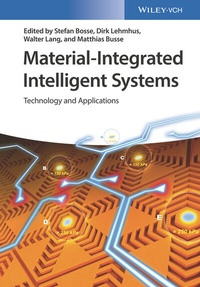
Material-Integrated Intelligent Systems
Technology and Applications
1st Edition
Published on 24. January 2018
Book
Hardback
696 pages
978-3-527-33606-7 (ISBN)
Description
Combining different perspectives from materials science, engineering, and computer science, this reference provides a unified view of the various aspects necessary for the successful realization of intelligent systems.
The editors and authors are from academia and research institutions with close ties to industry, and are thus able to offer first-hand information here. They adopt a unique, three-tiered approach such that readers can gain basic, intermediate, and advanced topical knowledge. The technology section of the book is divided into chapters covering the basics of sensor integration in materials, the challenges associated with this approach, data processing, evaluation, and validation, as well as methods for achieving an autonomous energy supply. The applications part then goes on to showcase typical scenarios where material-integrated intelligent systems are already in use, such as for structural health monitoring and smart textiles.
The editors and authors are from academia and research institutions with close ties to industry, and are thus able to offer first-hand information here. They adopt a unique, three-tiered approach such that readers can gain basic, intermediate, and advanced topical knowledge. The technology section of the book is divided into chapters covering the basics of sensor integration in materials, the challenges associated with this approach, data processing, evaluation, and validation, as well as methods for achieving an autonomous energy supply. The applications part then goes on to showcase typical scenarios where material-integrated intelligent systems are already in use, such as for structural health monitoring and smart textiles.
More details
Edition
1. Auflage
Language
English
Place of publication
Berlin
Germany
Target group
Professional and scholarly
Illustrations
325
275 s/w Abbildungen, 20 farbige Abbildungen, 30 s/w Tabellen
Dimensions
Height: 24.4 cm
Width: 17 cm
Thickness: 3.5 cm
Weight
1474 gr
ISBN-13
978-3-527-33606-7 (9783527336067)
Schweitzer Classification
Other editions
Additional editions
Stefan Bosse | Dirk Lehmhus | Walter Lang
Material-Integrated Intelligent Systems
Technology and Applications
E-Book
11/2017
1st Edition
Wiley-VCH
€259.99
Available for download
Stefan Bosse | Dirk Lehmhus | Walter Lang
Material-Integrated Intelligent Systems
Technology and Applications
E-Book
11/2017
1st Edition
Wiley-VCH
€259.99
Available for download
Persons
Stefan Bosse studied physics at the University of Bremen, Germany, from which he also received his PhD. Since 2008 he is actively involved in different projects in the University of Bremen's Scientific Center ISIS (Integrated Solutions in Sensorial Structure Engineering) pushing interdisciplinary research, and recently joined the ISIS council.
Dirk Lehmhus joined the Fraunhofer Institute for Manufacturing Technology and Advanced Materials (IFAM) in Bremen, Germany, in 1998 and subsequently obtained a PhD in production technology from Bremen University for optimization studies of aluminium foam production processes and properties. Since May 2009 he is Managing Director at the University of Bremen's Scientific Centre ISIS dedicated to the development of sensorial materials and sensor-equipped structures.
Walter Lang joined the Fraunhofer Institute for Solid State Technology (EMFT) in Munich, Germany, in 1987 where he worked on microsystems technology. In 1995, he became Head of the Sensors Department in the Institute of Micromachining and Information Technology of the Hahn Schickard Society. In 2003, he joined the University of Bremen where he is currently heading the Institute for Microsensors, -actuators and -systems at the Microsystems Center Bremen.
Matthias Busse holds the chair for near net-shape manufacturing technology in the Faculty of Production Engineering at the University of Bremen since 2003. At the same time, he became Director of the Fraunhofer IFAM. After his PhD in mechanical engineering he worked in various positions at Volkswagen Central Research, ultimately as Head of Production Research. Matthias Busse represents the University of Bremen's Scientific Centre ISIS as speaker of the board of directors.
Dirk Lehmhus joined the Fraunhofer Institute for Manufacturing Technology and Advanced Materials (IFAM) in Bremen, Germany, in 1998 and subsequently obtained a PhD in production technology from Bremen University for optimization studies of aluminium foam production processes and properties. Since May 2009 he is Managing Director at the University of Bremen's Scientific Centre ISIS dedicated to the development of sensorial materials and sensor-equipped structures.
Walter Lang joined the Fraunhofer Institute for Solid State Technology (EMFT) in Munich, Germany, in 1987 where he worked on microsystems technology. In 1995, he became Head of the Sensors Department in the Institute of Micromachining and Information Technology of the Hahn Schickard Society. In 2003, he joined the University of Bremen where he is currently heading the Institute for Microsensors, -actuators and -systems at the Microsystems Center Bremen.
Matthias Busse holds the chair for near net-shape manufacturing technology in the Faculty of Production Engineering at the University of Bremen since 2003. At the same time, he became Director of the Fraunhofer IFAM. After his PhD in mechanical engineering he worked in various positions at Volkswagen Central Research, ultimately as Head of Production Research. Matthias Busse represents the University of Bremen's Scientific Centre ISIS as speaker of the board of directors.
Content
SENSOR AND ELECTRONICS DEVELOPMENT FOR MATERIAL INTEGRATION
Function Scale Integration - The Concept of Limiting Wounds to Materials Induced by Sensor Integration
Development of New Types of Sensors Specifically Addressing Host Material Integration Aspects
Compliant Sensor and Electronics Technology
Techniques for Integrating Sensors with Materials: Bulk and Surface Integration
INTERFACING TECHNOLOGIES
Electrical and Optical Connectivity
Bonding Techniques
Printing Techniques for Interfacing Structures
RELIABLE DATA PROCESSING PROVIDING ROBUSTNESS
AI Methods for Data Evaluation
Networking with Distributed Data Processing
Sensor Signal Processing: Sensor Data Fusion
RELIABLE COMMUNICATION PROVIDING ROBUSTNESS
Communication Protocols on Link and Application Layer: Hard- and Software Side
Communication on Physical Layer: Hardware Side, Physical Realization
ENERGY SUPPLY
Distribution, Management, Harvesting and Storage of Energy
Low-Power Electronics for Signal and Data Processing
APPLICATIONS
Smart Skin
Structural Health Monitoring
Body Area Networks
Smart Textiles
Casttronics
Metacomposites Programming
Function Scale Integration - The Concept of Limiting Wounds to Materials Induced by Sensor Integration
Development of New Types of Sensors Specifically Addressing Host Material Integration Aspects
Compliant Sensor and Electronics Technology
Techniques for Integrating Sensors with Materials: Bulk and Surface Integration
INTERFACING TECHNOLOGIES
Electrical and Optical Connectivity
Bonding Techniques
Printing Techniques for Interfacing Structures
RELIABLE DATA PROCESSING PROVIDING ROBUSTNESS
AI Methods for Data Evaluation
Networking with Distributed Data Processing
Sensor Signal Processing: Sensor Data Fusion
RELIABLE COMMUNICATION PROVIDING ROBUSTNESS
Communication Protocols on Link and Application Layer: Hard- and Software Side
Communication on Physical Layer: Hardware Side, Physical Realization
ENERGY SUPPLY
Distribution, Management, Harvesting and Storage of Energy
Low-Power Electronics for Signal and Data Processing
APPLICATIONS
Smart Skin
Structural Health Monitoring
Body Area Networks
Smart Textiles
Casttronics
Metacomposites Programming