

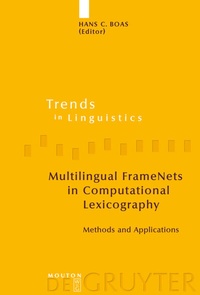
Multilingual FrameNets in Computational Lexicography
Methods and Applications
1st Edition
Published on 14. July 2009
X, 350 pages
978-3-11-021297-6 (ISBN)
Description

This book demonstrates how the underlying principles of the English-based FrameNet project are successfully applied to the description and analysis of typologically diverse languages.
The stimulating collection of articles brings together insights from lexical semantics, corpus linguistics, computational lexicography, machine learning, and psychology to address three main questions:
- To what degree is it possible to apply semantic frames derived from the English lexicon to the description and analysis of other languages?
- What types of resources are necessary for the creation of FrameNets for French, German, Hebrew, Japanese, and Spanish?
- How can the creation of multi-lingual FrameNets be automated?
The contents exemplifies the liveliness of current research on cross-lingual applications of Frame Semantics to natural language processing.
More details
Series
Language
English
Place of publication
Berlin/Boston
Germany
Publishing group
de Gruyter Mouton
Target group
Professional and scholarly
US School Grade: College Graduate Student
Illustrations
Num. figs. and tabs.
Num. figs. and tabs.
File size
3,60 MB
ISBN-13
978-3-11-021297-6 (9783110212976)
Schweitzer Classification
Other editions
Additional editions
Book
07/2009
1st Edition
De Gruyter Mouton
€189.95
Shipment within 7-9 days
Person
Hans C. Boas, The University of Texas at Austin, USA.
Content
1 - Frontmatter [Seite 1]
2 - Contents [Seite 9]
3 - 1. Recent trends in multilingual computational lexicography [Seite 11]
4 - 2. A bilingual lexical database for Frame Semantics [Seite 47]
5 - 3. Semantic frames as interlingual representations for multilingual lexical databases [Seite 69]
6 - 4. The Kicktionary - a multilingual lexical resource of football language [Seite 111]
7 - 5. Spanish FrameNet: A frame-semantic analysis of the Spanish lexicon [Seite 145]
8 - 6. Frame-based contrastive lexical semantics in Japanese FrameNet: The case of risk and kakeru [Seite 173]
9 - 7. Typological considerations in constructing a Hebrew FrameNet [Seite 193]
10 - 8. Using FrameNet for the semantic analysis of German: Annotation, representation, and automation [Seite 219]
11 - 9. Cross-lingual labeling of semantic predicates and roles: A low-resource method based on bilingua lL(atent) S(emantic) A(nalysis) [Seite 255]
12 - 10. Interlingual annotation of multilingual text corpora and FrameNet [Seite 297]
13 - 11. Universals and idiosyncrasies in multilingual WordNets [Seite 329]
14 - Backmatter [Seite 357]
2 - Contents [Seite 9]
3 - 1. Recent trends in multilingual computational lexicography [Seite 11]
4 - 2. A bilingual lexical database for Frame Semantics [Seite 47]
5 - 3. Semantic frames as interlingual representations for multilingual lexical databases [Seite 69]
6 - 4. The Kicktionary - a multilingual lexical resource of football language [Seite 111]
7 - 5. Spanish FrameNet: A frame-semantic analysis of the Spanish lexicon [Seite 145]
8 - 6. Frame-based contrastive lexical semantics in Japanese FrameNet: The case of risk and kakeru [Seite 173]
9 - 7. Typological considerations in constructing a Hebrew FrameNet [Seite 193]
10 - 8. Using FrameNet for the semantic analysis of German: Annotation, representation, and automation [Seite 219]
11 - 9. Cross-lingual labeling of semantic predicates and roles: A low-resource method based on bilingua lL(atent) S(emantic) A(nalysis) [Seite 255]
12 - 10. Interlingual annotation of multilingual text corpora and FrameNet [Seite 297]
13 - 11. Universals and idiosyncrasies in multilingual WordNets [Seite 329]
14 - Backmatter [Seite 357]
