

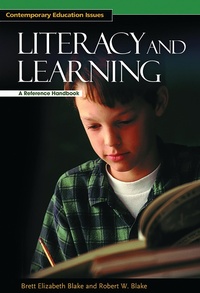
Literacy and Learning
A Reference Handbook
Published on 15. November 2002
286 pages
978-1-57607-531-9 (ISBN)
Description

A state-of-the-art compendium of resource materials and current practice that answers two basic questions: "What is literacy?" and "How do individuals become literate?"
Not long ago, literacy simply meant knowing how to read and write. Today, the study of literacy is a complex field encompassing many different areas, from computer literacy to geographic literacy, and including several degrees of competence such as functional, pragmatic, and cultured. In addition there are six kinds of readers: the submissive, the active, the semiotic, the subjective, the psychoanalytic, and the interpretive community reader, and at least two distinct ways of reading: aesthetic reading and rational reading.
In this comprehensive, accessible volume, two literacy experts not only help readers understand the latest theories and the heated controversies in this exciting field, they also show readers how this vast new knowledge is being applied in successful literacy programs.
Not long ago, literacy simply meant knowing how to read and write. Today, the study of literacy is a complex field encompassing many different areas, from computer literacy to geographic literacy, and including several degrees of competence such as functional, pragmatic, and cultured. In addition there are six kinds of readers: the submissive, the active, the semiotic, the subjective, the psychoanalytic, and the interpretive community reader, and at least two distinct ways of reading: aesthetic reading and rational reading.
In this comprehensive, accessible volume, two literacy experts not only help readers understand the latest theories and the heated controversies in this exciting field, they also show readers how this vast new knowledge is being applied in successful literacy programs.
More details
Series
Language
English
Place of publication
New York
United States
Publishing group
Bloomsbury Publishing Plc
Target group
Interest Age: From 7 to 17 years
File size
1,92 MB
ISBN-13
978-1-57607-531-9 (9781576075319)
Copyright in bibliographic data and cover images is held by Nielsen Book Services Limited or by the publishers or by their respective licensors: all rights reserved.
Schweitzer Classification
Other editions
Additional editions
Book
11/2002
ABC-CLIO
€59.00
Shipment within 3-4 weeks
Persons
Brett Elizabeth Blake is associate professor in the School of Education at St. John's University, New York, NY.
Robert W. Blake is professor emeritus of education and human development and English education at SUNY College, Brockport, Brockport, NY.
Robert W. Blake is professor emeritus of education and human development and English education at SUNY College, Brockport, Brockport, NY.
Content
- Cover
- Literacy and Learning
- Contents
- Series Editor's Preface
- Preface
- Acknowledgments
- Chapter One The Meanings of Literacy
- Reasons for Literacy
- Literacy Is Good for the Individual
- Literacy Is Good for Economic Well-Being
- Literacy Is Good for Society
- Literacy Is Good for Political Stability
- Literacy Is Good for the Community
- Literacy Is Good for the Economic Development of Countries
- Definitions of Literacy: A Variety
- Evolution of the Terms
- Defining Functional Literacy
- Age and Functional Literacy
- The Skills of Literacy
- Measuring Literacy
- Critical Levels of Literacy
- How Literacy Has Changed over Time
- Literacy and the Nonnative Speaker
- Literacy Debates
- Literacy/Illiteracy versus a Scale of Literacy Skills
- A Single Literacy versus Many Literacies
- High-Quantity Literacy Education versus High-Quality Literacy Education
- Summary
- References
- Chapter Two Chronology
- Chapter Three The Foundations of Literacy
- Speaking and Writing
- Characteristics of Speech
- The Development of Writing
- The Alphabet versus the Syllabary
- How the Alphabet Works
- Results of the Invention of the Alphabet
- Readership in Ancient Times
- Summary
- References
- Chapter Four The Consequences of Literacy
- Homer's Poetry
- The Birth of Prose in Western Thought and Language
- Fundamental Consequences of the Alphabet
- Early Modern Consequences of Literacy
- Summary
- References
- Chapter Five Reading: How We Learned to Read
- What We Do as We Read
- How We First Read: Texts with No Word Separation
- The Birth and Evolution of Modern Reading
- Reading at the Beginning of the Early Modern Era
- Summary
- References
- Chapter Six Reading Literature: Literature as a Way of Knowing
- Literature as a Way of Knowing
- Summary
- References
- Chapter Seven Reading Literature: New Criticism-Theory to Practice
- Reading Literature: Background
- New Criticism: Theory
- Principles of New Critical Theory
- New Criticism: Practice
- Summary
- How We Read Literature Using Principles of New Criticism
- References
- Chapter Eight Reading Literature: Reader Response-Theory to Practice
- Reader Response: Theory
- The Submissive Reader
- The Active Reader
- The Semiotic Reader
- The Subjective Reader
- The Psychoanalytic Reader
- The Interpretive Community Reader
- Principles of Reader Response Theory
- Reader Response: Practice
- Why Reader Response Practice Has Evolved So Slowly
- Lack of an Academic Theoretical Reader Response Model
- Lack of Training for Schoolteachers in Reader Response Practices
- Lack of a Reader Response Pedagogical Model for Teaching Literature in the Schools
- Classroom Reader Response: Practical Models
- Assumptions Underlying Classroom Reader Response
- Classroom Reader Response Program for Secondary Students
- Classroom Reader Response Program for Elementary Students
- Summary
- References
- Chapter Nine Literacy among Diverse Learners
- Who Are Today's Diverse Learners?
- Two Scenarios: English Language Learners in Diverse Settings
- Where Do I Begin?
- Second Language Acquisition Theories
- Reading and Second Language
- Literacy and Diverse Learners
- Five Assumptions
- Classroom Examples
- An Urban Fourth-Grade ESL Classroom
- Mrs. Kuhn's Urban Adolescent Classroom: ELLs and Special Needs
- Standards and Accountability: Role of School versus "Local Literacies"
- Summary and Implications
- References
- Chapter Ten Organizations and Educational Associations
- Organizations
- Educational Associations
- Chapter Eleven Selected Print and Nonprint Resources
- Print Sources
- Nonprint Sources
- General Interest
- Lesson Plans and Teaching Resources
- Literacy Research
- Index
- About the Authors
