

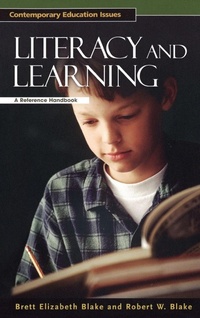
Literacy and Learning
A Reference Handbook
Published on 15. November 2002
Book
Hardback
267 pages
978-1-57607-273-8 (ISBN)
Description
A state-of-the-art compendium of resource materials and current practice that answers two basic questions: "What is literacy?" and "How do individuals become literate?"
Not long ago, literacy simply meant knowing how to read and write. Today, the study of literacy is a complex field encompassing many different areas, from computer literacy to geographic literacy, and including several degrees of competence such as functional, pragmatic, and cultured. In addition there are six kinds of readers: the submissive, the active, the semiotic, the subjective, the psychoanalytic, and the interpretive community reader, and at least two distinct ways of reading: aesthetic reading and rational reading.
In this comprehensive, accessible volume, two literacy experts not only help readers understand the latest theories and the heated controversies in this exciting field, they also show readers how this vast new knowledge is being applied in successful literacy programs.
Detailed discussion of reader response theory and the different types of readers
Contact information for a variety of literacy organizations along with a list of websites offering lesson plans, teaching resources, and literacy research
Not long ago, literacy simply meant knowing how to read and write. Today, the study of literacy is a complex field encompassing many different areas, from computer literacy to geographic literacy, and including several degrees of competence such as functional, pragmatic, and cultured. In addition there are six kinds of readers: the submissive, the active, the semiotic, the subjective, the psychoanalytic, and the interpretive community reader, and at least two distinct ways of reading: aesthetic reading and rational reading.
In this comprehensive, accessible volume, two literacy experts not only help readers understand the latest theories and the heated controversies in this exciting field, they also show readers how this vast new knowledge is being applied in successful literacy programs.
Detailed discussion of reader response theory and the different types of readers
Contact information for a variety of literacy organizations along with a list of websites offering lesson plans, teaching resources, and literacy research
Reviews / Votes
"This intriguing exploration of many facets of literacy is divided into 11 chapters that discuss the meaning of literacy . . . this work should be placed in the stacks . . . This work is recommended for most libraries, but especially those supporting programs in education, psychology, and philosophy." - American Reference Books AnnualMore details
Series
Language
English
Place of publication
United States
Publishing group
Bloomsbury Publishing Plc
Target group
College/higher education
Professional and scholarly
US School Grade: From Second Grade to Twelfth Grade, Interest Age: From 12 years
Dimensions
Height: 235 mm
Width: 157 mm
Thickness: 21 mm
Weight
618 gr
ISBN-13
978-1-57607-273-8 (9781576072738)
Copyright in bibliographic data and cover images is held by Nielsen Book Services Limited or by the publishers or by their respective licensors: all rights reserved.
Schweitzer Classification
Other editions
Additional editions
E-Book
11/2002
ABC-CLIO
€47.99
Available for download
Persons
Brett Elizabeth Blake is associate professor in the School of Education at St. John's University, New York, NY.
Robert W. Blake is professor emeritus of education and human development and English education at SUNY College, Brockport, Brockport, NY.
Robert W. Blake is professor emeritus of education and human development and English education at SUNY College, Brockport, Brockport, NY.