
The Collaborative Fight
Description
Alles über E-Books | Antworten auf Fragen rund um E-Books, Kopierschutz und Dateiformate finden Sie in unserem Info- & Hilfebereich.
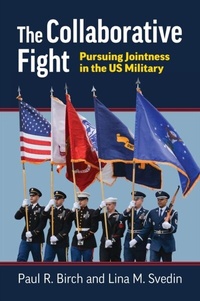
The beautiful picture of brothers in arms vanquishing a tyrant. The power of a well-orchestrated army and navy winning historic battles. Overwhelming military might and ability through teamwork. This is how the US military services portray themselves to the public and to their own service members through official doctrine. However, under the veneer of jointness, deeply fraught processes are at play. Frequently, the services think more about protecting organizational turf than about national security and maintaining an advantage against the United States' external adversaries. Uniting US military services is a difficult endeavor that becomes even more so the farther from a battlefield and the higher up the command structure the unifying needs to happen.
In The Collaborative Fight, Paul R. Birch and Lina M. Svedin examine cases of institutional jointness among US military services from the late nineteenth century into the twenty-first century. They draw actionable conclusions for practitioners in the defense establishment while giving examples of successful joint cooperation that overcame the difficulties inherent in pursuing it. Even the successful cases that Birch and Svedin discuss show that the US military services face bureaucratic incentives and organizational leadership issues that make battlefield cooperation less than ideal.
Birch and Svedin adeptly translate theory and history into approaches useful to practitioners in the field while examining the theoretical framework outlining the drivers in joint military cooperation.
All prices
More details
Other editions
Additional editions
Persons
Paul R. Birch works in the Plans and Programs directorate at Headquarters U.S. Air Force, the Pentagon.
Content
List of Tables
Series Editor's Foreword
Acknowledgments
List of Acronyms and Abbreviations
1. The Collaborative Fight: US Armed Services' Ambivalent Relationship to Jointness
2. Factors in Organizational Collaboration and Success Cases
3. The Army and Air Force Collaborate on AirLand Battle, 1973?1991
4. Cooperation in Peacetime: The Joint Primary Aviation Training System, 1988?Present
5. Air Support in Counterinsurgency, 2001?2012
6. Joint All-Domain Command and Control
7. An Empirically Informed Theory of Jointness
Conclusion: Jointness Is a Collaborative Fights
Appendix. Research Method and Case-Study Selection Criteria
Notes
Reference List
Index

System requirements
File format: ePUB
Copy protection: Adobe-DRM (Digital Rights Management)
System requirements:
- Computer (Windows; MacOS X; Linux): Install the free reader Adobe Digital Editions prior to download (see eBook Help).
- Tablet/smartphone (Android; iOS): Install the free app Adobe Digital Editions or the app PocketBook before downloading (see eBook Help).
- E-reader: Bookeen, Kobo, Pocketbook, Sony, Tolino and many more (not Kindle).
The file format ePub works well for novels and non-fiction books – i.e., „flowing” text without complex layout. On an e-reader or smartphone, line and page breaks automatically adjust to fit the small displays.
This eBook uses Adobe-DRM, a „hard” copy protection. If the necessary requirements are not met, unfortunately you will not be able to open the eBook. You will therefore need to prepare your reading hardware before downloading.
Please note: We strongly recommend that you authorise using your personal Adobe ID after installation of any reading software.
For more information, see our ebook Help page.
File format: PDF
Copy-Protection: Adobe-DRM (Digital Rights Management)
System requirements:
- Computer (Windows; MacOS X; Linux): Install the free reader Adobe Digital Editions prior to download (see eBook Help).
- Tablet/smartphone (Android; iOS): Install the free app Adobe Digital Editions or the app PocketBook before downloading (see eBook Help).
- E-reader: Bookeen, Kobo, Pocketbook, Sony, Tolino and many more (only limited: Kindle).
The file format PDF always displays a book page identically on any hardware. This makes PDF suitable for complex layouts such as those used in textbooks and reference books (images, tables, columns, footnotes). Unfortunately, on the small screens of e-readers or smartphones, PDFs are rather annoying, requiring too much scrolling.
This eBook uses Adobe-DRM, a „hard” copy protection. If the necessary requirements are not met, unfortunately you will not be able to open the eBook. You will therefore need to prepare your reading hardware before downloading.
Please note: We strongly recommend that you authorise using your personal Adobe ID after installation of any reading software.
For more information, see our eBook Help page.
File format: ePUB
Copy protection: Watermark-DRM (Digital Rights Management)
System requirements:
- Computer (Windows; MacOS X; Linux): Use a reading software that can process the file format ePUB: e.g., Adobe Digital Editions or FBReader – both free (see eBook Help).
- Tablet/Smartphone (Android; iOS): Before downloading, install the free app Adobe Digital Editions (see eBook Help).
- E-reader: Bookeen, Kobo, Pocketbook, Sony, Tolino and many more (not Kindle).
The file format ePUB works well for novels and non-fiction books – i.e., „flowing” text without complex layout. On an e-reader or smartphone, line and page breaks automatically adjust to fit the small displays.
This eBook uses Watermark-DRM, a „soft” copy protection. This means that there are no technical restrictions to prevent illegal distribution. However, there is a personalised watermark embedded in the eBook that can be used to identify the purchaser of the eBook in the event of misuse and to provide evidence for legal purposes.
For more information, see our eBook Help page.
