


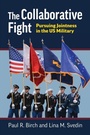
The Collaborative Fight
Pursuing Jointness in the US Military
Published on 9. February 2024
Book
Hardback
344 pages
978-0-7006-3621-1 (ISBN)
Description
The beautiful picture of brothers in arms vanquishing a tyrant. The power of a well-orchestrated army and navy winning historic battles. Overwhelming military might and ability through teamwork. This is how the US military services portray themselves to the public and to their own service members through official doctrine. However, under the veneer of jointness, deeply fraught processes are at play. Frequently, the services think more about protecting organizational turf than about national security and maintaining an advantage against the United States' external adversaries. Uniting US military services is a difficult endeavor that becomes even more so the farther from a battlefield and the higher up the command structure the unifying needs to happen.In The Collaborative Fight, Paul R. Birch and Lina M. Svedin examine cases of institutional jointness among US military services from the late nineteenth century into the twenty-first century. They draw actionable conclusions for practitioners in the defense establishment while giving examples of successful joint cooperation that overcame the difficulties inherent in pursuing it. Even the successful cases that Birch and Svedin discuss show that the US military services face bureaucratic incentives and organizational leadership issues that make battlefield cooperation less than ideal.
Birch and Svedin adeptly translate theory and history into approaches useful to practitioners in the field while examining the theoretical framework outlining the drivers in joint military cooperation.
Birch and Svedin adeptly translate theory and history into approaches useful to practitioners in the field while examining the theoretical framework outlining the drivers in joint military cooperation.
Reviews / Votes
"This unique study will be of great value to scholars and defense practitioners alike, particularly in staff and war colleges where there is always a need for rigorous, relevant, and informative case studies. Birch and Svedin offer penetrating insights why in the past the US military either failed to achieve jointness or to sustain if it was achieved for a time. This is a timely book that will challenge assumptions, fuel arguments, and do tremendous good for the joint force."-J. P. Clark, author of Preparing for War: The Emergence of the Modern U.S. Army, 1815--1917"The Collaborative Fight provides one of the only scholarly treatments of a word that dominates life in the million-person trillion-dollar defense industry: jointness. Since the Goldwater-Nichols reforms of 1986, jointness has been the coin of the realm for the US military, whether aspirationally or actually. Matters of budget, operations, doctrine, and education all esteem jointness as a predominant virtue-yet there is little robust understanding of what it is or why it is so difficult to achieve and sustain. Birch and Svedin offer a strong theoretical and empirical treatment of the subject, with novel case studies and appropriately eclectic theoretical antecedents. In short, far too little is known about a ubiquitous Pentagon buzzword-this book helps bridge the gap."-Jeffrey Donnithorne, Colonel (Ret.), USAF, and author of Four Guardians: A Principled-Agent View of American Civil-Military Relations
More details
Series
Language
English
Place of publication
Kansas
United States
Target group
Professional and scholarly
Product notice
sewn/stitched
Cloth over boards
With dust jacket
Illustrations
8 illustrations
Dimensions
Height: 235 mm
Width: 157 mm
Thickness: 25 mm
Weight
727 gr
ISBN-13
978-0-7006-3621-1 (9780700636211)
Copyright in bibliographic data and cover images is held by Nielsen Book Services Limited or by the publishers or by their respective licensors: all rights reserved.
Schweitzer Classification
Other editions
Additional editions
E-Book
02/2024
1st Edition
University Press of Kansas
from
€111.99
Available for download
Persons
Paul R. Birch works in the Plans and Programs directorate at Headquarters U.S. Air Force, the Pentagon. Lina M. Svedin is professor of strategy and security studies, School of Advanced Air and Space Studies, Air University, Montgomery, AL.
Content
List of Tables
Series Editor's Foreword
Acknowledgments
List of Acronyms and Abbreviations
1. The Collaborative Fight: US Armed Services' Ambivalent Relationship to Jointness
2. Factors in Organizational Collaboration and Success Cases
3. The Army and Air Force Collaborate on AirLand Battle, 1973-1991
4. Cooperation in Peacetime: The Joint Primary Aviation Training System, 1988-Present
5. Air Support in Counterinsurgency, 2001-2012
6. Joint All-Domain Command and Control
7. An Empirically Informed Theory of Jointness
Conclusion: Jointness Is a Collaborative Fights
Appendix. Research Method and Case-Study Selection Criteria
Notes
Reference List
Index
Series Editor's Foreword
Acknowledgments
List of Acronyms and Abbreviations
1. The Collaborative Fight: US Armed Services' Ambivalent Relationship to Jointness
2. Factors in Organizational Collaboration and Success Cases
3. The Army and Air Force Collaborate on AirLand Battle, 1973-1991
4. Cooperation in Peacetime: The Joint Primary Aviation Training System, 1988-Present
5. Air Support in Counterinsurgency, 2001-2012
6. Joint All-Domain Command and Control
7. An Empirically Informed Theory of Jointness
Conclusion: Jointness Is a Collaborative Fights
Appendix. Research Method and Case-Study Selection Criteria
Notes
Reference List
Index