

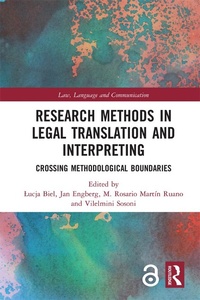
Research Methods in Legal Translation and Interpreting
Crossing Methodological Boundaries
1st Edition
Published on 9. May 2019
232 pages
978-1-351-03120-2 (ISBN)
Description

The field of Legal translation and interpreting has strongly expanded over recent years. As it has developed into an independent branch of Translation Studies, this book advocates for a substantiated discussion of methods and methodology, as well as knowledge about the variety of approaches actually applied in the field. It is argued that, complex and multifaceted as it is, legal translation calls for research that might cross boundaries across research approaches and disciplines in order to shed light on the many facets of this social practice. The volume addresses the challenge of methodological consolidation, triangulation and refinement. The work presents examples of the variety of theoretical approaches which have been developed in the discipline and of the methodological sophistication which is currently being called for. In this regard, by combining different perspectives, they expand our understanding of the roles played by legal translators and interpreters, who emerge as linguistic and intercultural mediators dealing with a rich variety of legal texts; as knowledge communicators and as builders of specialised knowledge; as social agents performing a socially-situated activity; as decision-makers and agents subject to and redefining power relations, and as political actors shaping legal cultures and negotiating cultural identities, as well as their own professional identity.
Chapter 2 of this book is freely available as a downloadable Open Access PDF at http://www.taylorfrancis.com under a Creative Commons Attribution-Non Commercial-No Derivatives (CC-BY-NC-ND) 4.0 license.
Chapter 2 of this book is freely available as a downloadable Open Access PDF at http://www.taylorfrancis.com under a Creative Commons Attribution-Non Commercial-No Derivatives (CC-BY-NC-ND) 4.0 license.
More details
Series
Edition
1. Auflage
Language
English
Place of publication
London
United Kingdom
Publishing group
Taylor & Francis Ltd
Target group
College/higher education
Product notice
Reflowable
Illustrations
39 Tables, black and white; 10 Line drawings, black and white; 10 Halftones, black and white
File size
5,37 MB
ISBN-13
978-1-351-03120-2 (9781351031202)
Copyright in bibliographic data and cover images is held by Nielsen Book Services Limited or by the publishers or by their respective licensors: all rights reserved.
Schweitzer Classification
Other editions
Additional editions
Lucja Biel | Jan Engberg | Rosario Martin Ruano
Research Methods in Legal Translation and Interpreting
Crossing Methodological Boundaries
Book
12/2020
1st Edition
Routledge
€68.30
Shipment within 15-20 days
Lucja Biel | Jan Engberg | Rosario Martin Ruano
Research Methods in Legal Translation and Interpreting
Crossing Methodological Boundaries
Book
05/2019
1st Edition
Routledge
€206.30
Shipment within 10-20 days
Persons
Lucja Biel is Associate Professor and Head of Corpus Research Centre at the Institute of Applied Linguistics, University of Warsaw, Poland, where she teaches and researches legal translation. She is Secretary General of the European Society of Translation Studies (EST) and deputy editor of the Journal of Specialised Translation . She has participated in a number of internationally and nationally funded research projects on legal and institutional translation. Her research interests focus on legal/EU translation, legal terminology, translator training
and corpus linguistics. She has published over 50 papers in this area, e.g. in The Translator, Meta. The Translators' Journal, The Interpreter and Translator Trainer, Fachsprache, LANS-TTS and a book Lost in the Eurofog. The Textual Fit of Translated Law (Peter Lang, 2014).
Jan Engberg, PhD is Professor of Knowledge Communication at the School of
Communication and Culture, University of Aarhus, Denmark. He teaches legal
as well as fi nancial translation at BA and MA level, as well as other branches of
text oriented foreign language skills. His main areas of research interest are the
study of translation and mediation of knowledge in the fi eld of law, texts and
genres in the academic fi eld, cognitive aspects of domain-specifi c discourse and
the relations between specialised knowledge and text formulation as well as basic
aspects of communication in domain-specifi c settings. His research focus is upon
communication and translation in the fi eld of law. He is editor-in-chief of the
international journal Fachsprache and member of the editorial or advisory boards
of a substantial number of international scholarly journals.
M. Rosario Martin Ruano is Associate Professor at the University of
Salamanca, Spain, where she is a member of the Research Group on Translation,
Ideology and Culture and where she currently leads the research project
entitled VIOSIMTRAD ('Symbolic Violence and Translation: Challenges
in the Representation of Fragmented Identities within the Global Society',
FFI2015-66516-P; MINECO/FEDER, UE). Her research interests include
legal and institutional translation, translation and ideology, and gender and postcolonial
approaches to translation. She has published widely on these issues,
including a number of books and co-edited collective volumes, as well as more
than 50 chapters and articles in journals such as The Interpreter and Translator
Trainer (ITT), TTR, JosTRans, Linguistica Antverpiensia , etc. and in volumes
by Routledge, Multilingual Matters, John Benjamins, St Jerome, etc. She is a
member of the editorial board of Perspectives, Estudios de Traduccion, Clina and a
reviewer for a number of specialised journals ( Target, Meta, JosTRans, Language
and Intercultural Communication, MonTI , etc.). She has been a practising
translator since 1997.
Vilelmini Sosoni is Assistant Professor at the Ionian University, Greece. She
teaches legal and economic translation as well as other branches of specialised
translation. She has participated in a number of internationally and nationally
funded research projects on legal translation and translation technology. Her
research interests lie in the areas of legal and institutional translation, corpus
linguistics, intercultural communication and translation technology. She has
published widely on these topics, including articles in journals such as Perspectives,
Jostrans, mTm, Journal of Language and Law , etc. and in volumes by Routledge,
John Benjamins, Springer, etc. She is a member of the editorial board of Jostrans
and Intercultural and Intersemiotic Translation . She has been a practising
translator since 1997.
and corpus linguistics. She has published over 50 papers in this area, e.g. in The Translator, Meta. The Translators' Journal, The Interpreter and Translator Trainer, Fachsprache, LANS-TTS and a book Lost in the Eurofog. The Textual Fit of Translated Law (Peter Lang, 2014).
Jan Engberg, PhD is Professor of Knowledge Communication at the School of
Communication and Culture, University of Aarhus, Denmark. He teaches legal
as well as fi nancial translation at BA and MA level, as well as other branches of
text oriented foreign language skills. His main areas of research interest are the
study of translation and mediation of knowledge in the fi eld of law, texts and
genres in the academic fi eld, cognitive aspects of domain-specifi c discourse and
the relations between specialised knowledge and text formulation as well as basic
aspects of communication in domain-specifi c settings. His research focus is upon
communication and translation in the fi eld of law. He is editor-in-chief of the
international journal Fachsprache and member of the editorial or advisory boards
of a substantial number of international scholarly journals.
M. Rosario Martin Ruano is Associate Professor at the University of
Salamanca, Spain, where she is a member of the Research Group on Translation,
Ideology and Culture and where she currently leads the research project
entitled VIOSIMTRAD ('Symbolic Violence and Translation: Challenges
in the Representation of Fragmented Identities within the Global Society',
FFI2015-66516-P; MINECO/FEDER, UE). Her research interests include
legal and institutional translation, translation and ideology, and gender and postcolonial
approaches to translation. She has published widely on these issues,
including a number of books and co-edited collective volumes, as well as more
than 50 chapters and articles in journals such as The Interpreter and Translator
Trainer (ITT), TTR, JosTRans, Linguistica Antverpiensia , etc. and in volumes
by Routledge, Multilingual Matters, John Benjamins, St Jerome, etc. She is a
member of the editorial board of Perspectives, Estudios de Traduccion, Clina and a
reviewer for a number of specialised journals ( Target, Meta, JosTRans, Language
and Intercultural Communication, MonTI , etc.). She has been a practising
translator since 1997.
Vilelmini Sosoni is Assistant Professor at the Ionian University, Greece. She
teaches legal and economic translation as well as other branches of specialised
translation. She has participated in a number of internationally and nationally
funded research projects on legal translation and translation technology. Her
research interests lie in the areas of legal and institutional translation, corpus
linguistics, intercultural communication and translation technology. She has
published widely on these topics, including articles in journals such as Perspectives,
Jostrans, mTm, Journal of Language and Law , etc. and in volumes by Routledge,
John Benjamins, Springer, etc. She is a member of the editorial board of Jostrans
and Intercultural and Intersemiotic Translation . She has been a practising
translator since 1997.
Content
Introduction to Research Methods in Legal Translation and Interpreting: Crossing Methodological Boundaries 1. Corpus methods in Legal Translation Studies 2. Implications of text categorisation for corpus-based legal translation research: the case of international institutional settings 3. Inverse legal translation: a corpus-driven study of multi-word units related to the structure of translated statutory provisions 4. Language of treaties - language of power relations? 5. Explicitation in Legal Translation: A Feature of Expertise? A Study of Spanish-Danish Translation of Judgments 6. Critical Discourse Analysis and the investigation of the interpreter's own positioning in a court hearing. A case study from an Austrian criminal court 7. How to apply comparative law to legal translation. A new 3-step juritraductological translating approach to legal texts 8. A matter of justice: integrating comparative law methods into the decision-making process in legal translation 9. A mixed-methods approach in Corpus-Based Interpreting Studies: quality of interpreting in criminal proceedings in Spain 10. An online survey as a means to research the 'outstitutional' legal translation market 11. Interviewing legal interpreters and translators: framing status perceptions and interactional and structural power
