

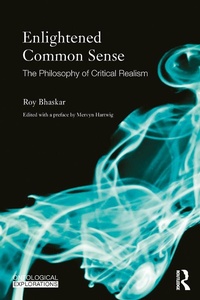
Enlightened Common Sense
The Philosophy of Critical Realism
Published on 1. July 2016
244 pages
978-1-134-86802-5 (ISBN)
Description

Since the 1970s, critical realism has grown to address a range of subjects, including economics, philosophy, science, and religion. It has become a complex and mature philosophy.
Enlightened Common Sense: The Philosophy of Critical Realism looks back over this development in one concise and accessible volume. The late Roy Bhaskar was critical realism's philosophical originator and chief exponent. He draws on a lifetime's experience to give a definitive, systematic account of this increasingly influential, international and multidisciplinary approach.
Critical realism's key element has always been its vindication and deepening of our understanding of ontology. Arguing that realist ontology is inexorable in knowledge and action, Bhaskar sees this as the key to a new enlightened common sense. From the definition of critical realism and its applicability in the social sciences, to explanation of dialectical critical realism and the philosophy of metaReality, this is the essential introduction for students of critical realism.
Enlightened Common Sense: The Philosophy of Critical Realism looks back over this development in one concise and accessible volume. The late Roy Bhaskar was critical realism's philosophical originator and chief exponent. He draws on a lifetime's experience to give a definitive, systematic account of this increasingly influential, international and multidisciplinary approach.
Critical realism's key element has always been its vindication and deepening of our understanding of ontology. Arguing that realist ontology is inexorable in knowledge and action, Bhaskar sees this as the key to a new enlightened common sense. From the definition of critical realism and its applicability in the social sciences, to explanation of dialectical critical realism and the philosophy of metaReality, this is the essential introduction for students of critical realism.
Reviews / Votes
Roy Bhaskar's too-brief life was a gift to humanity. His life's work gave us a solid ontological grounding for all those intuitions that most of us feel we should be able to justify, but are constantly being told by the reigning intellectual authorities we can't: that the world, and other people, are real, that freedom is inherent in the nature of the cosmos, that genuine human flourishing can never be at the expense of others. He lived to provide the intellectual heavy artillery for simple common decency and good sense. Much of his work was written in exceedingly difficult language. This book however, makes it accessible to those who have the most to gain from it: anyone trying to make the world a better place.David Graeber, Anthropologist; sometime revolutionary; Professor at London School of Economics, UK.
Roy Bhaskar writes: 'If there is a single big idea in critical realism it is the idea of ontology.' One big idea, perhaps, but Bhaskar developed it in three very different and equally innovative ways. From early depth ontology, through rethinking dialectical negativity, to the metaphysics of metaReality, Bhaskar pushed his thought - and himself. Guided always by the lodestar of emancipation, this final work demonstrates the unity in the three phases of his thought. Always willing to go against the mainstream, it is a fitting final tribute to a great philosopher.
Alan Norrie, Professor, University of Warwick, UK.
More details
Series
Language
English
Place of publication
London
United Kingdom
Publishing group
Taylor & Francis Ltd
Target group
College/higher education
Product notice
Reflowable
Illustrations
20 s/w Abbildungen, 10 s/w Tabellen, 20 s/w Zeichnungen
10 Tables, black and white; 20 Line drawings, black and white; 20 Illustrations, black and white
File size
1,16 MB
ISBN-13
978-1-134-86802-5 (9781134868025)
Copyright in bibliographic data and cover images is held by Nielsen Book Services Limited or by the publishers or by their respective licensors: all rights reserved.
Schweitzer Classification
Other editions
Additional editions
Book
06/2016
1st Edition
Routledge
€230.27
Shipment within 15-20 days
Book
06/2016
1st Edition
Routledge
€63.30
Shipment within 15-20 days
Persons
Roy Bhaskar (1944-2014) was the originator of the philosophy of critical realism and the author of many acclaimed and influential works, including A Realist Theory of Science, The Possibility of Naturalism, Scientific Realism and Human Emancipation, Dialectic: The Pulse of Freedom, Plato Etc., Reflections on MetaReality, From Science to Emancipation and (with Mervyn Hartwig) The Formation of Critical Realism. He was an author of Critical Realism: Essential Readings, Interdisciplinarity and Climate Change, Ecophilosophy in a World of Crisis and was the founding chair of the Centre for Critical Realism. He was also a World Scholar and Director of the International Centre of Critical Realism at the University of London Institute of Education.
Mervyn Hartwig is the founding editor of the Journal of Critical Realism and editor and principal author of the Dictionary of Critical Realism.
Mervyn Hartwig is the founding editor of the Journal of Critical Realism and editor and principal author of the Dictionary of Critical Realism.
Content
1. On the Presuppositions and Origins of the Philosophy of Critical Realism
2. Transcendental Realism and the Philosophy of Science
3. Critical Naturalism and the Philosophy of the Social/Human Sciences
4. Applied Critical Realism and Interdisciplinarity
5. Ethics and Language: Explanatory Critique and Critical Discourse Analysis
6. The Further Development of Critical Realism I: Dialectical Critical Realism
7. The Further Development of Critical Realism II: The Philosophy of metaReality
8. The Critique of the Philosophical Discourse of Modernity and the Western Philosophical Tradition
9. Critical Realism and the Ontology of the Good Society
2. Transcendental Realism and the Philosophy of Science
3. Critical Naturalism and the Philosophy of the Social/Human Sciences
4. Applied Critical Realism and Interdisciplinarity
5. Ethics and Language: Explanatory Critique and Critical Discourse Analysis
6. The Further Development of Critical Realism I: Dialectical Critical Realism
7. The Further Development of Critical Realism II: The Philosophy of metaReality
8. The Critique of the Philosophical Discourse of Modernity and the Western Philosophical Tradition
9. Critical Realism and the Ontology of the Good Society
