

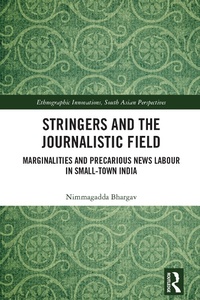
Stringers and the Journalistic Field
Marginalities and Precarious News Labour in Small-Town India
1st Edition
Published on 28. February 2023
210 pages
978-1-000-84035-3 (ISBN)
Description

This book is one of the first ethnographic works on small-town stringers or informal news workers in Indian journalism. It explores existing practices and cultures in the field of local journalism and the roles and spaces stringers occupy.
The book outlines the caste, gender, class and region-based biases in the production of Indian-language journalism with a specific focus on stringers working in Telugu dailies in small towns or 'mofussil' areas of Andhra Pradesh and Telangana, states in south India. Further, it captures their daily work and processes of news production, and the precarious lives they often lead while working in small towns or mofussils. The author, by using Bourdieu's field theory, introduces the journalistic practices of stringers working on the margins and how they negotiate the complex hierarchies that exist within the journalistic field and outside it.
This book will be of great interest to scholars and researchers of ethnography, media sociology, journalism and media studies, labour studies and Area studies, especially South Asian studies.
The book outlines the caste, gender, class and region-based biases in the production of Indian-language journalism with a specific focus on stringers working in Telugu dailies in small towns or 'mofussil' areas of Andhra Pradesh and Telangana, states in south India. Further, it captures their daily work and processes of news production, and the precarious lives they often lead while working in small towns or mofussils. The author, by using Bourdieu's field theory, introduces the journalistic practices of stringers working on the margins and how they negotiate the complex hierarchies that exist within the journalistic field and outside it.
This book will be of great interest to scholars and researchers of ethnography, media sociology, journalism and media studies, labour studies and Area studies, especially South Asian studies.
Reviews / Votes
'Steering clear of well-funded newsrooms and glitzy TV studios in metropoles, this book provides a deeply researched and beautifully written account of journalism in mofussil India. Through carefully observed and richly detailed accounts of stringers, Nimmagadda Bhargav charts a new path for regionally grounded studies of news production.'-Aswin Punathambekar, Annenberg School for Communication, University of Pennsylvania
'Increasingly precarious forms of employment for cultural workers such as journalists and its implications not only for the lives of these workers but more broadly for society is becoming an important issue for scholars writing about the Global North. Precarity for journalists in the Global South has been a fact of life for longer and this ethnographic study illuminating the lives of stringers working in small towns in southern India should be essential reading for those interested in understanding the nature and consequences of precarity whether at a local, national or global level. Based on careful and empathetic research of much maligned journalists and grounded in an impressive grasp of sociological and communicaton theory, this is a major contribution to the field of journalism studies in its quest to become global in orientation.'
-John Downey, Professor of Comparative Media Analysis, Centre for Research in Communication and Culture, School of Social Sciences and Humanities, Loughborough University and President, European Communication Research and Education Association
'In this excellent exploration of newspaper stringers in small towns of Telangana and Andhra Pradesh regions in India, Bhargav employs a grounded analytic framework by drawing theoretical and conceptual insights from Pierre Bourdieu's field theory and 'Ambedkarite social philosophy' to examine 'marginality, social organization, division of labour, precarity, and informality' in Indian language journalism culture in India. The topic of stringers in local Indian language newspapers remains an unexplored in India, and Bhargav should be commended for undertaking this study that offers fresh new theoretical insights into the local journalistic field and the world of the stringers.'
-Sanjay Asthana, Professor, School of Journalism and Strategic Media, Middle Tennessee State University 'Steering clear of well-funded newsrooms and glitzy TV studios in metropoles, this book provides a deeply researched and beautifully written account of journalism in mofussil India. Through carefully observed and richly detailed accounts of stringers, Nimmagadda Bhargav charts a new path for regionally grounded studies of news production'.
-Aswin Punathambekar, Professor of Communication, University of Pennsylvania's Annenberg School for Communication, and Director, Center for Advanced Research in Global Communication
'Increasingly precarious forms of employment for cultural workers such as journalists and its implications not only for the lives of these workers but more broadly for society is becoming an important issue for scholars writing about the Global North. Precarity for journalists in the Global South has been a fact of life for longer and this ethnographic study illuminating the lives of stringers working in small towns in southern India should be essential reading for those interested in understanding the nature and consequences of precarity whether at a local, national or global level. Based on careful and empathetic research of much maligned journalists and grounded in an impressive grasp of sociological and communicaton theory, this is a major contribution to the field of journalism studies in its quest to become global in orientation'.
-John Downey, Professor of Comparative Media Analysis, Centre for Research in Communication and Culture, School of Social Sciences and Humanities, Loughborough University and President, European Communication Research and Education Association
'In this excellent exploration of newspaper stringers in small towns of Telangana and Andhra Pradesh regions in India, Bhargav employs a grounded analytic framework by drawing theoretical and conceptual insights from Pierre Bourdieu's field theory and "Ambedkarite social philosophy" to examine "marginality, social organization, division of labour, precarity, and informality" in Indian language journalism culture in India. The topic of stringers in local Indian language newspapers remains unexplored in India, and Bhargav should be commended for undertaking this study that offers fresh new theoretical insights into the local journalistic field and the world of the stringers'.
-Sanjay Asthana, Professor, School of Journalism and Strategic Media, Middle Tennessee State University
More details
Series
Edition
1. Auflage
Language
English
Place of publication
London
United Kingdom
Publishing group
Taylor & Francis Ltd
Target group
College/higher education
Professional and scholarly
Product notice
Reflowable
Illustrations
29 Tables, black and white; 5 Halftones, black and white; 5 Illustrations, black and white
ISBN-13
978-1-000-84035-3 (9781000840353)
Copyright in bibliographic data and cover images is held by Nielsen Book Services Limited or by the publishers or by their respective licensors: all rights reserved.
Schweitzer Classification
Other editions
Additional editions
Nimmagadda Bhargav
Stringers and the Journalistic Field
Marginalities and Precarious News Labour in Small-Town India
Book
10/2024
1st Edition
Routledge India
€63.00
Shipment within 10-20 days
Nimmagadda Bhargav
Stringers and the Journalistic Field
Marginalities and Precarious News Labour in Small-Town India
Book
02/2023
1st Edition
Routledge India
€185.20
Shipment within 10-20 days
Person
Nimmagadda Bhargav is a faculty member in the communications at the Indian Institute of Management, Indore, India. He holds a Ph.D. from the University of Hyderabad's Department of Communication and was a postdoctoral research assistant on an Arts and Humanities Research Council and UKRI-funded project led by Loughborough University.
Content
Acknowledgements
A note on translation, transliteration, language, and style
Introduction: Studying small-town stringers
Locating the stringer: Social and political scaffoldings
Masculinity and missing women in the journalistic field
Dispositions and recruitment patterns of agents
Roles and/as hierarchies
The logic of local journalistic practice
Informality, precarity, and news labour
Conclusion: Newswork in the time of pandemic
Index
A note on translation, transliteration, language, and style
Introduction: Studying small-town stringers
Locating the stringer: Social and political scaffoldings
Masculinity and missing women in the journalistic field
Dispositions and recruitment patterns of agents
Roles and/as hierarchies
The logic of local journalistic practice
Informality, precarity, and news labour
Conclusion: Newswork in the time of pandemic
Index
