

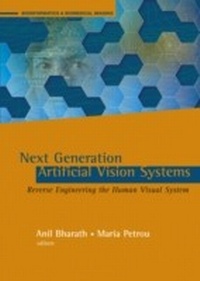
Next Generation Artificial Vision Systems
Reverse Engineering the Human Visual System
1st Edition
Published on 1. January 2008
400 pages
978-1-59693-225-8 (ISBN)
Description

This milestone interdisciplinary work brings you to the cutting edge of emerging technologies inspired by human sight, ranging from semiconductor photoreceptors based on novel organic polymers and retinomorphic processing circuitry to low-powered devices that replicate spatial and temporal processing in the brain. Moreover, it is the first work of its kind that integrates the full range of physiological, engineering, and mathematical issues and advances together in a single source. Emphasizing both the devices and the software simulation point of view, this definitive book provides state-of-the-art retinal cell and primary visual cortex (V1) models that reflect our rapidly advancing understanding of human visual signal communication networks. It explores design and fabrication considerations behind real-world implementations, including organic light sensors that mimic human rods and cones, analog circuitry to perform retinal processing, algorithm design for motion detection and tracking, wavelet-based visual detection systems, and interest point detectors. You get the latest techniques for resolution and motion detection enhancement, including both the design and applications of biologically motivated spatio-temporal filtering of visual data, as well as a statistical framework for studying object detection in a phase-invariant manner and tools for describing local object invariants. Moreover, this trail-blazing work includes insight into the challenges that lie ahead in this cutting-edge field.
More details
Other editions
Additional editions
Anil Bharath | Maria Petrou
Next Generation Artificial Vision Systems: Reverse Engineering the Human Visual System
Next Generation Artificial Vision Systems
Book
08/2008
Artech House Publishers
€154.50
Shipment within 10-20 days
Content
- Next Generation Artificial Vision Systems
- Contents
- Preface
- C H A P T E R 1 The Human Visual System: An Engineering Challenge
- 1.1 Introduction
- 1.2 Overview of the Human Visual System
- 1.2.1 The Human Eye
- 1.2.2 Lateral Geniculate Nucleus (LGN)
- 1.2.3 The V1 Region of the Visual Cortex
- 1.2.4 Motion Analysis and V5
- 1.3 Conclusions
- References
- P A R T I The Physiology and Psychology of Vision
- C H A P T E R 2 Retinal Physiology and Neuronal Modeling
- 2.1 Introduction
- 2.2 Retinal Anatomy
- 2.3 Retinal Physiology
- 2.4 Mathematical Modeling----Single Cells of the Retina
- 2.5 Mathematical Modeling----The Retina and Its Functions
- 2.6 A Flexible, Dynamical Model of Retinal Function
- 2.6.1 Foveal Structure
- 2.6.2 Differential Equations
- 2.6.3 Color Mechanisms
- 2.6.4 Foveal Image Representation
- 2.6.5 Modeling Retinal Motion
- 2.7 Numerical Simulation Examples
- 2.7.1 Parameters and Visual Stimuli
- 2.7.2 Temporal Characteristics
- 2.7.3 Spatial Characteristics
- 2.7.4 Color Characteristics
- 2.8 Conclusions
- References
- C H A P T E R 3 A Review of V1
- 3.1 Introduction
- 3.2 Two Aspects of Organization and Functions in V1
- 3.2.1 Single-Neuron Responses
- 3.2.2 Organization of Individual Cells in V1
- 3.3 Computational Understanding of the Feed Forward V1
- 3.3.1 V1 Cell Interactions and Global Computation
- 3.3.2 Theory and Model of Intracortical Interactions in V1
- 3.4 Conclusions
- References
- C H A P T E R 4 Testing the Hypothesis That V1 Creates a Bottom-Up Saliency Map
- 4.1 Introduction
- 4.2 Materials and Methods
- 4.3 Results
- 4.3.1 Interference by Task-Irrelevant Features
- 4.3.2 The Color-Orientation Asymmetry in Interference
- 4.3.3 Advantage for Color-Orientation Double Feature but Not Orientation-Orientation Double Feature
- 4.3.4 Emergent Grouping of Orientation Features by Spatial Configurations
- 4.4 Discussion
- 4.5 Conclusions
- Acknowledgments
- References
- P A R T II The Mathematics of Vision
- C H A P T E R 5 V1 Wavelet Models and Visual Inference
- 5.1 Introduction
- 5.1.1 Wavelets
- 5.1.2 Wavelets in Image Analysis and Vision
- 5.1.3 Wavelet Choices
- 5.1.4 Linear vs Nonlinear Mappings
- 5.2 A Polar Separable Complex Wavelet Design
- 5.2.1 Design Overview
- 5.2.2 Filter Designs: Radial Frequency
- 5.2.3 Angular Frequency Response
- 5.2.4 Filter Kernels
- 5.3 The Use of V1-Like Wavelet Models in Computer Vision
- 5.3.1 Overview
- 5.3.2 Generating Orientation Maps
- 5.3.3 Corner Likelihood Response
- 5.3.4 Phase Estimation
- 5.4 Inference from V1-Like Representations
- 5.4.1 Vector Image Fields
- 5.4.2 Formulation of Detection
- 5.4.3 Sampling of (B,X)
- 5.4.4 The Notion of ''Expected'' Vector Fields
- 5.4.5 An Analytic Example: Uniform Intensity Circle
- 5.4.6 Vector Model Plausibility and Extension
- 5.4.7 Vector Fields: A Variable Contrast Model
- 5.4.8 Plausibility by Demonstration
- 5.4.9 Plausibility from Real Image Data
- 5.4.10 Divisive Normalization
- 5.5 Evaluating Shape Detection Algorithms
- 5.5.1 Circle-and-Square Discrimination Test
- 5.6 Grouping Phase-Invariant Feature Maps
- 5.6.1 Keypoint Detection Using DTCWT
- 5.7 Summary and Conclusions
- References
- C H A P T E R 6 Beyond the Representation of Images by Rectangular Grids
- 6.1 Introduction
- 6.2 Linear Image Processing
- 6.2.1 Interpolation of Irregularly Sampled Data
- 6.2.2 DFT from Irregularly Sampled Data
- 6.3 Nonlinear Image Processing
- 6.3.1 V1-Inspired Edge Detection
- 6.3.2 Beyond the Conventional Data Representations and Object Descriptors
- 6.4 Reverse Engineering Some Aspect of the Human Visual System
- 6.5 Conclusions
- References
- C H A P T E R 7 Reverse Engineering of Human Vision: Hyperacuity and Super-Resolution
- 7.1 Introduction
- 7.2 Hyperacuity and Super-Resolution
- 7.3 Super-Resolution Image Reconstruction Methods
- 7.3.1 Constrained Least Squares Approach
- 7.3.2 Projection onto Convex Sets
- 7.3.3 Maximum A Posteriori Formulation
- 7.3.4 Markov Random Field Prior
- 7.3.5 Comparison of the Super-Resolution Methods
- 7.3.6 Image Registration
- 7.4 Applications of Super-Resolution
- 7.4.1 Application in Minimally Invasive Surgery
- 7.5 Conclusions and Further Challenges
- References
- C H A P T E R 8 Eye Tracking and Depth from Vergence
- 8.1 Introduction
- 8.2 Eye-Tracking Techniques
- 8.3 Applications of Eye Tracking
- 8.3.1 Psychology/Psychiatry and Cognitive Sciences
- 8.3.2 Behavior Analysis
- 8.3.3 Medicine
- 8.3.4 Human--Computer Interaction
- 8.4 Gaze-Contingent Control for Robotic Surgery
- 8.4.1 Ocular Vergence for Depth Recovery
- 8.4.2 Binocular Eye-Tracking Calibration
- 8.4.3 Depth Recovery and Motion Stabilization
- 8.5 Discussion and Conclusions
- References
- C H A P T E R 9 Motion Detection and Tracking by Mimicking Neurological Dorsal/ Ventral Pathways
- 9.1 Introduction
- 9.2 Motion Processing in the Human Visual System
- 9.3 Motion Detection
- 9.3.1 Temporal Edge Detection
- 9.3.2 Wavelet Decomposition
- 9.3.3 The Spatiotemporal Haar Wavelet
- 9.3.4 Computational Cost
- 9.4 Dual-Channel Tracking Paradigm
- 9.4.1 Appearance Model
- 9.4.2 Early Approaches to Prediction
- 9.4.3 Tracking by Blob Sorting
- 9.5 Behavior Recognition and Understanding
- 9.6 A Theory of Tracking
- 9.7 Concluding Remarks
- Acknowledgments
- References
- P A R T III Hardware Technologies for Vision
- C H A P T E R 10 Organic and Inorganic Semiconductor Photoreceptors Mimicking the Human Rods and Cones
- 10.1 Introduction
- 10.2 Phototransduction in the Human Eye
- 10.2.1 The Physiology of the Eye
- 10.2.2 Phototransduction Cascade
- 10.2.3 Light Adaptation of Photoreceptors: Weber-Fechner's Law
- 10.3 Phototransduction in Silicon
- 10.3.1 CCD Photodetector Arrays
- 10.3.2 CMOS Photodetector Arrays
- 10.3.3 Color Filtering
- 10.3.4 Scaling Considerations
- 10.4 Phototransduction with Organic Semiconductor Devices
- 10.4.1 Principles of Organic Semiconductors
- 10.4.2 Organic Photodetection
- 10.4.3 Organic Photodiode Structure
- 10.4.4 Organic Photodiode Electronic Characteristics
- 10.4.5 Fabrication
- 10.5 Conclusions
- References
- C H A P T E R 11 Analog Retinomorphic Circuitry to Perform Retinal and Retinal-Inspired Processing
- 11.1 Introduction
- 11.2 Principles of Analog Processing
- 11.2.1 The Metal Oxide Semiconductor Field Effect Transistor
- 11.2.2 Analog vs Digital Methodologies
- 11.3 Photo Electric Transduction
- 11.3.1 Logarithmic Sensors
- 11.3.2 Feedback Buffers
- 11.3.3 Integration-Based Photodetection Circuits
- 11.3.4 Photocurrent Current-Mode Readout
- 11.4 Retinimorphic Circuit Processing
- 11.4.1 Voltage Mode Resistive Networks
- 11.4.2 Current Mode Approaches to Receptive Field Convolution
- 11.4.3 Reconfigurable Fields
- 11.4.4 Intelligent Ganglion Cells
- 11.5 Address Event Representation
- 11.5.1 The Arbitration Tree
- 11.5.2 Collisions
- 11.5.3 Sparse Coding
- 11.5.4 Collision Reduction
- 11.6 Adaptive Foveation
- 11.6.1 System Algorithm
- 11.6.2 Circuit Implementation
- 11.6.3 The Future
- 11.7 Conclusions
- References
- C H A P T E R 12 Analog V1 Platforms
- 12.1 Analog Processing: Obsolete?
- 12.2 The Cellular Neural Network
- 12.3 The Linear CNN
- 12.4 CNNs and Mixed Domain Spatiotemporal Transfer Functions
- 12.5 Networks with Temporal Derivative Diffusion
- 12.5.1 Stability
- 12.6 A Signal Flow Graph-Based Implementation
- 12.6.1 Continuous Time Signal Flow Graphs
- 12.6.2 On SFG Relations with the MLCNN
- 12.7 Examples
- 12.7.1 A Spatiotemporal Cone Filter
- 12.7.2 Visual Cortical Receptive Field Modelling
- 12.8 Modeling of Complex Cell Receptive Fields
- 12.9 Summary and Conclusions
- Acknowledgments
- References
- C H A P T E R 13 From Algorithms to Hardware Implementation
- 13.1 Introduction
- 13.2 Field Programmable Gate Arrays
- 13.2.1 Circuit Design
- 13.2.2 Design Process
- 13.3 Mapping Two-Dimensional Filters onto FPGAs
- 13.4 Implementation of Complex Wavelet Pyramid on FPGA
- 13.4.1 FPGA Design
- 13.4.2 Host Control
- 13.4.3 Implementation Analysis
- 13.4.4 Performance Analysis
- 13.4.5 Conclusions
- 13.5 Hardware Implementation of the Trace Transform
- 13.5.1 Introduction to the Trace Transform
- 13.5.2 Computational Complexity
- 13.5.3 Full Trace Transform System
- 13.5.4 Flexible Functionals for Exploration
- 13.5.5 Functional Coverage
- 13.5.6 Performance and Area Results
- 13.5.7 Conclusions
- 13.6 Summary
- References
- C H A P T E R 14 Real-Time Spatiotemporal Saliency
- 14.1 Introduction
- 14.2 The Framework Overview
- 14.3 Realization of the Framework
- 14.3.1 Two-Dimensional Feature Detection
- 14.3.2 Feature Tracker
- 14.3.3 Prediction
- 14.3.4 Distribution Distance
- 14.3.5 Suppression
- 14.4 Performance Evaluation
- 14.4.1 Adaptive Saliency Responses
- 14.4.2 Complex Scene Saliency Analysis
- 14.5 Conclusions
- References
- Acronyms and Abbreviations
- About the Editors
- List of Contributors
- Index
