

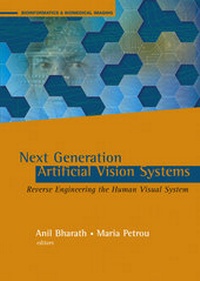
Next Generation Artificial Vision Systems: Reverse Engineering the Human Visual System
Next Generation Artificial Vision Systems
Published in August 2008
Book
Hardback
400 pages
978-1-59693-224-1 (ISBN)
Description
Artificial sight for the blind? We're not there yet, but this interdisciplinary guide explores the dramatic breakthroughs that now bring us to the brink. It is the first work that integrates the full range of physiological, engineering, and mathematical aspects driving the new technologies inspired by human sight, and explains the latest advances in everything from organic light sensors to devices that replicate spatial and temporal processing in the brain. Emphasizing both the devices and the software simulation point of view, the book provides retinal cell and primary visual cortex (V1) models that reflect our advancing understanding of visual signal communication networks. It explores design and fabrication considerations behind real-world implementations like semiconductor photosensors that mimic human rods and cones, circuitry that perform retinal processing, and wavelet-based visual detection systems. Engineers and researchers get the latest resolution and motion detection enhancement techniques, together with analytical tools needed to tackle the challenges ahead.
More details
Edition
Unabridged edition
Language
English
Place of publication
Norwood
United States
Target group
Professional and scholarly
Edition type
Unabridged edition
ISBN-13
978-1-59693-224-1 (9781596932241)
Copyright in bibliographic data and cover images is held by Nielsen Book Services Limited or by the publishers or by their respective licensors: all rights reserved.
Schweitzer Classification
Other editions
Additional editions
E-Book
01/2008
1st Edition
Artech House
€115.99
Available for download
Persons
Maria Petrou, Ph.D. is a professor of signal processing and the head of the Communications and Signal Processing Group at Imperial College in London. Anil Bharath, Ph.D. is reader in Image Analysis at Imperial College in London.
Content
Introduction.; Organic Semiconductor Photoreceptors to Mimic Human Rods and Cones.; Analog Retinomorphic Circuitry to Perform Retinal and Retinal Inspired Processing.; Retinal Cell Modeling.; Image Processing with Irregular Sampling Patterns.; V1 Modeling.; Analog Modeling of V1.; Wavelet Models for V1.; From Algorithm to Hardware Implementation.; Real-Time Saliency Maps.; Reverse Engineering of Human Vision: Hyperacuity and Super Resolution.; Motion Detection and Tracking by Mimicking Neurological Dorsal/Ventral Pathways.