

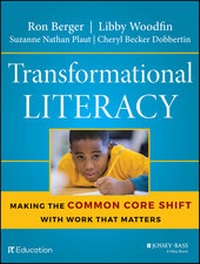
Transformational Literacy
Description

More details
Other editions
Additional editions
Persons
Content
Introduction: Embracing Challenge
At a number of Expeditionary Learning high schools across the United States, students begin their freshman year in an unusual way. They spend a week in the wilderness with their peers on an Outward Bound journey, climbing mountains together with heavy packs. They are overwhelmed, scared, sweaty, muddy, and sometimes miserable. But, with the help of their guides and teachers, they push themselves and each other, and every year they get their team to the summit and celebrate together. There is a clear message: school is not going to be easy—for anyone. We will be struggling through difficult terrain together for the next four years. But we will all make it, with perseverance and help from one another.
Back at school, the summit is no longer a rocky peak. It is college readiness and college acceptance for every student—much more daunting for many students than a physical mountain. Every year, they succeed in this realm as well. One hundred percent college acceptance for graduates is the norm in these schools. The students come from typical urban settings—they are mostly from low-income families and many will be the first in their families to attend college or, in many cases, to graduate from high school. Their achievement is remarkable.
Why are these students so successful? There is no simple answer, but one thing is clear: their success is built on embracing challenge, together. In the woods, the primary challenges are rough weather, daunting trails, and steep climbs in mud, rock, and bramble. In school, their primary challenge is academic. Reading and writing independently and proficiently is often the greatest challenge of all.
When students at these schools feel overwhelmed and discouraged by text that seems too dense, they can remind themselves that they have all been there before—in the wilderness. There is no way to get around it, just as there had been no way around getting through dense brush and up the mountain. They can complain, but it won’t help. They can try to hide from it, but there is no avoiding it. Just as in facing the challenges in the wilderness, no one can do it alone, so they learn to ask for help when they need it and draw on the different resources each person contributes to the group. Rather than seeing their daily academic struggles as a sign of weakness, they view them as a worthy challenge and come to see that with great effort and support they will build success. Just as they did on the trail, the students and teachers learn to celebrate their small successes, every day.
Overcoming the physical challenges of an Outward Bound trip is a metaphor for the academic challenges students overcome on their path to college.
At the other end of the K–12 spectrum, working with much younger students, principal Laurie Godwin and her staff at Tollgate Elementary School in Aurora, Colorado, see the transformational power of building strong literacy skills in their students in the same way. For Godwin, giving students the opportunity and tools to develop these skills is an equity issue:
We have to believe that students can be successful with academic challenges the same way they are with character and physical challenges. . . . We can’t wait until they are “ready,” because what happens is that students in poverty and students at risk never even get to attempt that kind of work. All students need the same access to academics that will prepare them for college and beyond.
THE OPPORTUNITY OF THE COMMON CORE STATE STANDARDS
Notwithstanding our political and philosophical differences, most Americans embrace a common goal for our students: college, career, and civic readiness. Preparing Americans for citizenship has always been at the core of the mission of public schooling in the United States. Thomas Jefferson wrote that public schools should “enable every American ‘to understand his duties to his neighbors and country’ and to scrutinize the actions of public officials ‘with diligence, candor and judgment’ ” (Wiener, 2014).
In contrast to civic readiness, the goal of college readiness for all students is a relatively new goal for our country. For most of our history, the goal of college readiness applied to a small elite group of students; all others were prepared for basic skills in life and work. Schools were designed to sort students and prepare them for their different roles. Although college may not be the path that every student takes, every student deserves to be prepared to make that choice and to be privileged with challenging academic preparation. The world of work, and even military service, has changed—strong literacy skills are prioritized in all sectors. A high score on the Armed Services Vocational Aptitude Battery can make the difference between a job filling vending machines on an aircraft carrier and a career as an aircraft electrician. Our new goal of universally preparing students for high academic standards is a wise investment in America’s future and the future of our world.
Preparing all students for success in college, careers, and civic life is no easy task. It will require that all students are privileged with more challenging and worthy tasks and texts. It will require that they build strong academic habits of scholarship that empower them to work independently, creatively, and collaboratively. It will require that teachers and students develop a new mindset about learning—one that emphasizes growth and effort over a notion of intelligence as “fixed.”
The Common Core State Standards provide us with a unique opportunity to reimagine what students can do. We believe the standards, and what they represent, will help all students rise to this challenge. For the first time in generations, schools across the United States are fundamentally reconsidering what they teach and how they teach. The standards themselves do not prescribe specific content or teaching practices, but they offer something critically important: the expected outcomes for students are more challenging than current standards in almost every state. They require much more high-level thinking—deep understanding, transfer, synthesis, critical analysis—than most schools currently expect of students. And they prioritize skills and dispositions that we believe are vital to citizenship in our democracy—skills to analyze, critique, communicate; to present arguments with evidence; to challenge ideas and understand and promote divergent perspectives; and build “classrooms and workplaces . . . in which people from widely divergent cultures, who represent diverse experiences and perspectives, must learn and work together” (National Governors Association Center for Best Practices, Council of Chief State School Officers, 2010).
Our interpretation of the standards may be more expansive than most. We believe that they represent an opportunity for students that is far deeper than simply math and literacy outcomes. We believe the standards invite us to build in our students critical skills for life—for career success and civic contribution. What is important is not just what the standards say, but how they are used. The standards can be used to build classrooms where students are active, reflective critical thinkers, not passive recipients of content. The standards can be used to build in students the dispositions and skills to do work that matters to them and their communities.
If we are going to prepare our students for the world that awaits them, we have no choice but to raise our expectations for academics and give students the tools they need to meet them. This does not mean that all fourth-grade students should understand trigonometry, but it does mean that, beyond adding fractions on a worksheet, students must understand how fractions work and be able to apply that understanding to new contexts and to real life. It does not mean that all students will feel at ease reading challenging text, but it does mean that all students should be given the opportunity and strategies to successfully tackle challenging text and learn from it so that they can build their knowledge of the world.
The Common Core instructional shifts are important for building stronger skills in literacy and math, and even more important, we believe, in compelling and supporting students to work together to tackle challenging material and solve difficult problems that will prepare them to contribute as active citizens who contribute to building a better world.
LEVERAGING THE SHIFTS
The authors of the Common Core State Standards describe three primary shifts in the focus of English language arts (ELA) and literacy instruction:
- Building knowledge through content-rich nonfiction
- Reading, writing, and speaking grounded in evidence from literary and informational text
- Regular practice with complex text and its academic language
They are called shifts because the standards intend to correct an imbalance in existing literacy instruction. In schools, the majority of reading instruction currently involves fictional text; in life, the majority of reading involves nonfiction. In schools, personal narratives and personal opinions comprise a great deal of writing assignments; in life, informative and argumentative writing, based in evidence, represents the majority of what is required. In all subjects in school, too many students are allowed to avoid challenging text, leaving them unprepared for the text complexity in...
