

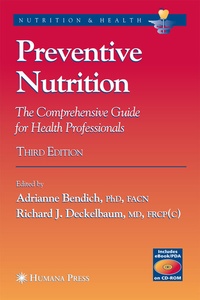
Preventive Nutrition
Description

Reviews / Votes
"Preventive Nutrition, 2nd edition has expanded to keep abreast of recent developments in nutritional sciences, is an extremely important and timely resource for physicians and other health professionals to seek valuable nutritional information. . .[It} encompasses a broad range of topics, from cancer and cardiovascular disease to infectious disease in children, and from reproductive and prenatal nutrition to global public health nutrition strategies. This book is notable not only for its comprehensiveness but also its up-to-date scientific information. . .Many cutting-edge developments in nutrition and health are reviewed in detail. . .This book gives careful consideration to practical dietary recommendations for all relevant nutritional factors. . .The integration of theory and practice will undoubtedly benefit physicians and other health professionals in achieving a deeper understanding of nutritional sciences and providing dietary counseling. Drs. Bendich and Deckelbaum are to be commended for Preventive Nutrition, 2nd edition, which remains the most comprehensive and up-to-date textbook in the field."-Foreword by Frank B. Hu, MD, PhD, Harvard School of Public Health, and JoAnn E. Manson, MD, DrPH, Harvard Medical School, Boston, MA
"This book is recommended for the health professional as a readable, concise resource for up-to-date information."-American Journal of Clinical Nutrition
"...an outstanding book...a very important contribution that will be of great value to many healthcare workers in the US and abroad." 4 Stars!
-Doody's Health Sciences Book Review Journal
"Scientists and clinicians in the field of nutrition and related fields must own this book to have a truly complete library...provides a valuable resource to assess the latest thinking about a nutrient and health-risk reduction."
-American Scientist
"...an excellent source for the health care practitioner who wants to more clearly understand all the pertinent issues in nutrition as they relate to the current health of his or her patients." -Journal of the American College of Nutrition
"...an excellent resource for public health professionals looking for accurate, up-to-date and comprehensive information on current research and recommendations on nutrition in the prevention of disease and disability."
-Canadian Journal of Public Health
"...highly recommended..." -Food and Nutrition Bulletin
Reviews of the first edition:
"...an excellent source for the healthcare practitioner who wants to more clearly understand all the pertinent issues in nutrition as they relate to the current health of his or her patients...strongly recommend[ed] to anyone in the field of primary care or nutrition...for...quick reference." -Journal of the American College of Nutrition
"...easy to read...It could provide invaluable information to those developing nutrition intervention strategies and would make an invaluable resource to seek and purchase for reference libraries." -Journal of Human Nutrition and Dietetics
"...this book is highly recommended, not only for its practical and objective coverage of many important nutritional and health issues, but also for the concise summaries and specific recommendations on them at the end of each chapter." -Food and Nutrition Bulletin
"This book should appeal to a broad audience of nutritionists, dietitians, healthcare providers, educators, and a substantial number of the lay public...The chapters generally have an abundance of tables and a modest number of figures that summarize the findings of a large number of scientific investigations....This is an outstanding book....It is a very important contribution that will be of great value to many healthcare workers in the U.S. and abroad. It serves as a milepost of important nutritional measures for the prevention of chronic disease."4 STARS-Doody's Health Science Book Review Journal
"...an excellent resource for public health professionals looking for accurate, up-to-date and comprehensive information on current research and recommendations on nutrition in the prevention of disease and disability." -Canadian Journal of Public Health
"...an important resource for physicians interested in nutrition...provides a scientific basis to evaluate the health claims of nutritional products [and] answer the nutritional inquiries of patients...nothing quite like it in scope and achievement for dealing with preventive nutrition." -Endocrinologist
"...should find a place on the bookshelves of all health profesionals who recognise the role of diet in health promotion; in particular, dieticians, nutritionists and medical practitioners who are regularly faced with questions on nutrition and disease prevention." -South African Medical Journal
"This book is successful in providing up-to-date, evidence-based, and thorough reviews of the nutrition topics that are covered...an educator, researcher, or practitioner who wants a very detailed summary of selected preventive nutrition topics will appreciate the in-depth nature of this book." - Doody's Health Sciences Book Review Journal
From the reviews of the third edition:
"This book, the 3rd in the series, provides a comprehensive and up-to-date review of the nutritional strategies available for the prevention of disease and the promotion of health through nutrition. The book, which is intended as a guide for health professionals, contains 37 chapters grouped into 9 sections . . The book is also accompanied by a value-added CD-ROM that contains an Adobe eBook version of the volume." (Food Science and Technology Abstracts, July, 2005)
More details
Other editions
New editions
Additional editions
Previous edition
Content
A steady decline in gastric cancer has been apparent in many countries for the past several decades. The declining rates were first noted in the United States as early as 1930 (105) and have persisted into this century (1). Survival rates have not appreciably changed (1,106); therefore, the decline in deaths cannot be attributed to better treatment and prolonged survival but, rather, to actual declines in incidence that are now well-documented (107).
This decline, which is believed to reflect changes in environmental factors, has been referred to as an “unplanned triumph,” because the shifts did not result from active medical or public health intervention and are believed to have resulted from large shifts in food processing and consumption (108) as well as a declining prevalence of H. pylori infection. It should be noted that the increase in esophageal adenocarcinoma that was documented in the previous section does include an increase in adenocarcinomas of the gastroesophageal junction and gastric cardia.
3.1. Histological Types
Adenocarcinomas account for more than 97% of gastric cancers, and studies of etiology are generally limited to this histological type (109). Building on an earlier observation that gastric carcinomas were often accompanied by features found in intestinal epithelium (110), Lauren (111) proposed a classification of adenocarcinomas into two subtypes: “intestinal” and “diffuse.”
Many, but not all, tumors can be classified into one of these subtypes, because some tumors contain characteristics of both types and others contain characteristics of neither. Diffuse carcinomas, sometimes referred to as “endemic,” tend to occur with similar frequency worldwide, whereas the distribution of intestinal, or “epidemic,” type of carcinomas tends to parallel the distribution of overall gastric cancer rates (i.e., this type is relatively more common in areas with high rates and lower where gastric cancer rates are low) (112).
3.2. Risk Factors
3.2.1. H. PYLORI
Spiral-shaped bacteria in contact with gastric mucosa were first reported by Pel about 100 yr ago (113) and were ignored for the following 90 yr. In 1984, Marshall and Warren (114) reported isolating these bacteria in cultures of biopsies taken from patients with gastritis and peptic ulcers who were undergoing endoscopy. By 1994, the International Agency for Research on Cancer, World Health Organization, had determined that infection with H. pylori is carcinogenic to humans, and declared it a Group I carcinogen based on the large body of research developed during the 11-yr period (115). H. pylori infection is one of the most prevalent infections worldwide, with a range of 20 to 40% in developed countries and a range as high as 70 to 90% in some developing countries (116,117)."
