

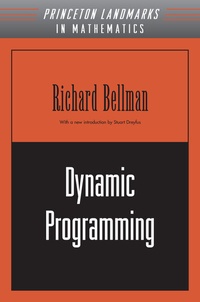
Dynamic Programming
1st Edition
Published on 25. August 2021
392 pages
978-1-4008-3538-6 (ISBN)
Description

This classic book is an introduction to dynamic programming, presented by the scientist who coined the term and developed the theory in its early stages. In Dynamic Programming, Richard E. Bellman introduces his groundbreaking theory and furnishes a new and versatile mathematical tool for the treatment of many complex problems, both within and outside of the discipline.
The book is written at a moderate mathematical level, requiring only a basic foundation in mathematics, including calculus. The applications formulated and analyzed in such diverse fields as mathematical economics, logistics, scheduling theory, communication theory, and control processes are as relevant today as they were when Bellman first presented them. A new introduction by Stuart Dreyfus reviews Bellman's later work on dynamic programming and identifies important research areas that have profited from the application of Bellman's theory.
The book is written at a moderate mathematical level, requiring only a basic foundation in mathematics, including calculus. The applications formulated and analyzed in such diverse fields as mathematical economics, logistics, scheduling theory, communication theory, and control processes are as relevant today as they were when Bellman first presented them. A new introduction by Stuart Dreyfus reviews Bellman's later work on dynamic programming and identifies important research areas that have profited from the application of Bellman's theory.
More details
Other editions
Additional editions
Richard E. Bellman
Dynamic Programming
Book
07/2010
Princeton University Press
€64.00
Shipment within 10-20 days
Person
Richard E. Bellman (1920-1984) is best known as the father of dynamic programming. He was the author of many books and the recipient of many honors, including the first Norbert Wiener Prize in Applied Mathematics.
Content
- Cover Page
- Half-title Page
- Title Page
- Copyright Page
- Dedication Page
- Contents
- Introduction to the 2010 Edition
- Preface
- Chapter I. A Multi-Stage Allocation Process
- 1.1 Introduction
- 1.2 A multi-stage allocation process
- 1.3 Discussion
- 1.4 Functional equation approach
- 1.5 Discussion
- 1.6 A multi-dimensional maximization problem
- 1.7 A "smoothing" problem
- 1.8 Infinite stage approximation
- 1.9 Existence and uniqueness theorems
- 1.10 Successive approximations
- 1.11 Approximation in policy space
- 1.12 Properties of the solution-I: Convexity
- 1.13 Properties of the solution-II: Concavity
- 1.14 Properties of the solution-III: Concavity
- 1.15 An "ornery" example
- 1.16 A particular example-I
- 1.17 A particular example-II
- 1.18 Approximation and stability
- 1.19 Time-dependent processes
- 1.20 Multi-activity processes
- 1.21 Multi-dimensional structure theorems
- 1.22 Locating the unique maximum of a concave function
- 1.23 Continuity and memory
- 1.24 Stochastic allocation processes
- 1.25 Functional equations
- 1.26 Stieltjes integrals
- Exercises and research problems
- Bibliography and comments
- Chapter II. A Stochastic Multi-Stage Decision Process
- 2.1 Introduction
- 2.2 Stochastic gold-mining
- 2.3 Enumerative treatment
- 2.4 Functional equation approach
- 2.5 Infinite stage approximation
- 2.6 Existence and uniqueness
- 2.7 Approximation in policy space and monotone convergence
- 2.8 The solution
- 2.9 Discussion
- 2.10 Some generalizations
- 2.11 The form off (x, y)
- 2.12 The problem for a finite number of stages
- 2.13 A three-choice problem
- 2.14 A stability theorem
- Exercises and research problems
- Bibliography and comments
- Chapter III. The Structure of Dynamic Programming Processes
- 3.1 Introduction
- 3.2 Discussion of the two preceding processes
- 3.3 The principle of optimality
- 3.4 Mathematical formulation-I. A discrete deterministic process
- 3.5 Mathematical formulation-II. A discrete stochastic process
- 3.6 Mathematical formulation-III. A continuous deterministic process
- 3.7 Continuous stochastic processes
- 3.8 Generalizations
- 3.9 Causality and optimality
- 3.10 Approximation in policy space
- Exercises and research problems
- Bibliography and comments
- Chapter IV. Existence and Uniqueness Theorems
- 4.1 Introduction
- 4.2 A fundamental inequality
- 4.3 Equations of type one
- 4.4 Equations of type two
- 4.5 Monotone convergence
- 4.6 Stability theorems
- 4.7 Some directions of generalization
- 4.8 An equation of the third type
- 4.9 An "optimal inventory" equation
- Exercises and research problems
- Bibliography and comments
- Chapter V. The Optimal Inventory Equation
- 5.1 Introduction
- 5.2 Formulation of the general problem
- A. Finite total time period
- B. Unbounded time period-discounted cost
- C. Unbounded time period-partially expendable items
- D. Unbounded time period-one period lag in supply
- E. Unbounded time period-two period lag
- 5.3 A simple observation
- 5.4 Constant stock level-preliminary discussion
- 5.5 Proportional cost-one-dimensional case
- 5.6 Proportional cost-multi-dimensional case
- 5.7 Finite time period
- 5.8 Finite time-multi-dimensional case
- 5.9 Non-proportional penalty cost-red tape
- 5.10 Particular cases
- 5.11 The form of the general solution
- 5.12 Fixed costs
- 5.13 Preliminaries to a discussion of more complicated policies
- 5.14 Unbounded process-one period time lag
- 5.15 Convex cost function-unbounded process
- Exercises and research problems
- Bibliography and comments
- Chapter VI. Bottleneck Problems In Multi-Stage Production Processes
- 6.2 A general class of multi-stage production problems
- 6.3 Discussion of the preceding model
- 6.4 Functional equations
- 6.5 A continuous version
- 6.6 Notation
- 6.7 Dynamic programming formulation
- 6.8 The basic functional equation
- 6.9 The resultant nonlinear partial differential equation
- 6.10 Application of the partial differential equation
- 6.11 A particular example
- 6.12 A dual problem
- 6.13 Verification of the solution given in § 10
- 6.14 Computational solution
- 6.15 Nonlinear problems
- Exercises and research problems
- Bibliography and comments
- Chapter VII. Bottleneck Problems: Examples
- 7.1 Introduction
- 7.2 Preliminaries
- 7.3 Delta-functions
- 7.4 The solution
- 7.5 The modified w solution
- 7.6 The equilibrium solution
- 7.7 A short-time w solution
- 7.8 Description of solution and proof
- Bibliography and comments
- Chapter VIII. A Continuous Stochastic Decision Process
- 8.1 Introduction
- 8.2 Continuous versions-I: A differential approach '
- 8.3 Continuous versions-II: An integral approach
- 8.4 Preliminary discussion
- 8.5 Mixing at a point
- 8.6 Reformulation of the gold-mining process
- 8.7 Derivation of the differential equations
- 8.8 The variational procedure
- 8.9 The behavior of Kt
- 8.10 The solution for T == oo
- 8.11 Solution for finite total time
- 8.12 The three-choice problem
- 8.13 Some lemmas and preliminary results
- 8.14 Mixed policies
- 8.15 The solution for infinite time, D & 0
- 8.16 D & 0
- 8.17 The caser = r4
- 8.18 Nonlinear utility-two-choice problem
- Bibliography and comments
- Chapter IX. A New Formalism in The Calculus Of Variations
- 9.1 Introduction
- 9.2 A new approach
- 9.3 Max [°° F(x,y)dt
- 9.4 Discussion
- 9.5 The two-dimensional case
- 9.6 Max (2 F(x, y)dt
- 9.7 Max F(x, y) dt under the constraint 0 &
- y &C x
- 9.8 Computational solution
- 9.9 Discussion
- 9.10 An example
- 9.11 A discrete version
- 9.12 A convergence proof
- 9.13 Max (T F{x&yJ)dt
- 9.14 Generalization and discussion
- 9.15 Integral constraints
- 9.16 Further remarks concerning numerical solution
- 9.17 Eigenvalue problems
- 9.18 The first formulation
- 9.19 An approximate solution
- 9.20 Second formulation
- 9.21 Discrete approximations
- 9.22 Successive approximation
- 9.23 Monotone approximation
- 9.24 Uniqueness of solution
- 9.25 Minimum maximum deviation
- Exercises and research problems
- Bibliography and comments
- Chapter X. Multi-Stage Games
- 10.1 Introduction
- 10.2 A single-stage discrete game
- 10.3 The min-max theorem
- 10.4 Continuous games
- 10.5 Finite resources
- 10.6 Games of survival
- 10.7 Pursuit games
- 10.8 General formulation
- 10.9 The principle of optimality and functional equations
- 10.10 More general process
- 10.11 A basic lemma
- 10.12 Existence and uniqueness
- 10.13 Proof of results
- 10.14 Alternate proof of existence
- 10.15 Successive approximations in general
- 10.16 Effectiveness of solution
- 10.17 Further results
- 10.18 One-sided min-max
- 10.19 Existence and uniqueness for games of survival
- 10.20 An approximation
- 10.21 Non-zero-sum games - games of survival
- 10.22 An approximate solution
- 10.23 Proof of the extended min-max theorem
- 10.24 A rationale for non-zero sum games
- Exercises and research problems
- Bibliography and comments
- Chapter XI. Markovian Decision Processes
- 11.1 Introduction
- 11.2 Markovian decision processes
- 11.3 Notation
- 11.4 A lemma
- 11.5 Existence and uniqueness-I
- 11.6 Existence and uniqueness-II
- 11.7 Existence and uniqueness-III
- 11.8 The Riccati equation
- 11.9 Approximation in policy space
- 11.10 Discrete versions
- 11.11 The recurrence relation
- 11.12 Min-max
- 11.13 Generalization of a Von Neumann result
- Exercises and research problems
- Bibliography and comments
- Index of applications
- Name and subject index
