

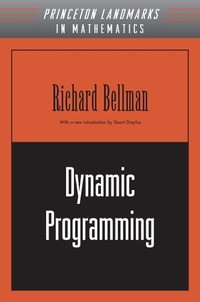
Dynamic Programming
Published on 21. July 2010
Book
Paperback/Softback
392 pages
978-0-691-14668-3 (ISBN)
Description
This classic book is an introduction to dynamic programming, presented by the scientist who coined the term and developed the theory in its early stages. In Dynamic Programming, Richard E. Bellman introduces his groundbreaking theory and furnishes a new and versatile mathematical tool for the treatment of many complex problems, both within and outside of the discipline. The book is written at a moderate mathematical level, requiring only a basic foundation in mathematics, including calculus. The applications formulated and analyzed in such diverse fields as mathematical economics, logistics, scheduling theory, communication theory, and control processes are as relevant today as they were when Bellman first presented them. A new introduction by Stuart Dreyfus reviews Bellman's later work on dynamic programming and identifies important research areas that have profited from the application of Bellman's theory.
More details
Series
Edition
Revised edition
Language
English
Place of publication
New Jersey
United States
Target group
Professional and scholarly
College/higher education
Edition type
Revised edition
Product notice
Paperback (trade)
Dimensions
Height: 242 mm
Width: 156 mm
Thickness: 25 mm
Weight
536 gr
ISBN-13
978-0-691-14668-3 (9780691146683)
Copyright in bibliographic data and cover images is held by Nielsen Book Services Limited or by the publishers or by their respective licensors: all rights reserved.
Schweitzer Classification
Other editions
Additional editions
Richard E. Bellman
Dynamic Programming
E-Book
08/2021
1st Edition
Princeton University Press
€61.49
Available for download
Previous edition

Richard E. Bellman
Dynamic Programming
Book
10/1957
Princeton University Press
€61.90
Article exhausted; check for reprint
Person
Richard E. Bellman (1920-1984) is best known as the father of dynamic programming. He was the author of many books and the recipient of many honors, including the first Norbert Wiener Prize in Applied Mathematics.