

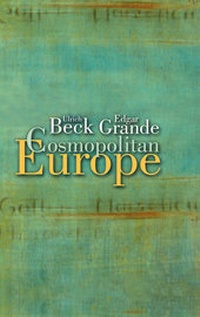
Cosmopolitan Europe
Description

Just as the Peace of Westphalia brought the religious civil warsof the seventeenth century to an end through the separation ofchurch and state, so too the separation of state and nationrepresents the appropriate response to the horrors of the twentiethcentury. And just as the secular state makes the exercise ofdifferent religions possible, so too cosmopolitan Europe mustguarantee the coexistence of different ethnic, religious andpolitical forms of life across national borders based on theprinciple of cosmopolitan tolerance.
The task the authors have set themselves in this book is nothingless than to rethink Europe as an idea and a reality. It representsan attempt to understand the process of Europeanization in light ofthe theory of reflexive modernization and thereby to redefine it atboth the theoretical and the political level.
This book completes Ulrich Beck's trilogy on'cosmopolitan realism', the volumes of which complementeach other and can be read independently. It is essential readingfor anyone interested in the key social and political developmentsof our time.
More details
Other editions
Additional editions
Persons
Content
Chapter 1: Introduction: The European Malady and Why the Idea of a Cosmopolitan Europe Could Evolve.
Chapter 2: The Reflexive Modernization of Europe.
Chapter 3: The Cosmopolitan Empire: The State and Power in the Case of Europeanization.
Chapter 4: Europe's Social Arena: On the Variable Dynamic of her Borders.
Chapter 5: Strategies for the Cosmopolitanization of Europe.
Chapter 6: Diversity and Acceptance: Pan-European Social Conflict and the Political Dynamic.
Chapter 7: On the Dialectics of Globalization and Europeanization:Without Oppositions to a Cosmopolitan Europe.
Chapter 8: A Cosmopolitan Vision for Europe.
Bibliography.
1
Introduction: The European Malaise and Why the Idea of Cosmopolitan Europe Could Overcome It
1 Rethinking Europe
The world is out of joint. No, this is not a reference to 'globalization' or to the 'terrorist threat', to the 'eastern enlargement of the European Union' or to Europe's 'shrinking population', but referred to an explosion in population, to the scandal that 'servants were becoming kings', that the Reformation was leading to the collapse of a global order and that the first signs indicated that the new form of state was indeed having disciplining effects. Even allowing for the fact that the symptoms of crisis of the current European transformation are different, it is striking how similar the forms of speech in use at the beginning of the twenty-first century are to those used by people responding to the loss of certainty in the early modern period, at the end of the sixteenth and the beginning of the seventeenth century (Schulze 2004). The more societies are confronted with transformations that threaten their very foundations, the more fearfully people cling to what is familiar and the more likely they are to misunderstand the new realities. Even changes for the better then provoke anxious resistance.
Even the most advanced sciences and scientists were not immune to this infatuation with error intended to protect the foundations of one's thought - far from it. For example, the invention of the printing press was dismissed as a passing fad. Those who viewed the sciences as the source of renewal stood corrected: the 'friend of truth' had to 'guard with all his strength against all innovation'. For 'omnis novitas periculosa' (Lentulus), all innovation is dangerous! Moreover, according to Bacon, 'whatever has not already been invented and understood, can never be so hereafter' (Novum organum). The phenomenon that dramatic changes inspire intellectual and normative stasis has already been remarked by Jacob Burckhardt: 'Major historical changes are always purchased at great cost, often after people imagined they had got them on the cheap' (Burckhardt 1957: 89).1
However, the differences in reactions and mentalities among countries were as pronounced then as they are today. In France and England, there were elements of a 'libertine climate of thought'. The changes were accepted but at the same time attempts were made to comprehend them and relate them to older realities. The German reaction was quite different: 'The German discussion was framed by a kind of fundamental moral critique of the existing, "bad", world.' People felt endangered, for example, by 'a Turkish threat of apocalyptic proportions' (Schulze 2004: 10).
Like the printing press at that time, today the European Union is similarly misunderstood, for the simple reason that it is still perceived within the outdated political and scientific framework of the nation, whereas the realities which are producing Europeanization represent the classic historical counter-example to the political and social ontology of the nation-state. Because the European Union seems to have been exhaustively researched, the principle that whatever has not yet been discovered and understood cannot be discovered and understood in the future either also seems to hold for research on Europe. This book demonstrates precisely the opposite. Europe stands for the most misunderstood thing in the world, for a powerful negation - neither state nor society, at least not in the sense in which the United States, for example, is both a state and a society.
In contrast to the great European minds who developed their philosophical and political vision of Europe long before they could have had an inkling of what Europeanization would actually entail, today we are confronting the experience of Europeanization without knowing how to conceptualize and understand it. Europe in movement - Europe as movement - escapes our understanding because this permanent process of transformation contradicts the conception within which Europe hitherto seemed to be self-evidently situated, namely, the conceptual horizon of national societies and states. To be sure, social and political history is not the same thing as the history of ideas. Europeanization is also shaped by interests and institutions, and whether this experiment will fail or not does not depend on its false understanding of itself alone. Nevertheless, interpreting a permanent, thoroughgoing transformation like Europeanization for which we lack interpretive categories that are able to represent it as meaningful, and even necessary, multiplies the burden of innovation without revealing its chances of success.
That Europe is trapped in a malaise is by now a truism. However, it is more difficult to explain how this malaise could be overcome. In our view, it would be premature to discard the very idea of Europe as outdated. On the contrary, today Europe is the last politically effective utopia. The maxim 'in dubio pro Europa' remains valid, although Europe for the most part tends to think and behave in national terms. How can the really existing utopia overcome this debilitating malaise?
That the prospects are bleak is taken as a given in public discourses. The assumption is now that the EU can't amount to much, even though not long ago it was the target of impassioned appeals to form a military and political counterweight to America. Internally, the EU has been confronted with intensifying criticism from its citizens, as documented impressively by the failed national referendums on the Constitutional Treaty in France and the Netherlands in 2005. Economically, Europe's performance is still much worse than that of the USA and there is no evidence that the ambitious political objects of the Lisbon Summit in 2000 will ever be met.
Eastern enlargement has added to the current malaise. In its largest extension to date, the European Union expanded eastwards in early 2004, thereby bridging the deep chasm opened up by hot and cold wars during the bloody history of the twentieth century. However, the new Eastern European member states harbour the same scepticism towards the distant bureaucracy in Brussels that nourished their mistrust of Moscow. In the East, Europe belongs to the past. It has been lost and lingers only in memory. It is like a faded family photograph from the interwar years, tinged with nostalgia and longing. In the West, by contrast, Europe signifies a different future, one yet to be discovered and constructed. Thus, the states which have recently been accepted into the European 'family' represent a terra incognita for their Western neighbours.
There is currently much talk of the provincialization of Europe. But isn't Europe mainly preoccupied with its favourite topic - namely, itself - while the world is falling to pieces? From the perspective of the postcolonial world, globalization is synonymous with the decline of Europe. For globalization is the materialization of the American world spirit. The erstwhile colonial masters have suddenly been demoted to second-class status and hence no longer set their own standards of greatness or incompetence. On this point, the postcolonial countries are in agreement with the American 'lords of the world'. Europe no longer even figures in their power calculations. Since Europe cannot assert itself militarily and speaks with many voices in foreign and security policy, it need not be taken seriously and merits only cosmetic regard.
Europe is also mired politically. The uninspired, petty way in which it tried to give itself a constitution is just one example of this. All sides exhaust themselves in complaints, demands and appeals: Something must happen! Something should have happened a long time ago! But nothing is happening - or so it seems. In fact, a lot is happening - for some, even far too much. Though it may sound paradoxical, over the past decade the European process has been driven forward by its 'failures'. 'I've been pronounced dead, so I must be!' is Europe's motto. Europe has grown up amid doom-laden prophecies. If the prophets of doom and their prophesies were correct, then Europe would never have experienced its current major crisis. If it is not to disintegrate, it must answer the question: Who is to set the political agenda for this gigantic entity encompassing twenty-seven states and over 494 million people, and how? However, the fact that the phoenix has hitherto always arisen invigorated from the ashes of the declarations of its demise does not mean that the present malaise can also be overcome merely by being loudly trumpeted.
Yet, could it be that the perpetual diagnosis of 'crisis' and 'decline' also reflects the fact that the nation-state narrative of society and politics which we impose on Europeanization misses reality and leads to systematic misunderstandings? Perhaps it is not a matter of regret that Europe is still at the planning stage in spite of two and a half millennia of history; maybe the point is that this contributes to the reality of Europeanization. Maybe the main problem is that the political script being played out in the minds of Europeans is at variance with the script which is actually determining European reality. Maybe what is lacking is not a single European identity that unites everybody but a narrative of Europeanization that makes sense...
