

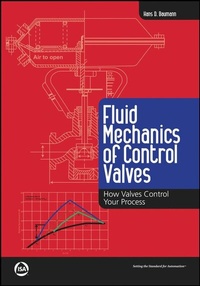
Fluid Mechanics of Control Valves
Description

Fluid Mechanics of Control Valves is a practical, experience-driven handbook that explains how control valves work and how to select, size and maintain them. This book covers valve types (globe, butterfly, ball and three-way), actuators and positioners, valve-sizing methods for liquids and gases, and how thermodynamic effects, such as choked flow, cavitation and auto-refrigeration, affect performance. It also guides readers on efficiency and power consumption, noise and vibration sources, practical noise-reduction strategies, sanitary valve design for food and biotech, fail-safe actions, inspection and testing, and modern concerns such as cybersecurity and loop stability.
This book also provides clear definitions, examples, tables and real-world advice to make complex fluid and acoustic concepts accessible.
More details
Other editions
Additional editions
Person
Baumanns many valve designs have won awards in the United States, France, and Japan, as well as a gold medal in Germany. He is credited with over 105 US patents and many foreign patents. Baumann has published 148 articles and has written 7 books on engineering, management, and historical subjects, including Control Valve Primer (now in its fourth edition, including a Japanese translation). In addition, he is the co-author of 8 handbooks on automatic controls and acoustics.
Baumann is an honorary member of the Fluid Controls Institute (FCI) and the Spanish Engineering Society. He is also an ISA Honorary Fellow, a Life Fellow of the American Society of Mechanical Engineers (ASME), and an inductee of the Automation Hall of Fame. ISA selected him as one of 50 outstanding Industrial Innovators.
Besides the above accomplishments, he continues to work as a consultant and to lead R&D projects for select clients.
Hans Baumann was 86 years old when he wrote this book. He can be contacted at hdbaumann@att.net.
Content
Foreword xi
About the Author xiii
Introduction 1
An Often-Asked Question: What Is a Control Valve? 1
Basic Definitions 3
Chapter 1 Control Valves 5
Valve Types 6
Ball Valves 6
Eccentric Rotary Plug Valves 7
Butterfly Valves 8
Globe Valves 8
Three-Way Valves 11
Actuators 12
Diaphragm Actuators 12
Pneumatic, Diaphragm-Less Piston Actuators 15
Electric Actuators 16
Hydraulic Actuators 16
Accessories 18
Valve Positioners 18
Chapter 2 Efficiency and Power Consumption of Control Valves 23
Chapter 3 Basic Functions of a Control Valve 27
Seat Leakage 31
Stem Packings and Bonnet Gaskets 31
Graphite Packings 33
Dynamic Instability in Control Valves 34
Installation 34
Chapter 4 Thermodynamic Effects 37
Auto-Refrigeration 37
Aerodynamic Throttling 38
Chapter 5 Valve-Sizing 41
In the Beginning... 41
The Easy Way to Size Valves 44
If the Fluid Is a Turbulent Liquid 44
Flashing of Liquids 46
When the Flow Is Gas or Steam 48
Flow in Mass 48
Flow in Volume 49
Terminology Used 50
Other Useful Numbers 51
Other proprietary symbols 51
Rangeability 51
Mixed Fluids 54
Non-Newton Fluids 54
Laminar Flow 54
Chapter 6 Sound Produced by Throttling 61
Basic Acoustic Terms 63
Turbulent Sound 64
Equations to Calculate Turbulent Sound Pressure Level in dBA 66
Sound Produced by Cavitation of Liquids 68
Calculating the Cavitation Sound Level and Therefore the Total Liquid Throttling Sound 71
Establishing the Correct XFz Factor 73
The Story of Globe Valves 75
Chapter 7 Estimating the Sound Pressure Level of Gases 79
Calculation of the Sound Pressure Level for Steel Pipe at 1 m Distance from the Pipe Wall 81
Accounting for Gases Other Than Air 83
A Word of Caution about Valve Sound Prediction 86
Chapter 8 Ways to Reduce Aerodynamic Noise 89
The Classical Way 89
Resistance in Series Devices 92
The Connoisseur's Way: Taking Advantage of the Aerodynamic Properties of Jets 93
Insulation and Silencers 95
Chapter 9 What to Do about Hydro-Noise? 97
Chapter 10 What to Expect of a Good Control Valve 99
Chapter 11 Fail-Safe Action 101
Chapter 12 Valves for Sanitary or Aseptic Service 103
Chapter 13 Inspection and Testing 107
Materials 107
Hydrostatic Testing 108
Seat Leakage Tests 108
Packing Leakage 108
Deadband Test 108
Chapter 14 Cybersecurity 109
Chapter 15 Control Valves as a Source of Loop Instability 111
Appendix A: Reference Tables 115
Index 127
Since the onset of the electronic age, because of the concern of keeping up with ever-increasing challenges by more sophisticated control instrumentation and control algorithms, instrument engineers have paid less and less attention to final control elements-even though all process control loops could not function without them.
Final control elements may be the most important part of a control loop because they control process variables, such as pressure, temperature, tank level, and so on. All these control functions involve the regulation of fluid flow in a system. The control valve is the most versatile device able to do this. Thermodynamically speaking, the moving element of a valve-may it be a plug, ball, or vane-together with one or more orifices, restricts the flow of fluid. This restriction causes the passing fluid to accelerate (converting potential energy into kinetic energy). The fluid exits the orifice into an open space in the valve housing, which causes the fluid to decelerate and create turbulence. This turbulence in turn creates heat, and at the same time, reduces the flow rate or pressure.
Unfortunately, this wastes potential energy because part of the process is irreversible. In addition, high-pressure reduction in a valve can cause cavitation in liquids or substantial aerodynamic noise with gases. One must choose special valves designed for those services.
There are other types of final control elements, such as speed-controlled pumps and variable speed drives. Speed-controlled pumps, while more efficient when flow rates are fairly constant, lack the size ranges, material choices, high pressure and temperature ratings, and wide flow ranges that control valves offer. Advertising claims touting better efficiency than valves cite as proof only the low-power consumption of the variable-speed motor and omit the high-power consumption of the voltage or frequency converter that is needed.
Similarly, variable-speed drives are mechanical devices that vary the speed between a motor and a pump or blower. These do not need an electric current converter because their speed is mechanically adjusted. Control valves have a number of advantages over speed-controlled pumps: they are available in a variety of materials and sizes; they have a wider rangeability (range between maximum and minimum controllable flow); and they have a better speed of response.
To make the reader familiar with at least some of the major types of control valves (the most important final control element), here is a brief description.
There are two basic styles of control valves: rotary motion and linear motion. The valve shaft of rotary motion valves rotates a vane or plug following the commands of a rotary actuator. The valve stem of linear motion valves moves toward or away from the orifice driven by reciprocating actuators. Ball valves and butterfly valves are both rotary motion valves; a globe valve is a typical linear motion valve. Rotary motion valves are generally used in moderate-to-light-duty service in sizes above 2 in (50 mm), whereas linear motion valves are commonly used for more severe duty service. For the same pipe size, rotary valves are smaller and lighter than linear motion valves and are more economical in cost, particularly in sizes above 3 in (80 mm).
Globe valves are typical linear motion valves. They have less pressure recovery (higher pressure recovery factor [FL]) than rotary valves and, therefore, have less noise and fewer cavitation problems. The penalty is that they have less Cv (Kv) per diameter compared to rotary types.
When a ball valve is used as a control valve, it will usually have design modifications to improve performance. Instead of a full spherical ball, it will typically have a ball segment. This reduces the amount of seal contact; thus, reducing friction and allowing for more precise positioning. The leading edge of the ball segment may have a V-shaped groove to improve the control characteristic. Ball valve trim material is generally 300 series stainless steel (see Figure 1-1).
Figure 1-1. Segmental ball valve cross section.Source: Masoneilan/Dresser (MNI is a division of GE).
Segmented ball valves are popular in paper mills due to their capability to shear fibers. Their flow capacity is similar to butterfly valves; therefore, they have high pressure recovery in mid- and high-flow ranges.
Another form of rotary control valve is the eccentric rotary-plug type (see Figure 1-2) with the closure member shaped like a mushroom and attached slightly offset to the shaft. This style provides good control along with a tight shutoff, as the offset supplies leverage to cam the disc face into the seat. The advantage of this valve is tight shutoff without the elastomeric seat seals used in ball and butterfly valves. The trim material for eccentric disc valves is generally 300 series stainless steel, which may be clad with Stellite® hard facing.
Figure 1-2. Typical eccentric rotary plug valve.The flow capacity is about equal to globe valves. These valves are less susceptible to slurries or gummy fluids due to their rotary shaft bearings.
Butterfly valves are a low-cost solution for control loops using low pressure and temperature fluids. They save space due to their small profile, are available in sizes from 2 in (50 mm) to 50 in (1250 mm), and can be rubber-lined for tight shutoff (see Figure 1-3). A more advanced variety uses a double-eccentric vane that, in combination with a metal seal ring, can provide low leakage rates even at elevated temperatures.
Figure 1-3. A rubber-lined butterfly valve with contoured vane to reduce dynamic torque.Source: Masoneilan/General Electric Co.
A more advanced design of butterfly valves is shown in Figure 1-4. Here the vane is in the shape of a letter Z. The gradual opening described above produces a preferred equal percentage characteristic in contrast to conventional butterfly valves having a typically linear characteristic.
Figure 1-4. Advanced design butterfly valve. The nonsliding contact (A) provides tight shutoff without "break-away" friction; the gradual opening (B) assures an equal percentage inherent characteristic; bidirectional pockets (C) prevent torque reversal.Source: Ergo Tech, Inc.
A butterfly valve used as a control valve may have a somewhat S-shaped disc (see Figure 1-3) to reduce the flow-induced torque on the disc; this allows for more precise positioning and prevents torque reversal. Butterfly valve trim material may be bronze, ductile iron, or 300 series stainless steel. A feature separating on/off rotary valves from those adapted for control is the tight connection between the plug or vane and the stem to ensure a tight seal when closed. Also needed is a tight coupling between the valve and actuator stem, which avoids loose play that leads to deadband, hysteresis, and, in turn, control loop instability.
These valves can be subdivided into two common styles: post-guided and cage-guided. In post-guided valves, the moving closure member or stem is guided by a bushing in the valve bonnet. The closure member is usually unbalanced, and the fluid pressure drop acting on the closure member can create significant forces. Post-guided trims are well suited for slurries and fluids with entrained solids. The post-guiding area is not in the active flow stream, reducing the chance of solids entering the guiding area. Post-guided valve-trim materials are usually either 400 series, 300 series, or type 17-4 PH stainless steel. Post-guided valves are preferred in valve sizes of 1/4 in (6 mm) to 2 in (50 mm) due to lower cost (see Figure 1-5).
Figure 1-5. Post-guided globe valve.A cage-guided valve has a cylindrical cage between the body and the bonnet. Below the cage is a seat ring. The cage/seat ring stack is sealed with resilient gaskets on both ends. The cage guides the closure member, also known as the plug. The plug is often pressure-balanced with a dynamic seal between the plug and cage. The balanced plug will have passageways through the plug to eliminate the pressure differential across the plug and the resulting pressure-induced force. The trim materials for cage-guided valves are often either 400 series, 300 series, or 17-4 PH stainless steel, sometimes nitrided or Stellite hard-faced (Figure 1-6). Care should be taken to allow for thermal expansion of the cage at high temperature, especially when the cage and housing are of dissimilar metal. One advantage of cage-guided valves is that they can easily be fitted with low-noise or anti-cavitation trim. The penalty is a reduction in flow capacity.
Figure 1-6. Cage-guided globe valve.Note: Do not use so-called cage-guided valves for sticky fluids or fluids that have solid contaminants, such as crude oil.
Typical configurations are used for valve sizes from 2 in (50 mm) to 12 in (300...
