

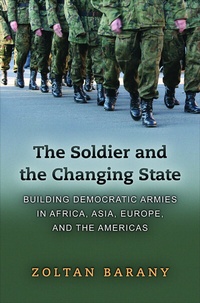
The Soldier and the Changing State
Building Democratic Armies in Africa, Asia, Europe, and the Americas
1st Edition
Published on 16. June 2015
472 pages
978-1-4008-4549-1 (ISBN)
Description

The Soldier and the Changing State is the first book to systematically explore, on a global scale, civil-military relations in democratizing and changing states. Looking at how armies supportive of democracy are built, Zoltan Barany argues that the military is the most important institution that states maintain, for without military elites who support democratic governance, democracy cannot be consolidated. Barany also demonstrates that building democratic armies is the quintessential task of newly democratizing regimes. But how do democratic armies come about? What conditions encourage or impede democratic civil-military relations? And how can the state ensure the allegiance of its soldiers?
Barany examines the experiences of developing countries and the armed forces in the context of major political change in six specific settings: in the wake of war and civil war, after military and communist regimes, and following colonialism and unification/apartheid. He evaluates the army-building and democratization experiences of twenty-seven countries and explains which predemocratic settings are most conducive to creating a military that will support democracy. Highlighting important factors and suggesting which reforms can be expected to work and fail in different environments, he offers practical policy recommendations to state-builders and democratizers.
Barany examines the experiences of developing countries and the armed forces in the context of major political change in six specific settings: in the wake of war and civil war, after military and communist regimes, and following colonialism and unification/apartheid. He evaluates the army-building and democratization experiences of twenty-seven countries and explains which predemocratic settings are most conducive to creating a military that will support democracy. Highlighting important factors and suggesting which reforms can be expected to work and fail in different environments, he offers practical policy recommendations to state-builders and democratizers.
More details
Edition
Core Textbook
Language
English
Place of publication
Princeton, NJ
United States
Publishing group
De Gruyter
Target group
Professional and scholarly
Edition type
Digital original
Product notice
Reflowable
Illustrations
9 tables.
File size
1,72 MB
ISBN-13
978-1-4008-4549-1 (9781400845491)
Schweitzer Classification
Other editions
Additional editions
Zoltan Barany
The Soldier and the Changing State
Building Democratic Armies in Africa, Asia, Europe, and the Americas
Book
09/2012
Princeton University Press
€116.50
Article not available at the moment
Zoltan Barany
The Soldier and the Changing State
Building Democratic Armies in Africa, Asia, Europe, and the Americas
Book
09/2012
Princeton University Press
€44.00
Shipment within 10-20 days
Person
Zoltan Barany is the Frank C. Erwin, Jr., Centennial Professor of Government at the University of Texas and the author of Democratic Breakdown and the Decline of the Russian Military (Princeton).
Content
Acknowledgments ix
Introduction 1
Chapter 1 What Does a Democratic Army Look Like? 14
BUILDING DEMOCRATIC ARMIES
After War
Chapter 2 After World War II: Germany, Japan, and Hungary 47
Chapter 3 After Civil War: Bosnia and Herzegovina, El Salvador, and Lebanon 78
After Regime Change
Chapter 4 After Military Rule in Europe: Spain, Portugal, and Greece 113
Chapter 5 After Military Rule in Latin America: Argentina, Chile, and Guatemala 143
Chapter 6 After Military Rule in Asia: South Korea, Thailand,
and Indonesia 178
Chapter 7 After State-Socialism in Europe: Slovenia, Russia, and Romania 212
After State Transformation
Chapter 8 After Colonial Rule in Asia: India, Pakistan, and Bangladesh 245
Chapter 9 After Colonial Rule in Africa: Ghana, Tanzania, and Botswana 275
Chapter 10 After (Re)Unification and Apartheid: Germany, South Africa, and Yemen 303
Conclusion 339
Notes 359
Bibliography 409
Index 443
Introduction 1
Chapter 1 What Does a Democratic Army Look Like? 14
BUILDING DEMOCRATIC ARMIES
After War
Chapter 2 After World War II: Germany, Japan, and Hungary 47
Chapter 3 After Civil War: Bosnia and Herzegovina, El Salvador, and Lebanon 78
After Regime Change
Chapter 4 After Military Rule in Europe: Spain, Portugal, and Greece 113
Chapter 5 After Military Rule in Latin America: Argentina, Chile, and Guatemala 143
Chapter 6 After Military Rule in Asia: South Korea, Thailand,
and Indonesia 178
Chapter 7 After State-Socialism in Europe: Slovenia, Russia, and Romania 212
After State Transformation
Chapter 8 After Colonial Rule in Asia: India, Pakistan, and Bangladesh 245
Chapter 9 After Colonial Rule in Africa: Ghana, Tanzania, and Botswana 275
Chapter 10 After (Re)Unification and Apartheid: Germany, South Africa, and Yemen 303
Conclusion 339
Notes 359
Bibliography 409
Index 443
