

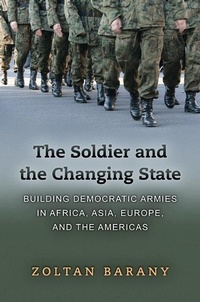
The Soldier and the Changing State
Building Democratic Armies in Africa, Asia, Europe, and the Americas
Will be published approx. on 16. September 2012
Book
Hardback
472 pages
978-0-691-13768-1 (ISBN)
Description
The Soldier and the Changing State is the first book to systematically explore, on a global scale, civil-military relations in democratizing and changing states. Looking at how armies supportive of democracy are built, Zoltan Barany argues that the military is the most important institution that states maintain, for without military elites who support democratic governance, democracy cannot be consolidated. Barany also demonstrates that building democratic armies is the quintessential task of newly democratizing regimes. But how do democratic armies come about? What conditions encourage or impede democratic civil-military relations? And how can the state ensure the allegiance of its soldiers? Barany examines the experiences of developing countries and the armed forces in the context of major political change in six specific settings: in the wake of war and civil war, after military and communist regimes, and following colonialism and unification/apartheid. He evaluates the army-building and democratization experiences of twenty-seven countries and explains which predemocratic settings are most conducive to creating a military that will support democracy.
Highlighting important factors and suggesting which reforms can be expected to work and fail in different environments, he offers practical policy recommendations to state-builders and democratizers.
Highlighting important factors and suggesting which reforms can be expected to work and fail in different environments, he offers practical policy recommendations to state-builders and democratizers.
Reviews / Votes
One of Choice's Outstanding Academic Titles for 2013 "This is an important work on militaries in newly democratizing regimes. The scope of the work is impressive... The topic of democratization of militaries is ... very important, and the remarkable breadth of the work will make it an essential handbook."--Choice "The Soldier and the Changing State is very useful reading for democracy scholars and practitioners. It lives up to its title, and it may even displace Huntington's classic as the first stop for those seeking to understand democratic civil-military relations today."--Harold A. Trinkunas, Journal of Democracy "The Soldier and the Changing State is an extraordinary book in both senses of that word, simultaneously remarkable and rare... The Soldier and the Changing State will probably be most widely read among specialists of civil-military relations, who will learn a great deal from the case studies in particular. But it should also find a considerable audience among democratization scholars. The book neither offers up a new theory of regime change nor tests existing theories, but there is no better general historical treatment of the ways in which civil-military relations influence the transition process in countries around the world."--Brian D. Taylor, Comparative Politics "The Soldier and the Changing State will probably be most widely read among specialists of civil-military relations, who will learn a great deal from the case studies in particular. But it should also find a considerable audience among democratization scholars. The book neither offers up a new theory of regime change nor tests existing theories, but there is no better general historical treatment of the ways in which civil-military relations influence the transition process in countries around the world."--Brian D. Taylor, Perspectives on Politics "Too often are military institutions and the threat they pose to democratic consolidation ignored. The Soldier and the Changing State provides a necessary corrective to this oversight by directly tackling the many challenges of building democratic militaries. Barany's work should thus inspire a new research agenda within the democratization field."--Kristen A. Harkness, Political Science QuarterlyMore details
Language
English
Place of publication
New Jersey
United States
Target group
College/higher education
Product notice
Trade binding
Illustrations
9 tables.
Dimensions
Height: 231 mm
Width: 160 mm
Thickness: 36 mm
Weight
816 gr
ISBN-13
978-0-691-13768-1 (9780691137681)
Copyright in bibliographic data and cover images is held by Nielsen Book Services Limited or by the publishers or by their respective licensors: all rights reserved.
Schweitzer Classification
Other editions
Additional editions
Zoltan Barany
The Soldier and the Changing State
Building Democratic Armies in Africa, Asia, Europe, and the Americas
E-Book
06/2015
1st Edition
Princeton University Press
€161.95
Available for download
Zoltan Barany
The Soldier and the Changing State
Building Democratic Armies in Africa, Asia, Europe, and the Americas
Book
09/2012
Princeton University Press
€44.00
Shipment within 10-20 days
Person
Zoltan Barany is the Frank C. Erwin, Jr., Centennial Professor of Government at the University of Texas and the author of Democratic Breakdown and the Decline of the Russian Military (Princeton).
Content
Acknowledgments ix Introduction 1 Chapter 1 What Does a Democratic Army Look Like? 14 BUILDING DEMOCRATIC ARMIES After War Chapter 2 After World War II: Germany, Japan, and Hungary 47 Chapter 3 After Civil War: Bosnia and Herzegovina, El Salvador, and Lebanon 78 After Regime Change Chapter 4 After Military Rule in Europe: Spain, Portugal, and Greece 113 Chapter 5 After Military Rule in Latin America: Argentina, Chile, and Guatemala 143 Chapter 6 After Military Rule in Asia: South Korea, Thailand, and Indonesia 178 Chapter 7 After State-Socialism in Europe: Slovenia, Russia, and Romania 212 After State Transformation Chapter 8 After Colonial Rule in Asia: India, Pakistan, and Bangladesh 245 Chapter 9 After Colonial Rule in Africa: Ghana, Tanzania, and Botswana 275 Chapter 10 After (Re)Unification and Apartheid: Germany, South Africa, and Yemen 303 Conclusion 339 Notes 359 Bibliography 409 Index 443