

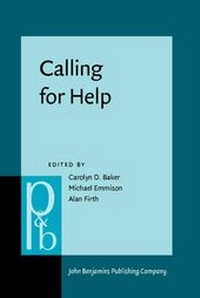
Calling for Help
Language and social interaction in telephone helplines
1st Edition
Published on 13. October 2005
XVIII, 352 pages
978-90-272-9408-1 (ISBN)
Description

Telephone helplines have become one of the most pervasive sites of expert-lay interaction in modern societies throughout the world. Yet surprisingly little is known of the in situ, language-based processes of help-seeking and help-giving behavior that occurs within them. This collection of original studies by both internationally renowned and emerging scholars seeks to improve upon this state of affairs. It does so by offering some of the first systematic investigations of naturally-occurring spoken interaction in telephone helplines. Using the methods of Conversation Analysis, each of the contributors offers a detailed investigation into the skills and competencies that callers and call-takers routinely draw upon when engaging one another within a range of helplines. Helplines in the US, the UK, Australia, Scandinavia, The Netherlands, and Ireland, dealing with the provision of healthcare, emotional support and counselling, technical assistance and consumer rights, tourism and finance, make up the studies in the volume. Collectively and individually, the research provides fascinating insight into an under-researched area of modern living and demonstrates the relevance and potential of helplines for the growing field of institutional interaction.
This book will be of interest to students of communication, applied linguistics, discourse and conversation, sociology, counselling, technology and work, social psychology and anthropology.
This book will be of interest to students of communication, applied linguistics, discourse and conversation, sociology, counselling, technology and work, social psychology and anthropology.
More details
Other editions
Additional editions
Carolyn Baker | Michael Emmison | Alan Firth
Calling for Help
Language and social interaction in telephone helplines
Book
10/2005
John Benjamins Publishing Co
€127.20
Shipment within 10-15 days
Persons
Content
- Calling for Help
- Editorial page
- Title page
- LCC data
- Dedication
- Table of contents
- Notes on contributors
- Preface
- Calling for help
- 1. Overview
- 2. Helplines: Some background
- 3. Seeking and providing help
- 4. The popularity of helplines and some interactional implications
- Low cost
- Accessibility
- Anonymous expert
- The conversationally-engaged call-taker
- 5. The studies
- Part I: Technical assistance
- Part II: Emotional support
- Part III: Healthcare provision
- Part IV: Consumer assistance
- Part V: Aspects of call management
- Notes
- References
- I. Technical assistance
- Calibrating for competence in calls to technical support
- 1. Introduction
- 2. Accounting for the call
- 3. Calibrating for competence
- Technical competence
- Social-interactional competence
- The caller's first description of their computer/software competence
- CT calibrations as orientation to the heard `competence' of the caller
- 4. The contingent use of a pedagogical format
- 5. Conclusion
- Notes
- References
- Collaborative problem description in help desk calls
- 1. Introduction
- 2. Overall organization of the calls
- Ticket announcement
- 3. The collaborative construction of the computer-aided ticket
- CTs production of incomplete and-prefaced statements as questions
- Caller's orientation to the information to be recorded by CT
- CTs working aloud while typing
- 4. Reading back the problem description
- Problem description - acceptance/non-acceptance
- 5. Conclusion
- Note
- References
- The metaphoric use of space in expert-lay interaction about computing systems
- 1. Introduction
- 2. Spatial scalability in concepts
- 3. Conceptual models and interactional structure
- 4. Interactional strategy at the beginning of a helpdesk call
- 5. Conclusion
- References
- II. Emotional support
- The mitigation of advice
- 1. Introduction
- 2. The practice of giving advice
- 3. Dilemmas of advice-giving on consumer-run warm lines
- 4. Methodology: Procedures for data collection and analysis
- 5. Encouraging clients to adopt a solution
- Client tells of an urgent problem
- Client implicitly seeks a solution
- 6. Discussion
- Notes
- References
- Four observations on openings in calls to Kids Help Line
- 1. Introduction
- 2. Kids Help Line
- Observation 1
- Observation 2
- Observation 3
- 2.1. Observation 4
- 3. Conclusion
- References
- 'I just want to hear somebody right now'
- 1. Introduction
- 2. Analytic material and context
- 3. Analysis
- Seeking help? (segment 1)
- A competent participant
- Needs and identities
- What is your star sign? (segment 2)
- I can't hear you, now what did you say?
- Aha aha: Outlining the client (segment 3)
- Having a very sensitive side (from Cancer probably)
- Psychological peeling
- 4. Conclusion
- Acknowledgements
- Notes
- References
- Original Dutch extract
- III. Healthcare provision
- Callers' presentations of problems in telephone calls to Swedish primary care
- 1. Introduction
- 1.1. The focus of this study
- 1.2. The database
- 1.3. Working on the telephone and computer
- 2. Callers' presentations of problems
- 2.1. Requests to see a doctor
- 2.2. Questions
- 2.3. Narratives
- 3. Discussion
- Note
- References
- Constructing and negotiating advice in calls to a poison information center
- 1. Introduction
- 2. The first advice sequence
- 3. Caller's response and its consequences
- 4. Conclusion
- Notes
- References
- IV. Consumer assistance
- Opportunities for negotiation at the interface of phone calls and service-counter interaction
- 1. Introduction
- 2. Aims of the study
- 3. The data
- 4. Background to the study: Stages of `Troubles-Telling'
- 5. Data analysis: Example 1
- Stage 1: Customer as `troubles-teller'
- Stage 2: Customer as `troubles-recipient'
- 6. Data analysis: Example 2
- Stage 1: Customer as `troubles-teller'
- Stage 2: Customer as `troubles-recipient'
- 7. Data analysis: Example 3
- 8. Summary and conclusion
- Note
- Appendix: Transcription notation
- References
- Institutionality at issue
- 1. Introduction: when institutionality is at issue
- 2. Language games in Wittgenstein and Garfinkel
- 3. Big and little language games in call 01
- Language games in a Consumer Complaint narrative
- Insertion sequence
- 4. Big game, play one
- The Sale of Goods Act and the ``short length of time''
- 5. Replaying the big game
- 6. The footing shift in the replay
- Caller's new ending - Preface
- 7. Institutionality at issue in a little game
- Institutionality at issue in caller's new ending - First
- Institutionality at issue (ii) in caller's new ending - Then
- Caller's new ending - Response
- 8. Institutionality at issue in the big game - helper's new ending story
- Helper's new ending - Then
- Call closing as caller's story response
- Call completion in two game plays
- 9. Conclusion
- Sacks' agent/client game
- One game or many?
- Notes
- References
- V. Aspects of call management
- Some initial reflections on conversational structures for instruction giving
- 1. Introduction
- 2. Instruction giving and instructional sequences
- 3. A system for the transfer of instructions
- Requesting the telephone number: The basic instructional chain
- Departures from the typical structure
- Further instructions
- 4. Ambiguity and repair
- End repairs
- Formulating instructional courses
- 5. Conclusion
- Notes
- References
- Appendix CN2:4-00
- Working a call
- 1. Introduction
- 2. Central County Dispatch
- 3. Interactional scaffolding
- 4. Mutual monitoring
- 5. Transitions between work and not-work activities
- Methods for disengaging talk
- Re-engagement displays and fitting
- Disengagement displays and fitting
- 6. "Speeding cars and a loud party'' redux
- 7. Conclusion
- Notes
- References
- Name index
- Subject index
- The Pragmatics & Beyond New Series
