

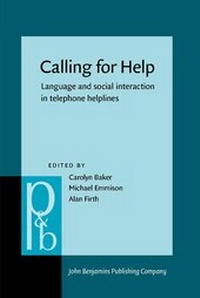
Calling for Help
Language and social interaction in telephone helplines
Published on 13. October 2005
Book
Hardback
352 pages
978-90-272-5386-6 (ISBN)
Description
Telephone helplines have become one of the most pervasive sites of expert-lay interaction in modern societies throughout the world. Yet surprisingly little is known of the in situ, language-based processes of help-seeking and help-giving behavior that occurs within them. This collection of original studies by both internationally renowned and emerging scholars seeks to improve upon this state of affairs. It does so by offering some of the first systematic investigations of naturally-occurring spoken interaction in telephone helplines. Using the methods of Conversation Analysis, each of the contributors offers a detailed investigation into the skills and competencies that callers and call-takers routinely draw upon when engaging one another within a range of helplines. Helplines in the US, the UK, Australia, Scandinavia, The Netherlands, and Ireland, dealing with the provision of healthcare, emotional support and counselling, technical assistance and consumer rights, tourism and finance, make up the studies in the volume. Collectively and individually, the research provides fascinating insight into an under-researched area of modern living and demonstrates the relevance and potential of helplines for the growing field of institutional interaction.
This book will be of interest to students of communication, applied linguistics, discourse and conversation, sociology, counselling, technology and work, social psychology and anthropology.
This book will be of interest to students of communication, applied linguistics, discourse and conversation, sociology, counselling, technology and work, social psychology and anthropology.
Reviews / Votes
[...] Calling for Help brings out various aspects of institutional talk that have been scantly studied by discourse analysts. In this respect, this book has opened a new frontier in conversation analysis. Because of its approach to language as a means of social interaction, the book can offer a great deal to those interested in studying language in society. -- Shiv R. Upadhyay, York University, Toronto, Canada, on Linguist List, Vol. 17.3279 (2006)More details
Series
Language
English
Place of publication
Amsterdam
Netherlands
Target group
Professional and scholarly
Dimensions
Height: 245 mm
Width: 164 mm
Weight
800 gr
ISBN-13
978-90-272-5386-6 (9789027253866)
Copyright in bibliographic data and cover images is held by Nielsen Book Services Limited or by the publishers or by their respective licensors: all rights reserved.
Schweitzer Classification
Other editions
Additional editions
Carolyn Baker | Michael Emmison | Alan Firth
Calling for Help
Language and social interaction in telephone helplines
E-Book
10/2005
1st Edition
John Benjamins Publishing Company
€149.99
Available for download
Persons
Content
1. Notes on contributors; 2. Preface; 3. Calling for help: An introduction (by Firth, Alan); 4. Technical assistance; 5. Calibrating for competence in calls to technical support (by Baker, Carolyn); 6. Collaborative problem description in help desk calls (by Houtkoop, Hanneke); 7. The metaphoric use of space in expert-lay interaction about computing systems (by Kraan, Wilbert); 8. Emotional support; 9. The mitigation of advice: Interactional dilemmas of peers on a telephone support service (by Pudlinski, Christopher); 10. Four observations on openings in calls to Kids Help Line (by Danby, Susan); 11. 'I just want to hear somebody right now': Managing identities on a telephone helpline (by Molder, Hedwig te); 12. Healthcare provision; 13. Callers' presentations of problems in telephone calls to Swedish primary care (by Leppanen, Vesa); 14. Constructing and negotiating advice in calls to a poison information center (by Landqvist, Hakan); 15. Consumer assistance; 16. Opportunities for negotiation at the interface of phone calls and service-counter interaction: A case study (by Chappell, Denise); 17. Institutionality at issue: The helpline call as a 'language game' (by Torode, Brian); 18. Aspects of call management; 19. Some initial reflections on conversational structures for instruction giving (by Murtagh, Ged M.); 20. Working a call: Multiparty management and interactional infrastructure in calls for help (by Whalen, Jack); 21. Name Index; 22. Subject Index