

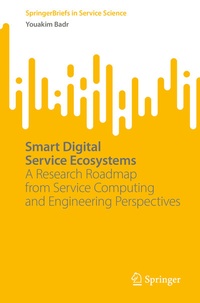
Smart Digital Service Ecosystems
Description

This book provides a holistic overview of the major advances that have been made in the context of Service Science with a focus on IT-enabled services. To address challenges in collaborative, social-centric, ad-hoc, dynamic and open environments, the book studies IT-enabled service systems from two distinct but complementary research perspectives: service engineering and service computing. From a service engineering view, the book shows how to apply a systemic approach to tackle social problems from holistic and multi-disciplinary perspectives by focusing on service systems and developing a service design framework, including socio-technical aspects, the service reference model, data-driven collaboration processes, the incremental design method, requirement propagation, and system adaptability with feedback loops. From a service computing view, the book introduces a service-oriented aided infrastructure to support IT-enabled service systems in ICT-facilitated environments and provide access to tangible and intangible resources in a trustworthy environment.
The book offers a valuable companion and comprehensive reference guide for undergraduate and graduate students who want to learn about current concepts for designing and implementing service systems; and for researchers who want to identify future directions in build smart digital service ecosystems, integrating Internet of Things (IoT) and Artificial Intelligence (AI) and cyber-security. The book also appeals to developers who need to implement advanced services and want to capitalize on corresponding business models, customer-driven interaction, and scalable architectures.
More details
Other editions
Additional editions
Person
Dr. Youakim Badr is Full Professor of Data Analytics at the Pennsylvania State University - Great Valley, and professor-in-charge of the professional master of studies in Artificial Intelligence. He received his Master of Science degree in "Mathematical Modeling and Scientific Software Engineering" from the Francophone University Agency in 1997. He earned his Ph.D. in computer science from the French National Institute of Applied Sciences (INSA-Lyon) in 2003, and the Habilitation degree ("Habilitation à diriger des recherches," the higher doctorate in France) from the University of Lyon in 2013.
Over the course of his research, Dr. Badr has worked extensively in the area of service computing (distributed systems, interoperable and reusable software components) and information security to design and deploy self-adaptable connected devices and build secure "service-oriented systems" for the Internet of Things (IoT). In addition, Dr. Badr conducted research activities on the integration of data analytic capabilities and service computing to make service systems smarter from the flood of data generated by connected devices.
Dr. Badr's current research strategy aims at designing and deploying "Trustworthy AI service systems." He investigates research challenges and business problems from a multidisciplinary and systemic perspective, focusing on AI analytics systems, Trustworthy AI systems and Composable AI systems.
Content
- Intro
- Preface
- Acknowledgments
- Contents
- 1 The Rise of IT-Enabled Services
- 1.1 The Service Economy
- 1.2 Productivity in Services
- 1.2.1 Multivarious Definitions
- 1.2.2 Multidisciplinarity of Services
- 1.2.3 Unconventional Characteristics of Services
- 1.3 Services in Service Science and the Service-Dominant Logic
- 1.4 IT-Enabled Services
- 1.5 Designing and Implementing IT-Enabled Services
- 1.5.1 The Systemic Thinking Perspective
- 1.5.2 The ICT Perspective
- 1.5.3 Service System Challenges
- 1.5.3.1 Compositions in Software Engineering: The SOA Perspective
- 1.5.3.2 Compositions in Service Engineering: The Business Perspective
- 1.5.4 Challenges Related to the Service Concept
- 1.5.5 Challenges Related to Service Processes
- 1.5.6 A Research Road Map for IT-Enabled Services
- 2 Service Reference Model and Requirements
- 2.1 Introduction
- 2.2 Services and Challenges
- 2.2.1 The Service Concept
- 2.2.2 Modeling Services
- 2.2.3 Service Frameworks
- 2.3 Design Requirements for Services
- 2.4 An Architectural Framework for IT-Enabled Services
- 2.4.1 Service System Reference Model
- 2.4.1.1 The System View
- 2.4.1.2 The Characteristics View
- 2.4.1.3 The Business View
- 2.4.1.4 The Interaction View
- 2.4.2 The Service Shared Requirement Model
- 2.4.2.1 Specifying Requirements with Service Characteristics
- 2.4.2.2 The Goal-Oriented Graphical Model
- 2.4.2.3 The Service Requirement Modeling Language
- 2.4.2.4 Customer Requirements with SBVR-Based Templates
- 2.4.2.5 Requirement Mapping Algorithms
- 2.5 Concluding Remarks
- 3 Collaborative Design Methods Driven by Business Artifacts
- 3.1 Introduction
- 3.2 Challenges Related to Service Processes
- 3.3 Service Collaborative Design and Processes with BusinessArtifacts
- 3.3.1 The Collaboration Model
- 3.3.1.1 Interaction Patterns
- 3.3.1.2 The Service Process Model
- 3.3.1.3 The Collaboration Process Life Cycle
- 3.3.1.4 Collaboration Patterns
- 3.3.1.5 The Collaborative Service Design Method
- 3.3.2 The Business Artifact Discovery Method
- 3.3.2.1 The Data Perspective
- 3.3.2.2 The Operation Perspective
- 3.3.2.3 The Common Perspective
- 3.4 Concluding Remarks
- 4 Toward Digital Service Ecosystems
- 4.1 Introduction
- 4.2 Challenges Related to the Digital Ecosystems
- 4.3 The Digital Service Ecosystem
- 4.3.1 Social-Based Relationships Between ServiceComponents
- 4.3.2 The Evolution of Digital Service Ecosystems
- 4.3.3 The Service Bundling Based on Collaboration Processes
- 4.3.3.1 The SaaS-Based Architecture for Service Front-Office Interfaces
- 4.3.3.2 Managing Service Characteristics
- 4.4 The Ad Hoc Web Service Composition
- 4.4.1 The Rule-Driven Composition Model
- 4.4.2 The Service Farming Algorithm
- 4.5 From Service Systems to Digital Service Ecosystems
- 4.6 Web Service Selection
- 4.6.1 Web Service Selection Based on NonfunctionalProperties
- 4.6.1.1 Web Service Nonfunctional Properties
- 4.6.1.2 WS-Policy Specification to Model Nonfunctional Properties
- 4.6.1.3 Publishing NFP WS-Policies in UDDIRegistries
- 4.6.1.4 The Matching Algorithm
- 4.6.1.5 Including User Preferences in Web ServiceSelection
- 5 Services in the Era of Artificial Intelligence and Internet of Things
- 5.1 Toward AI- and IoT-Enabled Services
- 5.2 Internet of Things and Services Systems
- 5.2.1 Self-Adaptable Connected Devices
- 5.2.2 IoT Big Data Management and Built-in Analytics
- 5.3 Artificial Intelligence and Services Systems
- 5.3.1 Composable AI Service Systems and Security-by-Design
- 5.3.2 AI Risks in Service Systems
- 5.3.3 Privacy-Preserving and Resilient Federated Learning
- References
