

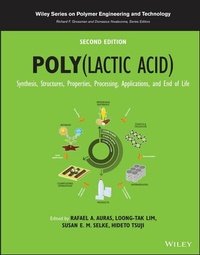
Poly(lactic acid)
Description

The second edition of a key reference, fully updated to reflect new research and applications
Poly(lactic acid)s - PLAs, biodegradable polymers derived from lactic acid, have become vital components of a sustainable society. Eco-friendly PLA polymers are used in numerous industrial applications ranging from packaging to medical implants and to wastewater treatment. The global PLA market is predicted to expand significantly over the next decade due to increasing demand for compostable and recyclable materials produced from renewable resources.
Poly(lactic acid) Synthesis, Structures, Properties, Processing, Applications, and End of Life provides comprehensive coverage of the basic chemistry, production, and industrial use of PLA. Contributions from an international panel of experts review specific processing methods, characterization techniques, and various applications in medicine, textiles, packaging, and environmental engineering. Now in its second edition, this fully up-to-date volume features new and revised chapters on 3D printing, the mechanical and chemical recycling of PLA, PLA stereocomplex crystals, PLA composites, the environmental footprint of PLA, and more.
* Highlights the biodegradability, recycling, and sustainability benefits of PLA
* Describes processing and conversion technologies for PLA, such as injection molding, extrusion, blending, and thermoforming
* Covers various aspects of lactic acid/lactide monomers, including physicochemical properties and production
* Examines different condensation reactions and modification strategies for enhanced polymerization of PLA
* Discusses the thermal, rheological, and mechanical properties of PLA
* Addresses degradation and environmental issues of PLA, including photodegradation, radiolysis, hydrolytic degradation, biodegradation, and life cycle assessment
Poly(lactic acid) Synthesis, Structures, Properties, Processing, Applications, and End of Life, Second Edition remains essential reading for polymer engineers, materials scientists, polymer chemists, chemical engineers, industry professionals using PLA, and scientists and advanced student engineers interested in biodegradable plastics.
More details
Other editions
Additional editions
Persons
RAFAEL A. AURAS, Professor, School of Packaging, College of Agriculture & Natural Resources, Michigan State University, USA.
LOONG-TAK LIM, Professor, Department of Food Science, University of Guelph, Canada.
SUSAN E. M. SELKE, Professor Emeritus, School of Packaging, College of Agriculture & Natural Resources, Michigan State University, USA.
HIDETO TSUJI, Professor, Department of Applied Chemistry and Life Science, Toyohashi University of Technology, Japan.
Content
List of Contributors xix
Preface xxiii
Author Biographies xxvii
Part I Chemistry and Production of Lactic Acid, Lactide, and Poly(Lactic Acid) 1
1 Production and Purification of Lactic Acid and Lactide 3 Wim Groot, Jan van Krieken, Olav Sliekersl, and Sicco de Vos
1.1 Introduction 3
1.2 Lactic Acid 4
1.2.1 History of Lactic Acid 4
1.2.2 Physical Properties of Lactic Acid 4
1.2.3 Chemistry of Lactic Acid 4
1.2.4 Production of Lactic Acid by Fermentation 5
1.2.5 Downstream Processing/Purification of Lactic Acid 8
1.2.6 Quality/Specifications of Lactic Acid 10
1.3 Lactide 10
1.3.1 Physical Properties of Lactide 10
1.3.2 Production of Lactide 11
1.3.3 Purification of Lactide 13
1.3.4 Quality and Specifications of Polymer-Grade Lactide 14
1.3.5 Concluding Remarks on Polymer-Grade Lactide 16
References 16
2 Aqueous Solutions of Lactic Acid 19 Carl T. Lira and Lars Peereboom
2.1 Introduction 19
2.2 Structure of Lactic Acid 19
2.3 Vapor Pressure of Anhydrous Lactic Acid and Lactide 19
2.4 Oligomerization in Aqueous Solutions 20
2.5 Equilibrium Distribution of Oligomers 21
2.6 Vapor-Liquid Equilibrium 23
2.7 Density of Aqueous Solutions 25
2.8 Viscosity of Aqueous Solutions 25
2.9 Summary 26
References 26
3 Industrial Production of High-Molecular-Weight Poly(Lactic Acid) 29 Anders Södergård, Mikael Stolt, and Saara Inkinen
3.1 Introduction 29
3.2 Lactic-Acid-Based Polymers by Polycondensation 30
3.2.1 Direct Condensation 31
3.2.2 Solid-State Polycondensation 32
3.2.3 Azeotropic Dehydration 33
3.3 Lactic Acid-Based Polymers by Chain Extension 34
3.3.1 Chain Extension with Diisocyanates 34
3.3.2 Chain Extension with Bis-2-Oxazoline 36
3.3.3 Dual Linking Processes 36
3.3.4 Chain Extension with Bis-Epoxies 36
3.4 Lactic-Acid-Based Polymers by Ring-Opening Polymerization 37
3.4.1 Polycondensation Processes 37
3.4.2 Lactide Manufacturing 37
3.4.3 Ring-Opening Polymerization 39
References 40
4 Design and Synthesis of Different Types of Poly(Lactic Acid)/Polylactide Copolymers 45 Ann-Christine
Albertsson, Indra Kumari Varma, Bimlesh Lochab, Anna Finne-Wistrand, Sangeeta Sahu, and Kamlesh Kumar
4.1 Introduction 45
4.2 Comonomers with Lactic Acid/Lactide 47
4.2.1 Glycolic Acid/Glycolide 47
4.2.2 Poly(Alkylene Glycol) 48
4.2.3 d-Valerolactone and ß-Butyrolactone 51
4.2.4 e-Caprolactone 51
4.2.5 1,5-Dioxepan-2-One 52
4.2.6 Trimethylene Carbonate 52
4.2.7 Poly(N-Isopropylacrylamide) 52
4.2.8 Alkylthiophene (P3AT) 53
4.2.9 Polypeptide 53
4.3 Functionalized PLA 54
4.4 Macromolecular Design of Lactide-Based Copolymers 55
4.4.1 Graft Copolymers 57
4.4.2 Star-Shaped Copolymers 59
4.4.3 Periodic Copolymers 60
4.5 Properties of Lactide-Based Copolymers 62
4.6 Degradation of Lactide Homo-and Copolymers 63
4.6.1 Drug Delivery from Lactide-Based Copolymers 64
4.6.2 Radiation Effects 65
References 65
5 Preparation, Structure, and Properties of Stereocomplex-Type Poly(Lactic Acid) 73 Neha Mulchandani, Yoshiharu Kimura, and Vimal Katiyar
5.1 Introduction 73
5.2 Stereocomplexation in Poly(Lactic Acid) 73
5.3 Crystal Structure of sc-PLA 74
5.4 Formation of Stereoblock PLA 75
5.4.1 Single-Step Process 75
5.4.2 Stepwise ROP 76
5.4.3 Chain Coupling Method 77
5.5 Stereocomplexation in Copolymers 79
5.5.1 Stereocomplexation in Random and Alternating Lactic Acid or Lactide-Based Polymers 79
5.5.2 sc-PLA-PCL Copolymers 80
5.5.3 sc-PLA-PEG Copolymers 80
5.6 Stereocomplex PLA-Based Composites 81
5.7 Advances in Stereocomplex-PLA 82
5.8 Conclusions 83
References 83
Part II Properties 87
6 Structures and Phase Transitions of PLA and Its Related Polymers 89 Hai Wang and Kohji Tashiro
6.1 Introduction 89
6.2 Structural Study of PLA 89
6.2.1 Preparation of Crystal Modifications of PLA 89
6.2.2 Crystal Structure of the a Form 91
6.2.3 Crystal Structure of the d Form 92
6.2.4 Crystal Structure of the ß Form 93
6.2.5 Structure of the Mesophase 94
6.3 Thermally Induced Phase Transitions 95
6.3.1 Phase Transition in Cold Crystallization 95
6.3.2 Phase Transition in the Melt Crystallization 95
6.3.3 Mechanically Induced Phase Transition 96
6.4 Microscopically-viewed Structure-Mechanical Properties of PLA 98
6.5 Structure and Formation of PLLA/PDLA Stereocomplex 100
6.5.1 Reconsideration of the Crystal Structure 100
6.5.2 Experimental Support of P3 Structure Model 103
6.5.3 Formation Mechanism of Stereocomplex 104
6.6 PHB and Other Biodegradable Polyesters 106
6.6.1 Poly(3-Hydroxybutyrate) (PHB) 106
6.6.2 Polyethylene Adipate (PEA) 109
6.7 Future Perspectives 110
Acknowledgements 110
References 110
7 Optical and Spectroscopic Properties 115 Isabel M. Marrucho
7.1 Introduction 115
7.2 Absorption and Transmission of UV-Vis Radiation 115
7.3 Refractive Index 118
7.4 Specific Optical Rotation 119
7.5 Infrared and Raman Spectroscopy 119
7.5.1 Infrared Spectroscopy 120
7.5.2 Raman Spectroscopy 125
7.6 1H and 13C NMR Spectroscopy 127
References 131
8 Crystallization and Thermal Properties 135 Luca Fambri and Claudio Migliaresi
8.1 Introduction 135
8.2 Crystallinity and Crystallization 136
8.3 Crystallization Regime 140
8.4 Fibers 142
8.5 Commercial Polymers and Products 144
8.6 Degradation and Crystallinity 146
Acknowledgments 148
References 148
9 Rheology of Poly(Lactic Acid) 153 John R. Dorgan
9.1 Introduction 153
9.2 Fundamental Chain Properties from Dilute Solution Viscometry 154
9.2.1 Unperturbed Chain Dimensions 154
9.2.2 Real Chains 154
9.2.3 Solution Viscometry 155
9.2.4 Viscometry of PLA 156
9.3 Processing of PLA: General Considerations 158
9.4 Melt Rheology: An Overview 159
9.5 Processing of PLA: Rheological Properties 160
9.6 Conclusions 165
Appendix 9.A Description of the Software 166
References 166
10 Mechanical Properties 169 Mohammadreza Nofar, Gabriele Perego, and Gian Domenico Cella
10.1 Introduction 169
10.2 General Mechanical Properties and Molecular Weight Effect 170
10.2.1 Tensile and Flexural Properties 170
10.2.2 Impact Resistance 171
10.2.3 Hardness 172
10.3 Temperature Effect 172
10.4 Relaxation and Aging 173
10.5 Annealing 174
10.6 Orientation 176
10.7 Stereoregularity 179
10.8 Self-Reinforced
PLA Composites 180
10.9 PLA Nanocomposites 180
10.10 Copolymerization 181
10.11 Plasticization 181
10.12 PLA Blends 182
10.13 Conclusions 186
References 186
11 Mass Transfer 191 Uruchaya Sonchaeng and Rafael Auras
11.1 Introduction 191
11.2 Background on Mass Transfer in Polymers 193
11.3 Mass Transfer Properties of Neat PLA Films 194
11.3.1 Mass Transfer of Gases 194
11.3.2 Mass Transfer of Oxygen 199
11.3.3 Mass Transfer of Water Vapor 201
11.3.4 Mass Transfer of Organic Vapors 203
11.4 Mass Transfer Properties of Modified PLA 205
11.4.1 PLA Stereocomplex and PLA Blends 206
11.4.2 PLA Nanocomposites 207
11.4.3 Other PLA Modifications 207
11.4.4 PLA in Other Forms 207
11.5 Final Remarks 208
Acknowledgments 208
References 208
12 Migration and Interaction with Contact Materials 217 Herlinda Soto-Valdez and Elizabeth Peralta
12.1 Introduction 217
12.2 Migration Principles 217
12.3 Legislation 218
12.4 Migration and Toxicological Data of Lactic Acid, Lactide, Dimers, and Oligomers 219
12.4.1 Lactic Acid 219
12.4.2 Lactide 224
12.4.3 Oligomers 225
12.5 EDI of Lactic Acid 226
12.6 Other Potential Migrants from PLA 227
12.7 Conclusions 227
References 228
Part III Processing and Conversion 231
13 Processing of Poly(Lactic Acid) 233 Loong-Tak Lim, Tim Vanyo, Jed Randall, Kevin Cink, and Ashwini K. Agrawal
13.1 Introduction 233
13.2 Properties of PLA Relevant to Processing 233
13.3 Modification of PLA Properties by Process Aids and Other Additives 235
13.4 Drying and Crystallizing 237
13.5 Extrusion 239
13.6 Injection Molding 241
13.7 Film and Sheet Casting 245
13.8 Stretch Blow Molding 249
13.9 Extrusion Blown Film 251
13.10 Thermoforming 252
13.11 Melt Spinning 254
13.12 Solution Spinning 258
13.13 Electrospinning 261
13.14 Filament Extrusion and 3D-Printing 265
13.15 Conclusion: Prospects of PLA Polymers 266
References 267
14 Blends 271 Ajay Kathuria, Sukeewan Detyothin, Waree Jaruwattanayon, Susan E. M. Selke, and Rafael Auras
14.1 Introduction 271
14.2 PLA Nonbiodegradable Polymer Blends 272
14.2.1 Polyolefins 272
14.2.2 Vinyl and Vinylidene Polymers and Copolymers 279
14.2.3 Rubbers and Elastomers 285
14.2.4 PLA/PMMA Blends 287
14.3 PLA/Biodegradable Polymer Blends 289
14.3.1 Polyanhydrides 289
14.3.2 Vinyl and Vinylidene Polymers and Copolymers 289
14.3.3 Aliphatic Polyesters and Copolyesters 297
14.3.4 Aliphatic-Aromatic Copolyesters 303
14.3.5 Elastomers and Rubbers 305
14.3.6 Poly(Ester Amide)/PLA Blends 307
14.3.7 Polyethers and Copolymers 307
14.3.8 Annually Renewable Biodegradable Materials 309
14.4 Plasticization of PLA 322
14.5 Conclusions 326
References 327
15 Foaming 341 Laurent M. Matuana
15.1 Introduction 341
15.2 Plastic Foams 341
15.3 Foaming Agents 342
15.3.1 Physical Foaming Agents 342
15.3.2 Chemical Foaming Agents 342
15.4 Formation of Cellular Plastics 343
15.4.1 Dissolution of Blowing Agent in Polymer 343
15.4.2 Bubble Formation 343
15.4.3 Bubble Growth and Stabilization 344
15.5 Plastic Foams Expanded with Physical Foaming Agents 344
15.5.1 Microcellular Foamed Polymers 344
15.5.2 Solid-State Batch Microcellular Foaming Process 345
15.5.3 Microcellular Foaming in a Continuous Process 353
15.6 PLA Foamed with Chemical Foaming Agents 358
15.6.1 Effects of CFA Content and Type 358
15.6.2 Effect of Processing Conditions 359
15.7 Mechanical Properties of PLA Foams 360
15.7.1 Batch Microcellular Foamed PLA 360
15.7.2 Extrusion of PLA 361
15.7.3 Microcellular Injection Molding of PLA 362
15.8 Foaming of PLA/Starch and Other Blends 362
References 363
16 Composites 367 Tanmay Gupta, Vijay Shankar Kumawat, Subrata Bandhu Ghosh, Sanchita Bandyopadhyay-Ghosh, and Mohini Sain
16.1 Introduction 367
16.2 PLA Matrix 367
16.3 Reinforcements 368
16.3.1 Natural Fiber Reinforcement 368
16.3.2 Synthetic Fiber Reinforcement 370
16.3.3 Organic Filler Reinforcement 370
16.3.4 Inorganic Filler Reinforcement 371
16.3.5 Laminated/Structural Composites 372
16.4 Nanocomposites 374
16.5 Surface Modification 375
16.5.1 Filler Surface Modification 375
16.5.2 Compatibilizing Agent 376
16.5.3 Composite Surface Modification 377
16.6 Processing 377
16.6.1 Conventional Processing 377
16.6.2 3D Printing 378
16.7 Properties 379
16.7.1 Mechanical Properties 379
16.7.2 Thermal Properties 382
16.7.3 Flame Retardancy 382
16.7.4 Degradation 383
16.7.5 Shape Memory Properties 383
16.8 Applications 384
16.8.1 Biomedical Applications 385
16.8.2 Packaging Applications 387
16.8.3 Automotive Applications 387
16.8.4 Sensing and Other Electronic Applications 388
16.9 Future Developments and Concluding Remarks 390
References 390
17 Nanocomposites: Processing and Mechanical Properties 411 Suprakas Sinha Ray
17.1 Introduction 411
17.2 Nanoclay-Containing PLA Nanocomposites 412
17.3 Carbon-Nanotubes-Containing PLA Nanocomposites 414
17.4 Graphene-Containing PLA Nanocomposites 416
17.5 Nanocellulose-Containing PLA Nanocomposites 417
17.6 Other Nanoparticle-Containing PLA Nanocomposites 418
17.7 Mechanical Properties of PLA-Based Nanocomposites 419
17.8 Possible Applications and Future Prospects 421
Acknowledgment 422
References 422
18 Mechanism of Fiber Structure Development in Melt Spinning of PLA 425 Nanjaporn Roungpaisan, Midori Takasaki, Wataru Takarada, and Takeshi Kikutani
18.1 Introduction-Fundamentals of Structure Development in Polymer Processing 425
18.2 High-speed Melt Spinning of PLLAs with Different d-Lactic Acid Content 426
18.2.1 Wide-angle X-ray Diffraction 426
18.2.2 Birefringence 427
18.2.3 Differential Scanning Calorimetry 428
18.2.4 Modulated-DSC and Lattice Spacing 429
18.3 High-speed Melt-Spinning of Racemic Mixture of PLLA and PDLA 430
18.3.1 Stereocomplex Crystal 430
18.3.2 Melt Spinning of PLLA/PDLA Blend 430
18.3.3 WAXD 431
18.3.4 Differential Scanning Calorimetry 432
18.3.5 In Situ WAXD upon Heating 432
18.4 Bicomponent Melt Spinning of PLLA and PDLA 433
18.4.1 Sheath-Core and Islands-in-the-Sea Configurations 433
18.4.2 Birefringence 434
18.4.3 DSC 434
18.4.4 Post Annealing 435
18.5 Concluding Remarks 436
References 437
Part IV Degradation, Environmental Impact, and End of Life 439
19 Photodegradation and Radiation Degradation 441 Wataru Sakai and Naoto Tsutsumi
19.1 Introduction 441
19.2 Mechanisms of Photodegradation 441
19.2.1 Photon 441
19.2.2 Photon Absorption 442
19.2.3 Photochemical Reactions of Carbonyl Groups 443
19.3 Mechanism of Radiation Degradation 443
19.3.1 High-Energy Radiation 443
19.3.2 Basic Mechanism of Radiation Degradation 444
19.4 Photodegradation of PLA 444
19.4.1 Fundamental Mechanism 444
19.4.2 Photooxidation Degradation 446
19.4.3 High-Energy Photo-Irradiation 447
19.4.4 Photosensitized Degradation of PLA 447
19.4.5 Photodegradation of PLA Blends 449
19.5 Radiation Degradation of PLA 449
19.6 Irradiation Effects on Biodegradability 451
19.7 Modification and Composites of PLA 452
References 452
20 Thermal Degradation 455 Haruo Nishida
20.1 Introduction 455
20.2 Thermal Degradation Behavior of PLLA Based on Weight Loss 455
20.2.1 Diverse Mechanisms 455
20.2.2 Factors Affecting the Thermal Degradation Mechanism 456
20.2.3 Thermal Stabilization 457
20.3 Kinetic Analysis of Thermal Degradation 458
20.3.1 Single-Step Thermal Degradation Process 458
20.3.2 Complex Thermal Degradation Process 459
20.4 Kinetic Analysis of Complex Thermal Degradation Behavior 460
20.4.1 Two-Step Complex Reaction Analysis of PLLA in Blends 460
20.4.2 Multistep Complex Reaction Analysis of Commercially Available PLLA 461
20.5 Thermal Degradation Behavior of PLA Stereocomplex: scPLA 463
20.6 Control of Racemization 464
20.7 Conclusions 465
References 465
21 Hydrolytic Degradation 467 Hideto Tsuji
21.1 Introduction 467
21.2 Degradation Mechanism 467
21.2.1 Molecular Degradation Mechanism 468
21.2.2 Material Degradation Mechanism 479
21.2.3 Degradation of Crystalline Residues 485
21.3 Parameters for Hydrolytic Degradation 488
21.3.1 Effects of Surrounding Media 488
21.3.2 Effects of Material Parameters 490
21.4 Structural and Property Changes During Hydrolytic Degradation 498
21.4.1 Fractions of Components 498
21.4.2 Crystallization 498
21.4.3 Mechanical Properties 499
21.4.4 Thermal Properties 499
21.4.5 Surface Properties 500
21.4.6 Morphology 500
21.5 Applications of Hydrolytic Degradation 500
21.5.1 Material Preparation 500
21.5.2 Recycling of PLA to Its Monomer 502
21.6 Conclusions 503
References 503
22 Enzymatic Degradation 517 Ken'ichiro Matsumoto, Hideki Abe, Yoshihiro Kikkawa, and Tadahisa Iwata
22.1 Introduction 517
22.1.1 Definition of Biodegradable Plastics 517
22.1.2 Enzymatic Degradation 517
22.2 Enzymatic Degradation of PLA Films 519
22.2.1 Structure and Substrate Specificity of Proteinase K 519
22.2.2 Enzymatic Degradability of PLLA Films 519
22.2.3 Enzymatic Degradability of PLA Stereoisomers and Their Blends 520
22.2.4 Effects of Surface Properties on Enzymatic Degradability of PLLA Films 521
22.3 Enzymatic Degradation of Thin Films 525
22.3.1 Thin Films and Analytical Techniques 525
22.3.2 Crystalline Morphologies of Thin Films 525
22.3.3 Enzymatic Adsorption and Degradation Rate of Thin Films 526
22.3.4 Enzymatic Degradation of LB Film 526
22.3.5 Application of Selective Enzymatic Degradation 529
22.4 Enzymatic Degradation of Lamellar Crystals 530
22.4.1 Enzymatic Degradation of PLLA Single Crystals 530
22.4.2 Thermal Treatment and Enzymatic Degradation of PLLA Single Crystals 532
22.4.3 Single Crystals of PLA Stereocomplex 533
22.5 Recent Advances in Characterization of Enzymes that Degrade PLAs Including PDLA and Related Copolymers 534
22.5.1 aß-Hydrolase 535
22.5.2 Lipases and Cutinase-Like Enzymes 535
22.5.3 Polyhydroxyalkanoate Depolymerases 536
22.5.4 Enhancement of Biodegradability of PLAs 536
22.5.5 Control of Enzymatic Degradation of PLAs 537
22.6 Future Perspectives 537
References 537
23 Environmental Footprint and Life Cycle Assessment of Poly (Lactic Acid) 541 Amy E. Landis, Shakira R. Hobbs, Dennis Newby, Ja'Maya Wilson, and Talia Pincus
23.1 Introduction to LCA and Environmental Footprints 541
23.1.1 Life Cycle Assessment 541
23.1.2 Uncertainty in LCA 542
23.2 Life Cycle Considerations for PLA 542
23.2.1 The Life Cycle of PLA 542
23.2.2 Energy Use and Global Warming 544
23.2.3 Environmental Trade-Offs 544
23.2.4 Waste Management 545
23.2.5 End of Life 546
23.3 Review of Biopolymer LCA Studies 546
23.3.1 Cradle-to-Gate and Cradle-to-Grave LCAs 546
23.3.2 End-of-Life LCAs 547
23.4 Improving PLA's Environmental Footprint 553
23.4.1 Agricultural Management 553
23.4.2 Feedstock Choice 554
23.4.3 Energy 554
23.4.4 Design for End of Life 555
References 555
24 End-of-Life Scenarios for Poly(Lactic Acid) 559 Anibal Bher, Edgar Castro-Aguirre, and Rafael Auras
24.1 Introduction 559
24.2 Transition from a Linear to a Circular Economy for Plastics 559
24.3 Waste Management System 561
24.4 End-of-Life Scenarios for PLA 564
24.4.1 Prevention and Source Reduction 565
24.4.2 Reuse 566
24.4.3 Recycling 566
24.4.4 Biodegradation 569
24.4.5 Incineration with Energy Recovery 572
24.4.6 Landfill 573
24.5 LCA of End-of-Life Scenario for PLA 574
24.6 Final Remarks 575
References 575
Part V Applications 581
25 Medical Applications 583 Shuko Suzuki and Yoshito Ikada
25.1 Introduction 583
25.2 Minimal Requirements for Medical Devices 583
25.2.1 General 583
25.2.2 PLA as Medical Implants 584
25.3 Preclinical and Clinical Applications of PLA Devices 585
25.3.1 Fibers 585
25.3.2 Meshes 588
25.3.3 Bone Fixation Devices 589
25.3.4 Micro-and Nanoparticles, and Thin Coatings 595
25.3.5 Scaffolds 597
25.4 Conclusions 598
References 598
26 Packaging and Consumer Goods 605 Hayati Samsudin and Fabiola Iñiguez-Franco
26.1 Introduction: Polylactic Acid (PLA) in Packaging and Consumer Goods 605
26.2 Food and Beverage 606
26.2.1 Evolution of PLA in the Food and Beverage Market 606
26.2.2 Growing Interest in PLA Serviceware 607
26.3 Distribution Packaging 612
26.4 Other Consumer Goods : Automotive 613
26.5 Other Consumer Goods 613
26.6 Challenges and Final Remarks 614
References 615
27 Textile Applications 619 Masatsugu Mochizuki
27.1 Introduction 619
27.2 Manufacturing, Properties, and Structure of PLA Fibers 619
27.2.1 PLA Fiber Manufacture 619
27.2.2 Properties of PLA Fibers and Textile 619
27.2.3 Effects of Structure on Properties 620
27.2.4 PLA Stereocomplex Fibers 621
27.3 Key Performance Features of PLA Fibers 621
27.3.1 Biodegradability and the Biodegradation Mechanism 621
27.3.2 Moisture Management 623
27.3.3 Antibacterial/Antifungal Properties 623
27.3.4 Low Flammability 624
27.3.5 Weathering Stability 624
27.4 Potential Applications 625
27.4.1 Geotextiles 625
27.4.2 Industrial Fabrics 625
27.4.3 Filters 626
27.4.4 Towels and Wipes 626
27.4.5 Home Furnishings 627
27.4.6 Clothing and Personal Belongings 627
27.4.7 3D-Printing Filament 628
27.5 Conclusions 628
References 628
28 Environmental Applications 631 Akira Hiraishi and Takeshi Yamada
28.1 Introduction 631
28.2 Application to Water and Wastewater Treatment 631
28.2.1 Application as Sorbents 631
28.2.2 Application to Nitrogen Removal 633
28.3 Application to Methanogenesis 637
28.3.1 Anaerobic Digestion 637
28.3.2 Methanogenic Microbial Community 637
28.4 Application to Bioremediation 638
28.4.1 Significance of PLA Use 638
28.4.2 Bioremediation of Organohalogen Pollution 638
28.4.3 Other Applications 639
28.5 Concluding Remarks and Prospects 640
Acknowledgments 641
References 641
Index 645
PREFACE
The technological breakthrough at Cargill, Inc. in the early 1990s to produce high-molecular-weight PLA via commercially viable lactide ring-opening polymerization can be considered as the key milestone that paved the way to transform PLA from a specialty material to a commodity thermoplastic (Table P.1). Today, PLA has emerged as one of the mainstream biodegradable polymers that find many applications ranging from biomedical to single-use food packages.
Like the first edition, this volume is organized into five parts. In Part I, Chapters 1 and 2 cover various aspects of lactic acid/lactide monomers, including their physicochemical properties and production. Chapter 3 looks at different condensation reactions for the polymerization of PLA. To enhance the properties of PLA, modification involving copolymerization with lactic acid/lactide of different isomers is one of the strategies available today. These topics are presented in Chapter 4. This sets the stage for the discussions in Chapter 5 on fundamentals and technologies related to stereocomplex PLA produced by co-crystallization of PLLA/PDLA stereoisomers; topics discussed include stereoblock formation, copolymerization, and composite formation. Structures and phase transition behaviors of various crystals for PLA and PLLA/PDLA stereoisomer are reviewed in Chapter 6, along with comparison to related biodegradable polyesters.
Part II is dedicated to the techniques for material characterization for PLA. This part starts with Chapter 7 that focuses on spectroscopy techniques for PLA analysis, including UV-Vis, Fourier transform infrared, Raman, nuclear magnetic resonance spectroscopies. Chapters 8, 9, and 10 discuss the thermal, rheological, and mechanical properties of PLA, respectively, as affected by factors such as temperature, aging, annealing, molecular stereoregularity, copolymerization, and additive incorporation. Mass transport phenomena of gases and nonvolatile compounds in PLA have important implications on their end-use performance, especially in packaging applications. Chapters 11 and 12 discuss these topics in great depth.
Part III is made up of six chapters that are devoted to processing and conversion technologies for PLA. Chapter 13 summarizes the main conversion methodologies for PLA based on melt and solution processing (e.g., extrusion, injection molding, blow molding, thermoforming, fiber spinning). Other conversion techniques are presented in the subsequent chapters, including blending (Chapter 14), foaming (Chapter 15), composites and nanocomposites processing (Chapters 16 and 17). Chapter 18 looks at melt spinning process in greater depth, explicitly dealing with the mechanisms of fiber structure development.
Part IV covers the degradation and environmental issues of PLA. Bio- and physicochemical degradation phenomena of PLA are discussed in great length by various authors. Chapter 19 presents the mechanisms of photodegradation and radiolysis of PLA. Thermal degradation phenomena are highly relevant during the processing of PLA; Chapter 20 focuses on this topic wherein the authors address the apparent complexities of degradation kinetics through a multi-step complex reaction analysis method. Chapter 21 discusses the mechanisms of hydrolytic degradation, taking polymer (e.g., molecular structure/weight, highly ordered structures, blends) and medium (e.g., temperature, pH) factors into considerations. Complementarily, Chapter 22 reviews the literature on enzymatic degradation, focusing on PLA derived from melt-crystallized, solvent-cast, and blend films. Recent advances in enzymes that degrade PLAs and their copolymers are also presented. The next two chapters deal with environmental issues, including topics such as life cycle assessment (Chapter 23) and end-of-life scenarios (Chapter 24). Finally, in Part V, various applications for PLA are discussed, including medical items (Chapter 25), packaging and consumer goods (Chapter 26), textiles (Chapter 27), and environmental applications (Chapter 28).
TABLE P.1 Significant Events Related to PLA Production that Occurred Over the Past Few Decades
2021 NatureWorks production capacity reached 150,000 metric tons in Blair, NE, and a new plant of 75,000 metric tons in the Nakhon Sawan Province, Thailand was announced to be opened in 2024. Total Corbion produces 75,000 metric tons in Rayong, Thailand, and it announces a second plant in Grandpuits, France 2015 Enzyme-based technology by Carbios rendering biodegradation of PLA at mesophilic conditions 2012 Announcement of production of high-heat PLA by Total Corbion enabling durable applications 2010 Jung et al. employed recombinant Escherichia coli to produce PLAa 2009 PURAC, Sulzer, and Synbra announced production of PLA from solid lactide for foamed products 2009 Galactic and Total Petrochemicals from Belgium created a joint venture, Futerro, to begin PLA production 2009 Cargill, Inc. acquired full NatureWorks ownership from Teijin Ltd. 2008 Uhde Inventa Fischer and Pyramide Bioplastics announced large-scale production of PLA in Guben, Germany 2008 PURAC started to commercialize solid lactide monomers under PURALACTT 2007 Teijin launched heat-resistant stereocomplex PLA under BiofrontT 2007 NatureWorks LLC and Teijin Limited formed 50-50 joint venture to market IngeoT biobased thermoplastic resins 2005 Cargill, Inc. acquired The Dow Chemical Company's share in Cargill-Dow LLC 50-50 joint venture 2003 Toyota produced and developed PLA for automotive applications 1997 Formation of Cargill-Dow LLC, a 50-50 joint venture of Cargill, Inc., and The Dow Chemical Company to commercialize PLA under the tradename NatureWorksT 1997 Fiberweb (now BBA, France) introduced melt-blown and spunlaid PLA fabrics under DeposaT brand name 1996 Mitsui Chemicals commercialize PLA produced by polycondensation route 1994 Kanebo Ltd. introduced Lactron® PLLA fiber and spun-laid nonwovens 1990s Cargill polymerized high-molecular-weight LA using commercially viable lactide ring-opening reaction 1932 Wallace Hume Carothers and coworkers polymerized lactide to produce PLA 1845 Théophile Jules Pelouze synthetized PLA by lactic acid condensationMore than 10 years have passed since the first edition of this volume was published in 2010. During this period, there have been considerable scientific advancements and technological developments of PLA. PLA continues to captivate the interests of technologists and researchers, as reflected by the sustained increase in the number of publications related to PLA (Figure P.1). The main goal for the second edition is to update the volume with new progress made on various topics of PLA. We made a minor change in the book title, adding "End of Life" to it given the expanded discussions related to this area.
FIGURE P.1 Number of publications since 1984 based on Web of Science search (accessed on 24 September 2021) using the keywords ("polylactide," "poly(lactic acid),", and "polylactic acid."
For completeness and better flow, we deliberately allowed some overlap between chapters so that they are relatively stand-alone. Chapter 1 is a reprint from the first edition. Chapter 9 is a reprint from Chapter 10 of the first edition. Since the theoretical framework of rheology for PLA remains valid, we have decided to include this chapter in the present edition. In addition, a part of Chapter 20, "Spinning of poly(lactic acid) fibers," from the first edition is now incorporated in Chapter 13 of the present edition.
We are grateful to all authors who contributed their manuscripts and thankful to them for entrusting us to edit their contributions to meet the needs of this volume. It would not have been possible to complete this project without their participation and patience during the preparation of this book. We hope that readers will find this updated edition of the book useful. We are looking forward to receiving comments and feedback regarding the content of this book.
September 2021
Rafael A. Auras
Loong-Tak Lim
Susan E. M. Selke
Hideto Tsuji
REFERENCE
- 1. Y.K. Jung, T.Y. Kim, S.J. Park, S.Y. Lee, Biotechnol. Bioeng. 2010,...
