

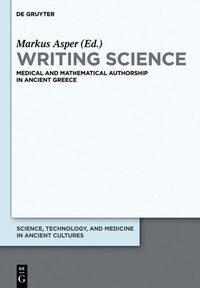
Writing Science
Description

Scientific and technological texts have not played a significant role in modern literary criticism. This applies to Classics, too, despite the fact that a large part of the field's extant texts deal with questions of medicine, mathematics, and natural philosophy. Focusing mostly on medical and mathematical texts, this collection aims at approaching ancient Greek science and its texts from the cross-disciplinary perspective of authorship. Among the questions addressed are: What is a scientific author? In what respect does scientific writing differ from 'literary' writing? How does the author present himself as an authoritative figure through his text? What strategies of trust do these authors employ? These and related questions cannot be discussed within the typical boundaries of modern academic disciplines, thus most of the sixteen authors, many of them leading experts in the fields of ancient science, bring a comparative perspective to their subjects. As a result, the collection not only offers a new approach to this vast area of ancient literature, thus effectively discovering new possibilities for literary criticism, it also reflects on our current forms of scientific and scholarly written communication.
Reviews / Votes
"The rich collection of topics, the diversity of backgrounds and approaches to scientific writing and its narratology, the inclusion of several different disciplines of ancient science, and the impressive learning which pervades the collection make this volume a welcome addition to the bibliography of ancient science and its Nachleben."Konstantinos Kapparis in: BMCR 2014.12.08More details
Other editions
Additional editions
Persons
Content
2 - A. Comparisons [Seite 23]
2.1 - The Name and Nature of Science: Authorship in Social and Evolutionary Context [Seite 25]
2.2 - Ancient Writings, Modern Conceptions of Authorship. Reflections on Some Historical Processes That Shaped the Oldest Extant Mathematical Sources from Ancient China [Seite 71]
2.3 - Scholarship and Competitiveness: Pliny the Elder's Attitude towards His Predecessors in the Naturalis Historia [Seite 91]
3 - B. Greek Medical Writing [Seite 117]
3.1 - Writing the Animal: Aristotle, Pliny the Elder, Galen [Seite 119]
3.2 - Galen and the Scientific Treatise: a Case Study of Mixtures [Seite 153]
3.3 - Galen on Poetic Testimony- [Seite 185]
3.4 - The Violent Scholiast: Power Issues in Ancient Commentaries- [Seite 199]
4 - C. Greek Mathematical Writing [Seite 223]
4.1 - Authorial Presence in the Ancient Exact Sciences [Seite 225]
4.2 - Accounts, Numeracy and Democracy in Classical Athens [Seite 263]
4.3 - Diagrammatic Reasoning: the Foundations of Mechanics [Seite 287]
4.4 - Three Introductions to Celestial Science in the First Century BC [Seite 307]
5 - D. Science Writing as/and Literature [Seite 339]
5.1 - On the Variety of 'Genres' of Greek Mathematical Writing: Thinking about Mathematical Texts and Modes of Mathematical Discourse [Seite 341]
5.2 - Sing, Muse, of the Hypotenuse: Influences of Poetry and Rhetoric on the Formation of Greek Mathematics [Seite 375]
5.3 - Making up Progress - in Ancient Greek Science Writing [Seite 419]
5.4 - In Strange Lands: Disembodied Authority and the Role of the Physician in the Hippocratic Corpus and Beyond [Seite 439]
6 - Notes on Contributors [Seite 481]
7 - General Index [Seite 485]
8 - Index Locorum [Seite 493]
