

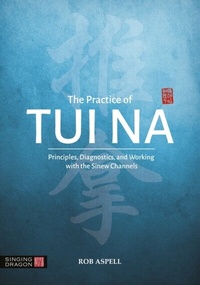
The Practice of Tui Na
Principles, Diagnostics and Working with the Sinew Channels
Published on 18. July 2019
296 pages
978-0-85701-370-5 (ISBN)
Description

Tui Na is one of the 'Four Pillars' of Chinese medicine (alongside Acupuncture, herbal medicine and Qi Gong) and is a form of bodywork that includes acupressure, massage techniques, assisted stretching, and joint mobilisations or adjustments that are all based on the key medical principles and diagnostics of the Classics of Chinese medicine. This book is an accessible clinical handbook of Tui Na principles and practice.
Tui Na can be used as much more than a musculoskeletal therapy, but in order to use it to its full potential as a medical intervention, it is essential to understand its uses on the Sinew channel system as opposed to the other channel systems commonly used within acupuncture. Tui Na requires an understanding of the principles and pathways of the Sinew channels as a standalone system of the body, as well as its relationship to the other channel and organ systems, and this book provides an accessible introduction to these channels before moving onto Tui Na practice. There are Sections on Diagnosis and Assessment, Techniques and Treatments with hand and joint manipulation techniques covered in detail, along with instruction on developing a Tui Na prescription and protocols for the treatment of common conditions.
This book can be used by beginners studying on a hands-on practical course in Tui Na, in addition to qualified Chinese medicine and Tui Na practitioners.
Tui Na can be used as much more than a musculoskeletal therapy, but in order to use it to its full potential as a medical intervention, it is essential to understand its uses on the Sinew channel system as opposed to the other channel systems commonly used within acupuncture. Tui Na requires an understanding of the principles and pathways of the Sinew channels as a standalone system of the body, as well as its relationship to the other channel and organ systems, and this book provides an accessible introduction to these channels before moving onto Tui Na practice. There are Sections on Diagnosis and Assessment, Techniques and Treatments with hand and joint manipulation techniques covered in detail, along with instruction on developing a Tui Na prescription and protocols for the treatment of common conditions.
This book can be used by beginners studying on a hands-on practical course in Tui Na, in addition to qualified Chinese medicine and Tui Na practitioners.
More details
Edition
Digital original
Language
English
Place of publication
London
United Kingdom
Publishing group
Jessica Kingsley Publishers
Edition type
Digital original
Illustrations
63 images (26 technique illustrations, 12 Sinew Channels images, 4 Section page images, 21 others)
File size
2,84 MB
ISBN-13
978-0-85701-370-5 (9780857013705)
Copyright in bibliographic data and cover images is held by Nielsen Book Services Limited or by the publishers or by their respective licensors: all rights reserved.
Schweitzer Classification
Other editions
Additional editions
Book
07/2019
Singing Dragon
€56.00
Shipment within 3-4 weeks
Person
Rob Aspell is a practitioner and teacher of Chinese medicine, including Tui Na. He is Director and Senior Lecturer at the Xian Tian College of Chinese Medicine, and teaches Chinese medicine in the UK and internationally throughout Europe.
Content
- Intro
- The Practice of Tui Na: Principles, Diagnostics and Working with the Sinew Channels by Rob Aspell
- Foreword by Damo Mitchell
- Acknowledgements
- Introduction
- Section 1: Foundations of Tui Na
- 1. Introduction to Tui Na
- Core principles of Tui Na
- Benefits of Tui Na
- Safe practice of Tui Na
- 2. Approaches to Practice and Practitioner Development
- Approaches to practice
- The nine therapeutic methods of Tui Na (Jiu Fa, ??)
- Patient after-care
- 3. The Sinew Channels (Jing Jin, ??)
- Categorisation of the channels and collaterals (Jing Luo, ??)
- Introduction to the Sinew channels (Jing Jin, ??)
- Pairings and groupings of the Sinew channels
- Acupoints and the Sinew channels
- Functions of the Sinew channels as a whole
- Relationship between the Sinew channels and the Primary channels
- Relationship between the Sinew channels and the Zang Fu ( ) organs
- The Sinew channels and Wei Qi ( ?)
- The sequence of Qi flow within the Sinew channels
- The Sinew channels and external pathogenic factors
- The Sinew channels and diagnosis
- Leg Tai Yang (Bladder) Sinew channel
- Leg Shao Yang (Gall Bladder) Sinew channel
- Leg Yang Ming (Stomach) Sinew channel
- Arm Tai Yang (Small Intestine) Sinew channel
- Arm Shao Yang (San Jiao) Sinew Channel
- Arm Yang Ming (Large Intestine) Sinew channel
- Leg Tai Yin (Spleen) Sinew channel
- Arm Tai Yin (Lung) Sinew channel
- Leg Shao Yin (Kidney) Sinew channel
- Arm Shao Yin (Heart) Sinew channel
- Leg Jue Yin (Liver) Sinew channel
- Arm Jue Yin (Pericardium) Sinew channel
- Section 2: Diagnostics of Tui Na
- 4. Diagnostics of Tui Na
- The importance of the Diaphragm and breathing
- Understanding pain in Chinese Medicine
- The nature of pain
- 5. Assessment of the Sinew Channels through Observation, Inquiry and Palpation
- Observation
- Inquiry
- Palpation
- 6. Assessment of the Sinew Channels through Movement and Engagement
- Pairing of the Sinew channels
- Assessment of the Sinew channels through strength and engagement
- 7. Special Examinations
- The spine
- Upper extremities
- Lower extremities
- Section 3: Hand Techniques
- 8. Introduction to Tui Na Techniques
- The Five Virtues of Tui Na
- Shaping the body's landscape
- Applying the correct pressure during treatment
- The six basic technique categories
- Choosing and combining Tui Na techniques - prescription building
- 9. Tui Na Hand Techniques
- ?? An Fa (pressing)
- ?? Ca Fa (to-and-fro rubbing)
- ?? Cuo Fa (palm twisting)
- ?? Gun Fa (rolling)
- ?? Dou Fa (shaking)
- ?? Ji Fa (striking/percussing)
- ?? Ma Fa (wiping)
- ?? Mo Fa (circular rubbing)
- ?? Na Fa (grasping)
- ?? Nian Fa (finger twisting)
- ?? Nie Fa (pinching)
- ?? Pai Fa (patting)
- ?? Rou Fa (kneading)
- ??? Tan Bo Fa (plucking)
- ?? Tui Fa (pushing)
- ?? Zhen Fa (vibrating)
- ????? Yi Zhi Chan Tui Fa (single finger meditation pushing)
- Passive joint manipulation techniques
- ??? Ba Shen Fa (traction)
- ?? Ban Fa (pulling and/or twisting)
- ?? Yao Fa (rocking/rotating)
- Section 4: Treatment Guidelines
- 10. Treatment Guidelines
- Stages of treatment
- Treatment of common conditions
- 11. Mental/Emotional Disorders
- The Five Spirits (Wu Shen, ??)
- Treatment to regulate the Shen (?)
- The Seven Emotions (??, Qi Qing)
- Treatment to regulate the emotions
- Key acupressure points
- Anxiety
- Depression
- 12. Respiratory Disorders
- Key acupressure points
- Releasing the diaphragm
- Treatment of conditions affecting the respiratory system
- 13. Digestive Disorders
- Key acupressure points
- Opening and regulating the abdomen
- Abdominal palpation and release techniques
- Constipation
- Diarrhoea
- Food retention
- 14. Gynaecological Disorders
- Key acupressure points
- The four phases of the menstrual cycle
- Phase One: Menstruation
- Phase Two: The Follicular Phase
- Phase Three: Ovulation
- Phase Four: The Luteal Phase
- 15. Musculoskeletal Disorders
- General headaches
- General neck pain
- General lower back pain
- Treatment of the upper limbs
- General shoulder pain
- General elbow pain
- General wrist pain
- Treatment of the lower limbs
- General knee pain
- General ankle pain (including plantar fasciitis)
- Index
- Blank Page
