

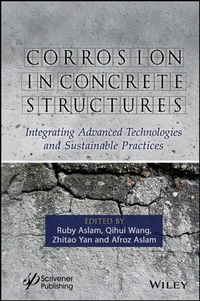
Corrosion in Concrete Structures
Description

Enhance the durability and longevity of critical infrastructure with this essential book that provides a comprehensive, multidisciplinary guide to the fundamentals of concrete corrosion and practical solutions using advanced anti-corrosion technologies and sustainable practices.
Concrete is the backbone of modern infrastructure, forming the foundation of bridges, high-ways, buildings, and countless other structures worldwide. Yet despite its strength and versatility, concrete is highly susceptible to corrosion, leading to structural degradation, safety risks, and costly repairs. Addressing this challenge requires a multidisciplinary approach that integrates fundamental corrosion science with cutting-edge technologies and sustainable practices.
Corrosion in Concrete Structures is a comprehensive guide to understanding and addressing corrosion in concrete. Starting with the fundamentals, this book explores the material properties of concrete, the key concepts behind corrosion, and the environments that make concrete prone to degradation. Readers will gain in-depth knowledge of corrosion assessment, inspection techniques, and the environmental and sustainability implications of concrete corrosion. The book also delves into the role of advanced anti-corrosion technologies, including coatings, sealants, and cathodic protection systems. It examines corrosion inhibitors and their applications, offering practical solutions for reducing corrosion in real-world settings.
With case studies and innovations in concrete corrosion control, this book serves as an invaluable resource for engineers, researchers, and industry professionals seeking to enhance the durability and sustainability of concrete structures in the face of corrosion challenges.
Audience
Engineers, materials scientists, chemists, academics, and researchers in the fields of civil engineering, structural engineering, and materials science, specifically those involved in the development of sustainable and innovative corrosion prevention technologies within the concrete and construction sectors.
More details
Other editions
Additional editions
Persons
Ruby Aslam, PhD is a Postdoctoral fellow in the School of Civil and Hydraulic Engineering, Chongqing University of Science and Technology, Chongqing, China. She has authored and co-authored more than 100 research articles in international peer-reviewed journals and edited 17 books. Her research focuses on corrosion inhibitors, ionic liquids, and colloid and surface science.
Qihui Wang, PhD works in the School of Civil Engineering and Architecture, Chongqing University of Science and Technology, Chongqing, China. His research focuses on the development and application of green corrosion inhibitors and theoretical calculations to explain the anti-corrosion mechanism of green corrosion inhibitors against metals.
Zhitao Yan, PhD is a Professor in the School of Civil Engineering and Architecture at the Chongqing University of Science and Technology, Chongqing, China. He has authored and co-authored more than 170 research articles in international peer-reviewed journals, authorized 57 Chinese patents, and published three monographs. His research interests include structure wind engineering, nonlinear vibration, and transmission tower line systems.
Afroz Aslam, PhD is an Assistant Professor in the Department of Chemistry, the Constituent Government College, Rohilkhand University, Bareilly, U.P. India. She has published many research articles and chapters in peer-reviewed international journals. Her research is mainly focused on organic synthesis, materials and corrosion, phytochemistry, and heterocyclic catalysis.
Content
Preface xv
1 Corrosion Fundamentals: Understanding the Science Behind the Damage 1
Kaoutar Zaidi, Walid Daoudi, Selma Lamghafri, Omar Dagdag, Abdelmalik El Aatiaoui and Abdelouahad Aouinti
1.1 Introduction 2
1.2 Basic Chemistry of Corrosion 3
1.3 Types of Corrosion 5
1.4 Electrochemical Corrosion Mechanisms 8
1.5 Corrosion-Inducing Factors 10
1.6 Conclusion 11
2 Concrete Material Properties and Corrosion 13
Rajae Salim, Jamila Lazrak, Elhachmia Ech-chihbi, Walid Ettahiri, Charafeddine Jama, Belkheir Hammouti and Mustapha Taleb
2.1 Introduction 14
2.2 Importance of Steel in Concrete 18
2.4 Corrosion Properties of Steel in Concrete 28
2.5 Causes of Concrete Corrosion 33
2.6 Consequences of Concrete Corrosion 35
2.7 Methods of Protecting Concrete against Corrosion 37
2.8 Techniques for Assessing Corrosion Concrete 48
2.9 Future Perspectives and Research Directions 52
2.10 Conclusion 52
3 Fundamentals and Understanding of Corrosion-Prone Environments in Concrete Corrosion 59
Demian I. Njoku, Annuncieta C. Njoku, Paul C. Uzoma, Ini-Ibehe Nabuk Etim and Inime I. Udoh
3.1 Introduction 60
3.2 Factors That Contribute to Concrete Corrosion 61
3.3 Concrete Corrosion-Prone Environments 63
3.4 Distinctive Analysis of the Process of Concrete Corrosion 68
3.5 Current Practices Used to Minimize Corrosion in Different Environments 71
3.6 Cases of Failures due to Corrosion of Concrete Structures in Different Environments and the Mitigations 74
3.7 Conclusions 76
4 Corrosion Assessment and Inspection in Concrete Corrosion 85
Ichraq Bouhouche, Khalid Bouiti, Nabil Lahrache, Najoua Labjar, Hamid Nasrellah, Said Laasri, Ayoub Cherrat and Souad El Hajjaji
4.1 Introduction to Corrosion Assessment and Inspection 86
4.2 Forms of Corrosion in Concrete 88
4.3 Visual Assessment Methods 90
4.4 Electrochemical Assessment Methods 93
4.5 Non-Destructive Testing (NDT) Techniques 98
4.6 Advanced Technologies in Corrosion Inspection 100
4.7 Case Studies in Corrosion Assessment 101
4.8 Discussion on Assessment and Inspection Results 104
4.9 Conclusion 105
5 Impact of Concrete Corrosion on Environmental Sustainability 119
Abhinay Thakur, Valentine C. Anadebe, Elyor Berdimurodov, Abdelkader Zarrouk, Omar Dagdag and Ashish Kumar
5.1 Introduction 120
5.2 Types of Concrete Corrosion 123
5.3 Impact on Structural Integrity and Concrete Durability 125
5.4 Environmental Consequences 129
5.5 Sustainability Challenges 133
5.6 Mitigation Strategies and Recent Advancements 136
5.7 Challenges and Future Directions 146
5.8 Conclusion 149
6 Role of Anti-Corrosion Coatings and Sealants in Preventing Concrete Corrosion 163
Humira Assad, Richika Ganjoo, Shveta Sharma, Praveen Kumar Sharma, Femiana Gapsari and Ashish Kumar
6.1 Introduction 164
6.2 Concrete Corrosion 166
6.3 Overview of Anti-Corrosion Coatings and Sealant Systems 168
6.4 Role of Anti-Corrosion Coatings and Sealants in Concrete Corrosion 177
6.5 Conclusion 180
7 Role of Cathodic Protection Systems in Preventing Concrete Corrosion 187
Samir H. Shafek, Ahmed H. Elged, Mohamed A. Shenashen, Emad A. Badr and Hassan H. H. Hefni
7.1 Introduction 188
7.2 Cathodic Protection 189
7.3 Cathodic Protection (CP) Monitoring Techniques in Concrete Structures 190
7.4 Anode Installation and Replacement 194
7.5 Anode Materials 197
7.6 Factors Affecting Cathodic Protection Design in Concrete Corrosion 203
7.7 New Trends of Cathodic Protection in Concrete Corrosion 204
7.8 Challenges in Implementing Cathodic Protection in Concrete and Addressing Environmental and Sustainability Considerations 208
7.9 Conclusion 208
8 Role of Corrosion Inhibitors in Preventing Concrete Corrosion 213
Shweta Goyal, Vijay Luxami and Sonia Rani
8.1 Introduction 214
8.2 Definition of Corrosion Inhibitors 215
8.3 Mechanism of Action of Inhibitor 216
8.4 Classification of Corrosion Inhibitors 217
8.5 Classification Based on Mechanism of Action 217
8.6 Classification Based on Field Application 220
8.7 Classification Based on Chemical Composition 222
8.8 Green Inhibitors 238
8.9 Smart Inhibitors 243
8.10 Testing and Evaluation Methods of Inhibitors 245
8.11 Challenges and Future Perspectives 247
8.12 Conclusion 248
9 Case Studies on Concrete Corrosion 257
Ali Dashan, Hedieh Kazemi, Bahram Ramezanzadeh and Ghasem Bahlakeh
9.1 Introduction 258
9.2 Principles of Cathodic Protection: An Examination of Case Studies 259
9.3 Corrosion Protection Based on Anti-Corrosion Coating: An Examination of Case Studies 269
9.4 Utilizing Corrosion Inhibitors: An Examination of Case Studies 276
9.5 Comparative Analysis, Challenges, and Outlooks 285
10 Innovations in Concrete Corrosion Control 291
Ruby Aslam, Zhitao Yan, Qihui Wang, Yi Sun, Afroz Aslam and Jeenat Aslam
10.1 Introduction 292
10.2 Innovative Materials for Corrosion Control 293
10.3 Nanomaterials in Concrete 299
10.4 Advanced Coatings and Sealants 300
10.5 Chemical Admixtures for Corrosion Protection 301
10.6 Electrochemical Techniques 304
10.7 Role of AI and ML in Designing Corrosion-Resistant Concrete 307
10.8 Future Considerations 308
10.9 Conclusion 310
11 Role of Nanotechnology in Concrete Corrosion Prevention 317
Nabil Lahrache, Khalid Bouiti, Ichraq Bouhouche, Najoua Labjar, Hamid Nasrellah, Said Laasri, Ayoub Cherrat and Souad El Hajjaji
11.1 Introduction 318
11.2 Role of Nanotechnology in Corrosion Prevention 319
11.3 Types of Nanomaterials Used in Concrete Corrosion Prevention 323
11.4 Challenges and Limitations 331
11.5 Future Perspectives 331
11.6 Conclusion 331
References 332
Index 343
1
Corrosion Fundamentals: Understanding the Science Behind the Damage
Kaoutar Zaidi1, Walid Daoudi2*, Selma Lamghafri3, Omar Dagdag4, Abdelmalik El Aatiaoui2 and Abdelouahad Aouinti1
1University Mohammed Premier, Faculty of Sciences, Laboratory: Applied Chemistry and Environment (LCAE), Department of Chemistry, Oujda, Morocco
2Laboratory of Molecular Chemistry, Materials and Environment (LCM2E), Department of chemistry, Multidisciplinary Faculty of Nador, University Mohamed I, Nador, Morocco
3Laboratory of Applied Sciences, National School of Applied Sciences Al-Hoceima, Abdelmalek Essaadi University, Tetouan, Morocco
4Department of Mechanical Engineering, Gachon University, Seongnam, Republic of Korea
Abstract
This chapter explores the basics of corrosion, an electrochemical process that degrades materials, especially metals, on contact with the environment. It explains that corrosion involves redox reactions and describes the different types of corrosion, such as uniform, galvanic, and pitting. Accelerating factors such as humidity, chloride ions, and acidity are also discussed etc. The concepts of anode, cathode, electrochemical potential, and corrosion cell are explained in detail, providing a better understanding of the mechanisms involved. The role of electrolytes in corrosion cell formation is highlighted.
Keywords: Corrosion, electrochemical process, redox reactions, corrosion types, environmental factors
1.1 Introduction
Metals and alloys are often used in service conditions that expose them to aggressive environments, making them vulnerable to corrosion in a variety of forms [1]. Knowledge on the fundamentals of corrosion is relevant to many industries from engineering to materials science, where it is well recognized that corrosion can have an unfavorable effect on structures and equipment. Corrosion can be defined broadly as the deterioration of materials caused by chemical and/or electrochemical reactions with the surrounding environment, which can generate safety and economic issues worldwide. There are many types of corrosive conditions that can develop based on the environmental conditions and the properties of the materials that are involved [2]. Corrosion can be in the form of uniform, galvanic, localized, and others, which can be affected by environmental conditions, materials, and surface morphology. The electrochemical reactions that are involved in the deterioration of metals underpin the understanding of corrosion, where metals degrade due to oxidation and reduction reactions taking place in the presence of moisture, oxygen, and other elements [3].
It is important to include the mechanical, physical, and chemical properties of metals. Mechanical and physical properties can be defined through constants; however, the chemical properties of a particular or specific metal are entirely dependent on the exact environmental conditions that the metal encounters while in use. The importance of mechanical, physical, and chemical properties is determined by the use of the metal. For example, railway tracks place importance on mechanical properties such as elasticity, tensile strength, hardness, and wear resistance, while electrical transmission relies primarily on electrical conductivity. Although a metal or alloy might often be chosen based on its mechanical or physical characteristics, in most applications, the interaction between the metal and its environment cannot be entirely disregarded [4]. However, the impact of this interaction differs in importance depending on the specific conditions. The impact of the interaction between a metal and its environment on the environment itself can be more critical than the metal's own degradation. For example, lead pipes are unsuitable for transporting plumbo-solvent waters, as lead concentrations above 0.1 ppm are toxic. Similarly, galvanized steel is not appropriate for certain food products due to the toxicity of zinc salts. In numerous chemical processes, the choice of metal is often driven by the need to prevent environmental contamination from metallic impurities that could alter the color or taste of products or trigger unwanted reactions. For instance, copper and its alloys are unsuitable for soap production because trace amounts of copper ions can cause discoloration and rancidity in the soap. In such cases, it becomes necessary to use unreactive and relatively costly metals, even if the environment would not cause significant deterioration of less expensive options like mild steel [5].
1.2 Basic Chemistry of Corrosion
1.2.1 Electrochemical Nature of Corrosion
Aqueous corrosion is fundamentally electrochemical, rooted in Michael Faraday's nineteenth-century principles of electrochemistry. Understanding corrosion and its prevention hinges on these principles. Each electrochemical corrosion cell necessitates four components: an anode (the corroding metal), a cathode (another conductor where environmental reactions occur), an electrolyte (aqueous environment facilitating ionic conduction between the anode and cathode), and an electrical connection (enabling electron flow between the anode and cathode). Typically, anodes and cathodes are close together, often on the same metal piece. Without any of these components, electrochemical corrosion cannot occur, so analyzing the corrosion cell is crucial for mitigation. Corrosion reactions can be divided into anode and cathode half-cell reactions for clearer understanding; the anode reaction involves the metal corroding and releasing ions into the electrolyte [6].
1.2.2 Chemical Reaction of Corrosion
The principles of corrosion as a heterogeneous chemical reaction refer to understanding how metals react with nonmetal environments (the reactants) at their interface, leading to the degradation of the metal. This approach simplifies the complex details of metal structures by focusing on the overall chemical reaction where the metal (A) and the nonmetal (B) reactants produce new compounds (C and D). The reaction can be represented by a simple chemical equation, highlighting that while many environmental factors may be present, only a few significantly influence the corrosion process. The nonmetallic reactants are often called the environment, but it is important to note that in a complex environment, the primary constituents might play a minor role in the reaction. For instance, in the atmospheric corrosion of steel, nitrogen makes up 75% of the atmosphere, yet its impact is negligible compared to that of moisture, oxygen, sulfur dioxide, solid particles, etc. However, in the high-temperature reaction of titanium with the atmosphere, nitrogen becomes a significant factor [7].
Electrochemical corrosion reaction equations contain symbols for electrons, reacting elements (ions and/or molecules), and ions or molecules produced by the corrosion reaction [8]. For example, the corrosion of iron is represented by the anodic electrochemical equation
(1.1)where Fe° represents iron atoms at the metal surface, Fe+2 represents iron ions, and 2e-represents the two electrons produced by the anodic reaction. Equation 1.1 is referred to as an anodic half reaction because free electrons are produced.
The electrode at which chemical reduction occurs (or + current enters the electrode from the electrolyte) is called the cathode. Examples of cathodic reactions are:
(1.2) (1.3) (1.4)All of them represent reduction in the chemical sense.
The electrode at which chemical oxidation occurs (or + electricity leaves the electrode and enters the electrolyte) is called the anode. Examples of anodic reactions are:
(1.5) (1.6) (1.7)These equations represent oxidation in the chemical sense. Corrosion of metals usually occurs at the anode. Nevertheless, alkaline reaction products forming at the cathode can sometimes cause secondary corrosion of amphoteric metals, such as Al, Zn, Pb, and Sn, which corrode rapidly on exposure to either acids or alkalines [9].
1.3 Types of Corrosion
Corrosion can affect the metal in a variety of ways, which depend on its nature and the precise environmental conditions prevailing, and a broad classification of the various forms of corrosion. However, corrosion damage occurs in other ways as well, resulting, for example, in failure by cracking or in loss of strength or ductility. The five primary categories of corrosion are categorized based on their visual characteristics or changes in physical properties.
1.3.1 Uniform Corrosion
This is the most prevalent form of corrosion, characterized by uniform deterioration across the metal surface. It generally leads to a consistent reduction in material thickness [10]. When iron corrodes in acidic environments or aluminum in alkaline conditions, the entire surface can be compromised. The formation of protective oxide films on specific areas is not feasible, as these films cannot maintain stability in such liquids. Examples include oxidation and tarnishing, active dissolution in acids, anodic oxidation and passivation, as well as chemical and electrochemical polishing. Additionally, corrosion can occur both in atmospheric conditions and when immersed in certain environments. One approach to prevent this type of corrosion is to choose a material that forms a passive layer in the specific environment. Alternatively, conducting...
