

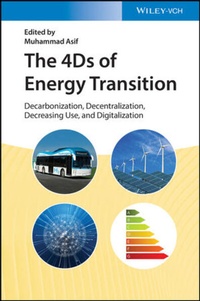
The 4Ds of Energy Transition
Description

More details
Other editions
Additional editions
Person
Content
INTRODUCTION
PART II
DECARBONISATION
1)Renewable Energy
2)Decarbonisation of the Fossil Fuel Sector
3)Nuclear Power: Status and Trends
4)Electric Vehicles
5)Hydrogen and Fuel Cells
6)Batteries and Energy Storage
PART III
DECREASING USE
1)Fundamentals of Energy Conservation and Management
2)Energy Efficiency: Cross Sectoral Scope and Application
3)Techno-economics of Energy Efficiency
PART IV
DECENTRALIZATION
1)Fundamentals of Distributed Generation
2)Distributed Generation: Power Infrastructure and Grid Parity
3)Distributed Generation: Application and Economics
PART V
DIGITALIZATION
1)Digitalization of Energy Value Chain
2)Smart Meters to Smart Cities
3)Digitalisation: Industry and Policy Status and Trends
1
Introduction to the Four-Dimensional Energy Transition
Muhammad Asif
Department of Architectural Engineering, King Fahd University of Petroleum and Minerals, Dhahran, Saudi Arabia
1.1 Energy: Resources and Conversions
Growing human dependence on energy is one of the defining characteristics of the modern age. Historically, the increasingly extensive and efficient utilization of energy has been pivotal in the evolution of societies. However, the eighteenth/nineteenth-century industrial revolution has been a turning point in human-energy interaction. Energy has attained the status of a prerequisite for all crucial aspects of societies, i.e. mobility, agriculture, industry, health, education, and trade and commerce [1]. Energy resources exist in many physical states, harnessing and capitalizing through various technologies. They can be broadly classified into two categories: renewables and non-renewables. Renewable energy resources are naturally replenished or renewed.
Examples of renewable resources include solar energy, wind power, hydropower, and wave and tidal power. Energy resources that are finite and exhaustible are non-renewable such as coal, oil, and natural gas. In terms of resources, energy can also be classified into two types: primary resources and secondary resources. Primary energy resources consist of natural or unrefined resources such as raw fossil fuel, biomass, solar radiation, wind, and flowing water. These resources can be extracted or harnessed directly from nature. Secondary energy resources are refined/converted from primary resources. For example, electricity is a secondary energy resource that can be produced by transforming different primary resources. Figure 1.1 shows examples of primary and secondary energy resources.
Energy can be classified in different forms, typically through several conversion and transformation processes in their usable life cycle. Different forms of energy include chemical energy, thermal energy, mechanical energy, electrical energy, light energy, and sound energy. The four commonly used forms of energy and their mutual transformations are shown in Figure 1.2. It also highlights the associated energy resources.
Figure 1.1 Primary and secondary energy resources.
Figure 1.2 Energy resources and transformations.
The energy contained in fossil fuels - coal, oil, and natural gas - contributing to almost 80% of the world's total primary energy supplies is chemical energy. Nuclear power and geothermal energy enter the usable energy equation in the form of thermal energy. Wind power, hydropower, and wave and tidal power are capitalized as mechanical energy, while solar energy can be harnessed in the form of thermal energy and electrical energy. The most common energy requirements in day-to-day life include heat, electricity, and mechanized mobility. Heat is primarily acquired through fossil fuels, making it a chemical to thermal energy conversion process. Useable heat can also be directly acquired from solar energy, geothermal energy, and nuclear power. One of the most common energy transformation pathways is to convert chemical energy into mechanical energy. The first stage in this transformation process involves converting fossil fuel's chemical energy into thermal energy, usually in the form of steam, hot water, or hot gases, through boilers, rotating turbines, or internal combustion engines. In the second stage, thermal energy is converted to mechanical energy through internal combustion engines and rotary turbines. The produced mechanical energy is used in many applications, such as running machinery and transportation. This mechanical energy can also be used to produce electricity with the help of generators. Electricity can be produced through various transformation routes, including chemical-thermal-mechanical-electrical, thermal-mechanical-electrical, and mechanical-electrical.
1.2 Climate Change in Focus
Climate change is arguably the biggest challenge the world faces today. It is widely regarded as a consequence of global warming. The gradual warming of the Earth's atmospheric temperature as a small fraction of the solar radiation is entrapped by greenhouse gases. Greenhouse gases are part of the Earth's atmosphere. Human activities such as burning fossil fuels, transportation, power generation, and industrial and agricultural processes increase the concentration of these gases in the atmosphere. The eighteenth-century industrial revolution is considered to have triggered the rapid growth in the release of greenhouse gases. For example, the atmosphere's carbon dioxide (CO2) concentration has increased from the pre-industrial age level of 280 parts-per-million (ppm) to 415 ppm. The acceleration in the growth of CO2 concentration can be gauged from the fact that almost 100 ppm of the total 135 ppm increment has occurred since 1960. Commonly known greenhouse gases include water vapor, carbon dioxide, nitrous oxide, methane, chlorofluorocarbons (CFCs), and hydrofluorocarbons (HFCs). The impact of a greenhouse gas depends on various factors such as their level of concentration or abundance, lifetime (duration of stay in the atmosphere), and ability to trap radiation (radiative efficiency). Carbon dioxide (CO2) is the primary greenhouse gas emitted through human activities and has been adopted as a reference index to represent the concentration of greenhouse gases. Accordingly, the global warming potential (GWP) - an index to compare the global warming impact of different greenhouse gases - of CO2 has been regarded as one.
Due to numerous involved factors and their dynamic and complex inter-relationship, it is difficult to precisely predict the nature and extent of the implications of climate change. However, based on the expert interpretations of the available data and scientific models, certain weather-related incidents are attributed to climate change with a great degree of confidence. Accordingly, climate change leads to many challenges, including seasonal disorder, a pattern of intense and more frequent weather-related events such as floods, droughts, storms, heat waves and wildfires, financial loss, and health problems [2]. Climate change also exacerbates water and food crises in many parts of the world. In recent decades, the global focus on climate change has increased exponentially. Extreme weather events and natural disasters such as floods, storms, hurricanes, wildfires, and droughts have played a vital role. Since 1880, the atmospheric temperature has increased by 1.23 °C (2.21 °F). The rising temperature is driven largely by increased anthropogenic greenhouse gas emissions. According to the US National Aeronautics and Space Administration (NASA), most atmospheric warming has occurred over the last four decades [3]. Warmer temperatures are increasing the sea level due to the melting of glaciers. During the twentieth century, the global sea level rose by around 20 cm. The rise in sea level has been accelerating every year - over the last two decades. It has almost doubled that of the last century [3]. Glaciers are shrinking worldwide, including the Himalayas, Alps, Alaska, Rockies, and Africa.
Extreme weather conditions and climate abnormalities are becoming more frequent. The situation is already widely dubbed as the climate crisis. With the recorded acceleration in the accumulation of greenhouse gases and consequent increase in atmospheric temperature, climate change-driven weather-related disasters are becoming more intense and recurrent. The recent seven years have been the warmest since records began, while 2016 and 2020 are reportedly tied for the hottest year on record [3]. July 2021 witnessed heat waves, wildfires, storms, and floods worldwide. North America particularly faced intense heat waves, besides record high temperatures and massive wildfires. California's Death Valley recorded a temperature of 54.4 °C (130 °F), potentially the highest ever temperature recorded on the planet, and British Columbia witnessed a temperature of 49.6 °C, obliterating Canada's previous national temperature record by 8 °C [4]. While the heat wave killed over 500 people in Canada alone, Europe and Asia were hit by unprecedented flooding. High temperatures, heat waves, and droughts are also causing record-breaking wildfires. The 2019-2020 wildfire in Australia burnt around 19 million ha, resulting in an economic loss of over AU$ 100 billion that became the costliest natural disaster in national history [5]. The year 2021 has also witnessed heat waves fueling massive wildfires in Australia, North America, and Europe. Extreme wildfires are now becoming a new normal as experts predict more fires and higher degrees of devastation as each fire season comes.
1.3 The Unfolding Energy Transition
The global energy scenario experiences a string of challenges such as climate change, rapid growth in energy demand, depletion of fossil fuel reserves, volatile energy prices, and lack of universal access to energy. The post-industrial revolution energy scenario is closely linked to global warming as fossil fuels are...
