
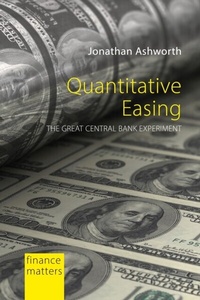
Quantitative Easing
Description
Alles über E-Books | Antworten auf Fragen rund um E-Books, Kopierschutz und Dateiformate finden Sie in unserem Info- & Hilfebereich.
Before the Great Financial Crisis of 2008-09, significant reductions in official interest rates typically proved sufficient to generate sustainable economic recoveries from downturns. However, with economies and financial markets in freefall during the crisis despite a cut in interest rates to effectively zero, policymakers in some advanced economies launched a major new tool called quantitative easing (QE). This involved central banks purchasing huge amounts of financial assets.
This book offers a thorough and perspicacious analysis of QE, which has become a recovery method of last resort. Whilst it was successful in averting another Great Depression and stimulating growth, it remains controversial and continues to promote widespread debate in economics, financial, and political-economy circles. This book is essential reading for anyone wishing to understand central banking in the national economy.
All prices
More details
Other editions
Additional editions
Person
Jonathan Ashworth is an independent economist. He has worked as an economist at Morgan Stanley and Barclays Wealth and his work has been widely cited in the media including The Economist, The Financial Times and The Wall Street Journal. He has also worked as an economist in the productivity and structural reform team at HM Treasury, where he did work on the famous "Five Tests" for whether Britain should join the euro.
Content
Foreword by C. A. E. Goodhart1. Monetary policymaking since the end of Bretton Woods2. Key monetary policy trends and events before the Great Financial Crisis3. The Great Financial Crisis and quantitative easing4. How quantitative easing works5. Measuring the effectiveness and impact of quantitative easing6. International spillovers of quantitative easing7. Criticisms and negative externalities of quantitative easing8. Exiting quantitative easing and policies for the next slowdown

System requirements
File format: ePUB
Copy protection: Adobe-DRM (Digital Rights Management)
System requirements:
- Computer (Windows; MacOS X; Linux): Install the free reader Adobe Digital Editions prior to download (see eBook Help).
- Tablet/smartphone (Android; iOS): Install the free app Adobe Digital Editions or the app PocketBook before downloading (see eBook Help).
- E-reader: Bookeen, Kobo, Pocketbook, Sony, Tolino and many more (not Kindle).
The file format ePub works well for novels and non-fiction books – i.e., „flowing” text without complex layout. On an e-reader or smartphone, line and page breaks automatically adjust to fit the small displays.
This eBook uses Adobe-DRM, a „hard” copy protection. If the necessary requirements are not met, unfortunately you will not be able to open the eBook. You will therefore need to prepare your reading hardware before downloading.
Please note: We strongly recommend that you authorise using your personal Adobe ID after installation of any reading software.
For more information, see our ebook Help page.
File format: ePUB
Copy protection: Watermark-DRM (Digital Rights Management)
System requirements:
- Computer (Windows; MacOS X; Linux): Use a reading software that can process the file format ePUB: e.g., Adobe Digital Editions or FBReader – both free (see eBook Help).
- Tablet/Smartphone (Android; iOS): Before downloading, install the free app Adobe Digital Editions (see eBook Help).
- E-reader: Bookeen, Kobo, Pocketbook, Sony, Tolino and many more (not Kindle).
The file format ePUB works well for novels and non-fiction books – i.e., „flowing” text without complex layout. On an e-reader or smartphone, line and page breaks automatically adjust to fit the small displays.
This eBook uses Watermark-DRM, a „soft” copy protection. This means that there are no technical restrictions to prevent illegal distribution. However, there is a personalised watermark embedded in the eBook that can be used to identify the purchaser of the eBook in the event of misuse and to provide evidence for legal purposes.
For more information, see our eBook Help page.