

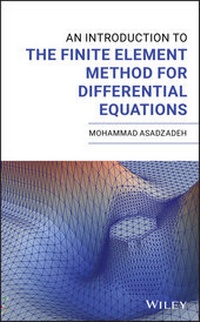
An Introduction to the Finite Element Method for Differential Equations
Description

An Introduction to the Finite Element Method (FEM) for Differential Equations provides readers with a practical and approachable examination of the use of the finite element method in mathematics. Author Mohammad Asadzadeh covers basic FEM theory, both in one-dimensional and higher dimensional cases.
The book is filled with concrete strategies and useful methods to simplify its complex mathematical contents. Practically written and carefully detailed, An Introduction to the Finite Element Method covers topics including:
* An introduction to basic ordinary and partial differential equations
* The concept of fundamental solutions using Green's function approaches
* Polynomial approximations and interpolations, quadrature rules, and iterative numerical methods to solve linear systems of equations
* Higher-dimensional interpolation procedures
* Stability and convergence analysis of FEM for differential equations
This book is ideal for upper-level undergraduate and graduate students in natural science and engineering. It belongs on the shelf of anyone seeking to improve their understanding of differential equations.
More details
Other editions
Additional editions
Person
MOHAMMAD ASADZADEH, PHD is Professor of Applied Mathematics at the Department of Mathematical Sciences, Chalmers University of Technology and University of Gothenburg. His primary research interests include the numerical analysis of hyperbolic pdes, as well as convection-diffusion and integro-differential equations.
Content
Preface xi
Acknowledgments xiii
1 Introduction 1
1.1 Preliminaries 2
1.2 Trinities for Second-Order PDEs 4
1.3 PDEs in Rn, Further Classifications 10
1.4 Differential Operators, Superposition 12
1.4.1 Exercises 14
1.5 Some Equations of Mathematical Physics 15
1.5.1 The Poisson Equation 16
1.5.2 The Heat Equation 17
1.5.2.1 A Model Problem for the Stationary Heat Equation in 1d 17
1.5.2.2 Fourier's Law of Heat Conduction, Derivation of the Heat Equation 18
1.5.3 The Wave Equation 21
1.5.3.1 The Vibrating String, Derivation of the Wave Equation in 1d 21
1.5.4 Exercises 24
2 Mathematical Tools 27
2.1 Vector Spaces 27
2.1.1 Linear Independence, Basis, and Dimension 30
2.2 Function Spaces 33
2.2.1 Spaces of Differentiable Functions 33
2.2.2 Spaces of Integrable Functions 34
2.2.3 Weak Derivative 35
2.2.4 Sobolev Spaces 36
2.2.5 Hilbert Spaces 37
2.3 Some Basic Inequalities 38
2.4 Fundamental Solution of PDEs 41
2.4.1 Green's Functions 43
2.5 The Weak/Variational Formulation 44
2.6 A Framework for Analytic Solution in 1d 46
2.6.1 The Variational Formulation in 1d 48
2.6.2 The Minimization Problem in 1d 51
2.6.3 A Mixed Boundary Value Problem in 1d 52
2.7 An Abstract Framework 54
2.7.1 Riesz and Lax-Milgram Theorems 57
2.8 Exercises 63
3 Polynomial Approximation/Interpolation in 1d 67
3.1 Finite Dimensional Space of Functions on an Interval 67
3.2 An Ordinary Differential Equation (ODE) 71
3.2.1 Forward Euler Method to Solve IVP 71
3.2.2 Variational Formulation for IVP 72
3.2.3 Galerkin Method for IVP 73
3.3 A Galerkin Method for (BVP) 74
3.3.1 An Equivalent Finite Difference Approach 79
3.4 Exercises 82
3.5 Polynomial Interpolation in 1d 83
3.5.1 Lagrange Interpolation 90
3.6 Orthogonal- and L2-Projection 94
3.6.1 The L2-Projection onto the Space of Polynomials 94
3.7 Numerical Integration, Quadrature Rule 96
3.7.1 Composite Rules for Uniform Partitions 98
3.7.2 Gauss Quadrature Rule 101
3.8 Exercises 105
4 Linear Systems of Equations 109
4.1 Direct Methods 110
4.1.1 LU Factorization of an n × n Matrix A 113
4.2 Iterative Methods 115
4.2.1 Jacobi Iteration 115
4.2.2 Convergence Criterion 116
4.2.3 Gauss-Seidel Iteration 117
4.2.4 The Successive Over-Relaxation Method (S.O.R.) 119
4.2.5 Abstraction of Iterative Methods 120
4.2.5.1 Questions 120
4.2.6 Jacobi's Method 120
4.2.7 Gauss-Seidel's Method 121
4.2.7.1 Relaxation 121
4.3 Exercises 122
5 Two-Point Boundary Value Problems 125
5.1 The Finite Element Method (FEM) 125
5.2 Error Estimates in the Energy Norm 127
5.2.1 Adaptivity 132
5.3 FEM for Convection-Diffusion-Absorption BVPs 132
5.4 Exercises 140
6 Scalar Initial Value Problems 147
6.1 Solution Formula and Stability 147
6.2 Finite Difference Methods for IVP 149
6.3 Galerkin Finite Element Methods for IVP 151
6.3.1 The Continuous Galerkin Method 152
6.3.1.1 The cG(1) Algorithm 154
6.3.1.2 The cG(q) Method 154
6.3.2 The Discontinuous Galerkin Method 155
6.4 A Posteriori Error Estimates 156
6.4.1 A Posteriori Error Estimate for cG(1) 156
6.4.1.1 The Dual Problem 157
6.4.2 A Posteriori Error Estimate for dG(0) 161
6.4.3 Adaptivity for dG(0) 163
6.4.3.1 An Adaptivity Algorithm 163
6.5 A Priori Error Analysis 164
6.5.1 A Priori Error Estimates for the dG(0) Method 164
6.6 The Parabolic Case (a(t) = 0) 168
6.6.1 An Example of Error Estimate 171
6.7 Exercises 173
7 Initial Boundary Value Problems in 1d 177
7.1 The Heat Equation in 1d 177
7.1.1 Stability Estimates 179
7.1.2 FEM for the Heat Equation 183
7.1.3 Error Analysis 186
7.1.4 Exercises 192
7.2 The Wave Equation in 1d 193
7.2.1 Wave Equation as a System of Hyperbolic PDEs 194
7.2.2 The Finite Element Discretization Procedure 195
7.2.3 Exercises 197
7.3 Convection-Diffusion Problems 199
7.3.1 Finite Element Method 202
7.3.2 The Streamline-Diffusion Method (SDM) 203
7.3.3 Exercises 205
8 Approximation in Several Dimensions 207
8.1 Introduction 207
8.2 Piecewise Linear Approximation in 2d 209
8.2.1 Basis Functions for the Piecewise Linears in 2d 209
8.3 Constructing Finite Element Spaces 216
8.4 The Interpolant 219
8.4.1 Error Estimates for Piecewise Linear Interpolation 222
8.5 The L2(Revisited) and Ritz Projections 228
8.5.1 The Ritz or Elliptic Projection 230
8.6 Exercises 231
9 The Boundary Value Problems in RN 235
9.1 The Poisson Equation 235
9.1.1 Weak Stability 236
9.1.2 Error Estimates for the CG(1) FEM 237
9.1.3 Proof of the Regularity Lemma 242
9.2 Stationary Convection-Diffusion Equation 243
9.2.1 The Elliptic Case 243
9.2.1.1 A Brief Note on Distributions 244
9.2.2 Error Estimates 248
9.3 Hyperbolicity Features 249
9.3.1 Convection Dominating Case 250
9.3.2 The SD Method for Convection Diffusion Problem 251
9.3.3 Stability Estimates 252
9.3.4 Error Estimates for Convention Dominating in 2d 252
9.4 Exercises 255
10 The Initial Boundary Value Problems in RN 261
10.1 The Heat Equation in RN261
10.1.1 The Fundamental Solution 262
10.1.2 Stability 263
10.1.3 The Finite Element for Heat Equation 265
10.1.3.1 The Semidiscrete Problem 265
10.1.4 A Fully Discrete Algorithm 269
10.1.5 The Discrete Equations 270
10.1.6 A Priori Error Estimate: Fully Discrete Problem 271
10.2 The Wave Equation in Rd 272
10.2.1 The Weak Formulation 273
10.2.2 The Semidiscrete Problem 273
10.2.2.1 A Priori Error Estimates for the Semidiscrete Problem 274
10.2.3 The Fully Discrete Problem 275
10.2.3.1 Finite Elements for the Fully Discrete Problem 276
10.2.4 Error Estimate for cG(1) 278
10.3 Exercises 279
Appendix A Answers to Some Exercises 285
Chapter 1. Exercise Section 1.4.1 285
Chapter 1. Exercise Section 1.5.4 285
Chapter 2. Exercise Section 2.11 286
Chapter 3. Exercise Section 3.5 286
Chapter 3. Exercise Section 3.8 287
Chapter 4. Exercise Section 4.3 288
Chapter 5. Exercise Section 5.4 289
Chapter 6. Exercise Section 6.7 291
Chapter 7. Exercise Section 7.2.3 292
Chapter 7. Exercise Section 7.3.3 292
Chapter 9. Poisson Equation. Exercise Section 9.4 292
Chapter 10. IBVPs: Exercise Section 10.3 293
Appendix B Algorithms and Matlab Codes 295
B.1 A Matlab Code to Compute the Mass Matrix M for a Nonuniform Mesh 296
B.1.1 A Matlab Routine to Compute the Load Vector b 297
B.2 Matlab Routine to Compute the L2-Projection 298
B.2.1 A Matlab Routine for the Composite Midpoint Rule 299
B.2.2 A Matlab Routine for the Composite Trapezoidal Rule 299
B.2.3 A Matlab Routine for the Composite Simpson's Rule 299
B.3 A Matlab Routine Assembling the Stiffness Matrix 300
B.4 A Matlab Routine to Assemble the Convection Matrix 301
B.5 Matlab Routine for Forward-, Backward-Euler, and Crank-Nicolson 302
B.6 A Matlab Routine for Mass-Matrix in 2d 304
B.7 A Matlab Routine for a Poisson Assembler in 2d 304
Appendix C Sample Assignments 307
C.1 Assignment 1 307
C.2 Assignment 2 308
C.2.1 Grading Policy of the Assignment 308
C.2.2 Theory 308
C.2.3 Selected Applications 309
C.2.3.1 Convection-Diffusion-Absorption/Reaction 309
C.2.3.2 Electrostatics 310
C.2.3.3 2d Fluid Flow 310
C.2.3.4 Heat Conduction 310
C.2.3.5 Quantum Physics 310
Appendix D Symbols 313
D.1 Table of Symbols 313
Bibliography 317
Index 327
1
Introduction
There are two ways of spreading light:
to be the candle or the mirror that reflects it.
Edith Wharton
This book presents an introduction to the Galerkin finite element method (FEM) as a powerful and general tool for approximating solution of differential equations. Our objective is twofold.
- i) To present the main ordinary and partial differential equations (ODEs and PDEs) modeling different phenomena in science and engineering and introduce mathematical tools and environments for their analytic and numerical studies.
- ii) To construct some common FEMs for approximate solutions of differential equations and analyze their well-posedness (existence, uniqueness, and stability of such approximate solutions) as well as the accuracy of the approximation.
In its final step, a finite element procedure yields a linear system of equations (LSEs) where the unknowns are the approximate values of the solution at certain nodes. Then, an approximate solution is constructed by adapting piecewise polynomials of certain degree to these, approximate, nodal values.
The entries of the coefficient matrix and the right-hand side of FEM's final LSEs consist of integrals which, e.g. for complex geometries or less smooth, and/or more complex, data, are not always easily computable. Therefore, numerical integration and quadrature rules are introduced to approximate such integrals. Furthermore, iteration procedures are included in order to efficiently compute the numerical solutions of such obtained LSEs.
Interpolation techniques are presented for both accurate polynomial approximations and also to derive basic a priori and a posteriori error estimates necessary to determine qualitative properties of the approximate solutions. That is to show how the approximate solution, in some adequate measuring environment, e.g. a certain norm, approaches the exact solution as the number of nodes, hence, the number of unknowns increases. For convenience, the frequently used classical inequalities, such as the Cauchy-Schwarz' and Poincare, likewise the inverse and trace estimates, that are of vital importance in error analysis and stability estimates, are introduced. In the theoretical abstraction, we demonstrate the fundamental solution approach based on Green's functions and prove the Riesz (Lax-Milgram) theorem which is essential in proving the existence of a unique solution for a minimization problem that in turn is equivalent both to a variational formulation as well as a corresponding boundary value problem (BVP).
Galerkin's method for solving a general differential equation is based on seeking an approximate solution, which is
- Easy to differentiate and integrate
- Spanned by a set of "nearly orthogonal" base functions in a finite-dimensional vector space.
- Satisfies Galerkin orthogonality relation.
Roughly speaking, this means a closeness relation in the sense that:
- I). In a priori case, the difference between the exact and approximate solution is orthogonal to the finite dimensional vector space of the approximate solution.
- II). In a posteriori case, the residual of the approximate solution (=the difference between the left- and right-hand side of an expression obtained from the differential equation where exact solution is replaced by the approximate solution) is orthogonal to the finite dimensional vector space of the approximate solution.
1.1 Preliminaries
In this section, we give a brief introduction to some key concepts in differential equations. A standard classification and some general properties are presented in Trinities below.
- A differential equation is a relation between an unknown function and its derivatives.
- If the differentiation in the equation is with respect to only one variable, e.g. , (or in ), then the equation is called an ordinary differential equation (ODE).
- The order of a differential equation is the order of the highest derivative of the function that appears in the equation.
- If the function depends on more than one variable, and the differential equation possesses derivatives with respect to at least two variables, then the differential equation is called a partial differential equation (PDE), e.g. is a homogeneous PDE of the second order, whereas for , the equations and are nonhomogeneous PDEs of the second order.
- A solution to a differential equation is a function; (e.g. , , or above), which satisfies the corresponding differential equation.
- In general, the solution of a differential equation cannot be expressed in terms of elementary functions, and numerical methods are the only way to solve the differential equations through constructing approximate solutions. Then, the main questions are
- To what extent does the approximate solution preserve the physical properties of the exact solution, or satisfies a corresponding, discrete, version of the differential equation (consistency)?
- How sensitive is the solution to the change of the data (stability)?
- How close is the approximate solution to the exact solution (convergence)?
- Which are the adequate environments to measure this closeness?
- These are some of the questions that we want to deal within this text when approximating with the FEMs.
- A linear ODE of order has the general form: where denotes the derivative, with respect to , and , with (the -th order derivative). The corresponding linear differential operator is denoted by
1.2 Trinities for Second-Order PDEs
Problems modeled by PDEs of the second order can be classified using, the so-called, trinities. Below we introduce basic ingredients of this concept. For detailed study see, e.g. [68].
The usual three operators in PDEs of second order in .
(1.2.1) (1.2.2) (1.2.3)where we have the space variable , the time variable , and denotes the second partial derivative with respect to . We also define a first-order operator, namely the gradient operator which is the vector valued operator
Often, the dimension is obvious from the context and therefore, usually, the subindex is suppressed and the operators and are simply denoted by (or by ) and , respectively.
Classifying general second-order PDEs in two dimensions.
- I) The constant coefficients case
A second-order PDE in two dimensions, with constant coefficients, can be written in its general form as
We introduce the discriminant : a quantity that specifies the role of the coefficients of the second-order terms, in determining the equation type in the sense that the equation is
Elliptic: if Parabolic: if and Hyperbolic: if
- II) The case of variable coefficients
In the variable coefficients case, one can only have a local classification.
Figure 1.1 Tricomi equation: an example of a variable coefficient classification.
The usual three types of problems in differential equations.
- Initial value problems (IVPs)
The simplest differential equation is for . But for any such , also for any constant . To determine a unique solution, a specification of the initial value is generally required. For example for , we have and the general solution is . With an initial value of , we get . Hence, the unique solution to this IVP is . Likewise, for a time-dependent differential equation of second order (two time derivatives), the initial values for , i.e. and , are generally required. For a PDE such as the heat equation, the initial value can be a function of the space variable.
- Boundary value problems (BVP) )
Consider the one-dimensional stationary heat equation:
In order to determine a solution uniquely (see Remark 1.2), the differential equation is complemented by boundary conditions imposed at the boundary points and ; for example and , where and are given real numbers.
- Eigenvalue problems (EVPs)
Let be a given square, say matrix. The relation , is a linear equation system, where is an eigenvalue and is an eigenvector. In the Example 1.7 below, we introduce the corresponding terminology for differential...
