

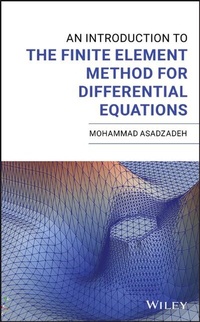
An Introduction to the Finite Element Method for Differential Equations
1st Edition
Published on 13. October 2020
Book
Hardback
352 pages
978-1-119-67164-0 (ISBN)
Description
The objective of this book is two-fold. The first objective is to construct, as much as possible, stable finite element schemes without affecting accuracy. The second objective is to derive convergence of the numerical schemes up to maximal available regularity of the exact solution. The first two chapters of the book cover existence, uniqueness and stability as well as the working environment, such as vector and function spaces and principle mathematical inequalities. Chapters 3 and 4 cover the approximation procedure with piecewise linears, interpolation, numerical integration and numerical solution of linear system of equations. Chapters 5 through 7 are devoted to the finite element approximations for the one-space dimensional, boundary value problems, initial value problems, and initial-boundary value problems. Finally, Chapters 8 through 10 are an extension of Chapters 3 and 5-7 to higher spatial dimensions. This book is a great resource for upper undergraduates and graduates in applied math, engineering and natural sciences, as well as researchers in industry and academia in need of finite element approximation techniques. Researchers in industry and academia in need of finite element approximation techniques. Some advanced classes in second year.
More details
Other editions
Additional editions
Mohammad Asadzadeh
An Introduction to the Finite Element Method for Differential Equations
E-Book
08/2020
1st Edition
Wiley
€104.99
Available for download
Mohammad Asadzadeh
An Introduction to the Finite Element Method for Differential Equations
E-Book
08/2020
1st Edition
Wiley
€104.99
Available for download
Content
1 Introduction 11
1.1 Preliminaries 13
1.2 Trinities for 2nd order PDEs 14
1.3 PDEs in Rn, further classifications 22
1.4 Differential operators, superposition 24
1.4.1 Exercises 27
1.5 Some equations of mathematical physics 28
1.5.1 The Poisson equation 29
1.5.2 The Heat Equation 30
1.5.3 The Wave Equation 34
1.5.4 Exercises 38
2 Mathematical Tools 41
2.1 Vector spaces 42
2.1.1 Linear independence, basis and dimension 45
2.2 Function spaces 49
2.2.1 Spaces of differentiable functions 49
2.2.2 Spaces of integrable functions 51
2.2.3 Weak derivative 51
2.2.4 Sobolev spaces 53
2.2.5 Hilbert spaces 54
2.3 Some basic inequalities 55
2.4 Fundamental Solution of PDEs1 59
2.4.1 Green's Functions 60
2.5 The weak/variational formulation 63
2.6 A framework for analytic solution in 1d 65
2.6.1 The variational formulation in 1d. 68
2.6.2 The minimization problem in 1d. 71
2.6.3 A mixed Boundary Value Problem in 1d 73
2.7 An abstract framework 76
2.7.1 Riesz and Lax-Milgram Theorems 79
2.8 Exercises 87
3 Polynomial Approximation/Interpolation in 1d 91
3.1 Finite dimensional space of functions on an interval 92
3.2 An ordinary differential equation (ODE) 96
3.2.1 Forward Euler method to solve IVP 96
3.2.2 Variational formulation for IVP 97
3.2.3 Galerkin method for IVP 99
3.3 A Galerkin method for (BVP) 101
3.3.1 An equivalent finite difference approach 106
3.4 Exercises 110
3.5 Polynomial Interpolation in 1d 113
3.5.1 Lagrange interpolation 121
3.6 Orthogonal- and L2-projection 125
3.6.1 The L2-projection onto the space of polynomials 126
3.7 Numerical integration, Quadrature rule 127
3.7.1 Composite rules for uniform partitions 131
3.7.2 Gauss quadrature rule 135
3.8 Exercises 139
4 Linear Systems of Equations 143
4.1 Direct methods 144
4.2 Iterative methods 151
4.3 Exercises 160
5 Two-point boundary value problems 165
5.1 The finite element method (FEM) 165
5.2 Error estimates in the energy norm 167
5.3 FEM for convection-diffusion-absorption BVPs 174
5.4 Exercises 184
6 Scalar Initial Value Problems 193
6.1 Solution formula and stability 194
6.2 Finite difference methods for IVP 195
6.3 Galerkin finite element methods for IVP 198
6.3.1 The continuous Galerkin method 199
6.3.2 The discontinuous Galerkin method 202
6.4 A posteriori error estimates 204
6.4.1 A posteriori error estimate for cG(1) 204
6.4.2 A posteriori error estimate for dG(0) 210
6.4.3 Adaptivity for dG(0) 213
6.5 A priori error analysis 214
6.5.1 A priori error estimates for the dG(0) method 214
6.6 The parabolic case (a(t) >= 0) 218
6.6.1 An example of error estimate 223
6.7 Exercises 224
7 Initial Boundary Value Problems in 1d 227
7.1 The heat equation in 1d 227
7.1.1 Stability estimates 229
7.1.2 FEM for the heat equation 234
7.1.3 Error analysis 238
7.1.4 Exercises 245
7.2 The wave equation in 1d 248
7.2.1 Wave equation as a system of hyperbolic PDEs 249
7.2.2 The finite element discretization procedure 250
7.2.3 Exercises 253
7.3 Convection - diffusion problems 256
7.3.1 Finite Element Method 259
7.3.2 The Streamline-diffusion method (SDM) 261
7.3.3 Exercises 263
8 Approximation in several dimensions 265
8.1 Introduction 265
8.2 Piecewise linear approximation in 2 D 268
8.2.1 Basis functions for the piecewise linears in 2 D 268
8.3 Constructing finite element spaces 276
8.4 The interpolant 279
8.4.1 Error estimates for piecewise linear interpolation 282
8.5 The L2 (revisited) and Ritz projections 289
8.5.1 The Ritz or elliptic projection 292
8.6 Exercises 292
9 The Boundary Value Problems in RN 299
9.1 The Poisson equation 300
9.1.1 Weak stability 300
9.1.2 Error Estimates for the CG(1) FEM 301
9.1.3 Proof of the regularity Lemma 308
9.2 Stationary convection-diffusion equation 309
9.2.1 The elliptic case 309
9.2.2 Error estimates 315
9.3 Hyperbolicity features 317
9.3.1 Convection dominating case 318
9.3.2 The SD method for convection diffusion problem 318
9.3.3 Stability estimates 319
9.3.4 Error estimates for convention dominating in 2d 321
9.4 Exercises 324
10 The Initial Boundary Value Problems in RN 331
10.1 The heat equation in RN 332
10.1.1 The fundamental solution 332
10.1.2 Stability 334
10.1.3 The finite element for heat equation 337
10.1.4 A fully discrete algorithm 341
10.1.5 The discrete equations 342
10.1.6 A priori error estimate: Fully discrete problem 343
10.2 The wave equation in Rd 345
10.2.1 The semi-discrete problem 346
10.2.2 The fully-discrete problem 349
10.2.3 Error estimate for cG(1) 352
10.3 Exercises 354
1 Answers to some exercises 361
2 Algorithms and MATLAB Codes 371
3 Sample Assignments 389
4 Symbols 395