

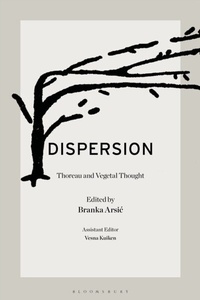
Dispersion
Thoreau and Vegetal Thought
1st Edition
Published on 29. July 2021
312 pages
978-1-5013-7060-1 (ISBN)
Description

Plants are silent, still, or move slowly; we do not have the sense that they accompany us, or even perceive us. But is there something that plants are telling us? Is there something about how they live and connect, how they relate to the world and other plants that can teach us about ecological thinking, about ethics and politics?
Grounded in Thoreau's ecology and in contemporary plant studies, Dispersion: Thoreau and Vegetal Thought offers answers to those questions by pondering such concepts as co-dependence, the continuity of life forms, relationality, cohabitation, porousness, fragility, the openness of beings to incessant modification by other beings and phenomena, patience, waiting, slowness and receptivity.
Grounded in Thoreau's ecology and in contemporary plant studies, Dispersion: Thoreau and Vegetal Thought offers answers to those questions by pondering such concepts as co-dependence, the continuity of life forms, relationality, cohabitation, porousness, fragility, the openness of beings to incessant modification by other beings and phenomena, patience, waiting, slowness and receptivity.
Reviews / Votes
The strongest essays in Dispersion shed valuable fresh light on Thoreau's thinking about the relation-and dis-relation-between human and vegetable. * Lawrence Buell, Powell M. Cabot Research Professor of American Literature, Emeritus, Harvard University, USA * Dispersion is a beautiful, uncanny, and indispensable work. No brief comment can adequately describe this volume rising and falling between lyric and scholarly modes. Arsic and the contributors she has gathered write-spin-from inside the dark incandescence of Thoreau's ecological thought, weaving us into his occult ontology-simultaneously 'aerial' and 'rooted'-of the vegetal. At the same time, they write with an urgency attuned to the ecological crisis of our time and joyfully alive to the seismic ethical stakes of the questions they pose and, through their tracings, make partly fathomable. Each essay, by turns quiet and alert, rich with strange confluences, opens into a 'flower-truth.' For this is a volume about tending: it stirs strange sympathies for the nonhuman world and a fragile trust in the invisible but sensed forms of entwinement between human and ecological phenomena. In her earlier work Arsic has already brilliantly re-oriented the study of Thoreau's work; here, she re-draws-redrifts-the boundaries of study in the humanities. * Marta Werner, Martin J. Svaglic Chair in Textual Studies, Loyola University Chicago, USA * A philosophically rich and spirited look at Thoreau's surprising, open encounters with vegetal life and at how instructive the relations between plants and humans can be. Every essay speaks to the vital continuities we share with other life forms, to the ways we impress, influence, and wildly depend on each other, and to the ecological ethics of these dependencies. Dispersion, like the motion of plants Thoreau describes, branches out ambitiously, while staying grounded and sinking in. * Elisa Tamarkin, University of California, Berkeley, USA * The uniformly astute essays Branka Arsic has gathered in this collection render the seed-concepts scattered across Thoreau's sundry writings on vegetal thinking indispensable resources for conceptualizing contemporary ecological problems and will make Dispersion required reading in the growing fields of Thoreau studies and Green Cultural Studies. * Donald E. Pease, Ted & Helen Geisel Professor of the Humanities, Dartmouth College, USA * With animal studies already a thriving site of scholarly inquiry, Dispersion turns our attention to the quieter potentialities of the vegetal world. This capacious and imaginative collection makes clear how Thoreau laid the ground for this next phase in the ongoing project of thinking beyond our anthropocentric view. Arsic, one of the most inventive voices in this endeavor, has brought together a dream team of emerging and established scholars, whose work here offers a cornucopia of insights along with new roots to track. * Jennifer Fleissner, Associate Professor of English, Indiana University, USA *More details
Edition
1. Auflage
Language
English
Place of publication
New York
United States
Publishing group
Bloomsbury Publishing PLC (Digital)
Target group
Professional and scholarly
ISBN-13
978-1-5013-7060-1 (9781501370601)
Copyright in bibliographic data and cover images is held by Nielsen Book Services Limited or by the publishers or by their respective licensors: all rights reserved.
Schweitzer Classification
Other editions
Additional editions
Book
03/2023
Bloomsbury Academic USA
€55.95
Shipment within 15-20 days
Book
08/2021
Bloomsbury Academic USA
€141.36
Shipment within 15-20 days
Person
Branka Arsic is Charles and Lynn Zhang Professor of American Literature in the Department of English and Comparative Literature at Columbia University, USA. She is the author, most recently, of Bird Relics: Grief and Vitalism in Thoreau (2016), which was awarded the MLA James Russell Lowell prize for the outstanding book of 2016. She has also written On Leaving: A Reading in Emerson (2010), and a book on Melville entitled Passive Constitutions or 71/2 Times Bartleby (2007). She co-edited (with Kim Evans) a collection of essays on Melville, entitled Melville's Philosophies (Bloomsbury, 2017) and (with Cary Wolfe) a collection of essays on Emerson, entitled The Other Emerson: New Approaches, Divergent Paths (2010).
Content
Introduction: Thoreau's Vegetal Ontology: The Aerial, the Rootless and the Analogous
Branka Arsic (Columbia University, USA)
1. Thoreau Experiments with Natural Influences
Jane Bennett (Johns Hopkins University, USA)
2. A Material Faith: Thoreau's Terrennial Turn
Laura Dassow Walls (Notre Dame University, USA)
3. Auto-Heteronomy: Thoreau's Circuitous Return to the Vegetal World
Michael Marder (University of the Basque Country, Spain)
4. Thoreau's Garden Politics
Antoine Traisnel (University of Michigan, USA)
5. "Wild Thinking" and Vegetal Intelligence in Thoreau's Later Writings
Michael Jonik (Sussex University, UK)
6. Green Fire: Thoreau's Forest Figuration
Monique Allewaert (University of Wisconsin, Madison, USA)
7. The Riddle of Forest Succession
Mark Noble (Georgia State University, USA)
8. Low-Tech Thoreau; or, Remediations of the Human in The Dispersion of Seeds
Jason Gladstone (University of Colorado, Boulder, USA)
9. Chastity & Vegetality: On Thoreau's Eco-erotics
Cristin Ellis (University of Mississippi, USA)
10. Thoreau's Pomontology in 'Wild Apples'
Vesna Kuiken (University at Albany, State University of New York, USA)
11. 'Wild only like myself': Thoreau at Home with Plants
Mary Kuhn (University of Virginia, USA)
12. Roots, Seeds, & Thoreauvian Trans-temporality: Poetry in the Common Sense
Gillian Osborne (Harvard Extension School, USA)
Branka Arsic (Columbia University, USA)
1. Thoreau Experiments with Natural Influences
Jane Bennett (Johns Hopkins University, USA)
2. A Material Faith: Thoreau's Terrennial Turn
Laura Dassow Walls (Notre Dame University, USA)
3. Auto-Heteronomy: Thoreau's Circuitous Return to the Vegetal World
Michael Marder (University of the Basque Country, Spain)
4. Thoreau's Garden Politics
Antoine Traisnel (University of Michigan, USA)
5. "Wild Thinking" and Vegetal Intelligence in Thoreau's Later Writings
Michael Jonik (Sussex University, UK)
6. Green Fire: Thoreau's Forest Figuration
Monique Allewaert (University of Wisconsin, Madison, USA)
7. The Riddle of Forest Succession
Mark Noble (Georgia State University, USA)
8. Low-Tech Thoreau; or, Remediations of the Human in The Dispersion of Seeds
Jason Gladstone (University of Colorado, Boulder, USA)
9. Chastity & Vegetality: On Thoreau's Eco-erotics
Cristin Ellis (University of Mississippi, USA)
10. Thoreau's Pomontology in 'Wild Apples'
Vesna Kuiken (University at Albany, State University of New York, USA)
11. 'Wild only like myself': Thoreau at Home with Plants
Mary Kuhn (University of Virginia, USA)
12. Roots, Seeds, & Thoreauvian Trans-temporality: Poetry in the Common Sense
Gillian Osborne (Harvard Extension School, USA)
