

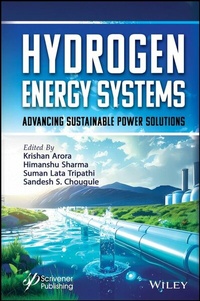
Hydrogen Energy System for Sustainable Power Solutions
Description

Drive the global shift toward sustainability with this comprehensive guide that explores the latest advancements in renewable energy technologies, smart grids, and energy storage and providing the expert policy and economic insights needed to navigate the green energy transition.
As the world faces the pressing challenges of climate change, resource depletion, and environmental degradation, green energy offers a path toward reducing carbon emissions and fostering economic resilience. This book outlines the latest technological advancements and considers the broader economic, social, and political factors influencing the green energy transition. Through case studies, real-world examples, and expert insights, readers will gain a comprehensive understanding of the role of renewable energy in shaping a sustainable future. The book centers around the transformative potential of green energy, exploring the technologies, innovations, and policies driving the global shift toward sustainable power generation. Covering a wide spectrum of renewable energy sources, such as solar, wind, hydro, geothermal, and biomass, the book examines how these alternatives are reshaping the energy landscape. By discussing advancements in energy storage, smart grids, and energy efficiency, the book delves into the solutions that address the growing global demand for cleaner, more sustainable energy.
More details
Other editions
Additional editions
Persons
Krishan Arora, PhD is a Professor and the Head of the Department of Power Systems in the School of Electronics and Electrical Engineering at Lovely Professional University with more than 17 years of experience in academics and research. He has published five books, more than 85 research papers in refereed journals and conferences, six Indian patents, and one copyright. His areas of expertise include electrical machines, non-conventional energy sources, load frequency control, automatic generation control, and modernization of smart grids.
Himanshu Sharma, PhD is an Assistant Professor at Lovely Professional University with more than four years of experience in academics. He has published more than 10 research papers in international journals and conferences and organized several workshops, summer internships, and expert lectures for students. His areas of expertise include power electronics, optimization techniques, load frequency control, automatic generation control, and modernization of smart grids.
Suman Lata Tripathi, PhD is a Professor at Lovely Professional University with more than 22 years of experience in academics and research. She has published more than 30 books and 145 research papers in refereed science journals, conference proceedings, as well as 20 Indian patents and four copyrights. Her area of expertise includes microelectronics device modeling and characterization, low-power VLSI circuit design, and advanced FET design for IoT and embedded system design.
Sandesh S. Chougule, PhD is post doc researcher in the Clean Energy Processes Laboratory in the Department of Chemical Engineering at Imperial College London. He has authored 57 research papers in international conference proceedings and journals. His research focuses on heat pipes, nanofluids, renewable energy, and refrigeration.
Content
1
A Comprehensive Analysis of Hydrogen Production Methods and Their Environmental Footprints on Earth
Brijlal Mallik1*, Manish Kumar2, Yawei Lu3, Pravin Kumar2 and Dev Kumar Mondal2
1Department of Business Studies, MITS College, Rayagada, Odisha, India
2Department of Management, Brainware University, Kolkata, India
3College of Safety Science and Engineering, Nanjing Tech University, Nanjing, China
Abstract
Hydrogen production is a key component in the transition toward sustainable energy systems, offering a clean alternative to fossil fuels. This chapter presents a comprehensive analysis of various hydrogen production methods, including steam methane reforming (SMR), water electrolysis, biomass gasification, and thermochemical water splitting. Although SMR remains the dominant method, it generates significant carbon emissions, raising concerns about its environmental sustainability. In contrast, water electrolysis, especially when powered by renewable energy, presents a greener alternative. Biomass gasification and thermochemical water splitting offer additional pathways but require further technological advancements to enhance efficiency and reduce negative environmental impacts. The environmental footprint of these methods is critically assessed to guide policymakers, technologists, and investors in making informed decisions. Emphasizing the need for renewable energy integration in hydrogen production, this chapter highlights the pivotal role of hydrogen as a clean energy carrier in the global shift toward decarbonization.
Keywords: Hydrogen production, environmental impact, renewable energy, decarbonization, sustainable energy
1.1 Introduction
Techniques for hydrogen production and their impacts on the environment are therefore critical concerns to today's global search for efficient energy production. Hydrogen is thus a promising, multilateral energy vector that can redefine various sectors within transportation, manufacturing, and electric power industries, aiming to replace traditional fossil fuels. Nevertheless, the effect on the external environment drawing out hydrogen differs depending on the method used. The main sources are steam methane reforming (SMR), water electrolysis, biomass gasification, and thermochemical water splinting. All the methods are beneficial and problematic in their perspectives, affecting the overall sustainability and feasibility.
Yet, the current favorite, the method called SMR, separates hydrogen from natural gas and produces significant volumes of carbon emissions in the process. On the other hand, water electrolysis, especially when driven through the electric energy obtained from renewable sources, is environment-friendly because it directly dissociates water into hydrogen and oxygen without releasing gases into the environment. The two processes, biomass gasification that involves the conversion of organic matter into hydrogen and thermochemical water splitting (TWS) that breaks down water through heat, also show potential, but they have not been developed fully yet concerning efficiency and negative impact on the environment.
Assessing the environmental impacts of this hydrogen generation process allows policymakers, technologists, and investors in the hydrogen economy to make proper decisions with the ultimate aim of reducing carbon footprints. All these methods are discussed in detail regarding their environmental impact and show that further advancements and deployment of renewable energy sources [20] in the hydrogen production process remain critical to safe and sustainable hydrogen applications.
Hydrogen has emerged as a pivotal energy carrier in the global transition toward a sustainable and low-carbon economy. As an alternative to fossil fuels, hydrogen offers the potential to decarbonize various industrial, transportation, and energy sectors [2]. However, the environmental footprint of hydrogen production methods varies significantly, depending on the feedstock, production technology, and energy sources used. This chapter provides a comprehensive analysis of different hydrogen production methods and their environmental implications, highlighting both challenges and opportunities in achieving a sustainable hydrogen economy.
Theoretical Background of the Stated Problem
The Growing Importance of Hydrogen
Hydrogen plays a vital role in combating climate change by providing a clean energy source that has the potential to replace traditional fossil fuels [1]. It can serve in several applications crucial to our energy future: fuel cells for electricity generation, industrial applications [22] such as steel production, and as a feedstock in the chemical processing that underpins the economy. In addition, hydrogen can store excess energy from renewable sources [21] and thus increase the reliability of intermittent energy supply systems such as wind and solar power [4].
Even with these benefits, the environmentally sound nature of hydrogen largely rests on how it is produced. At present, methods for producing hydrogen are classified into three main types-gray, blue, and green hydrogen-according to the kinds of sources from which they draw the means to produce hydrogen and the kinds of emissions those methods generate [5].
Hydrogen Production Methods and their Environmental Footprints
- Gray hydrogen: fossil fuel-based production
The primary method to produce hydrogen is through a process called SMR. It involves gaseous methane reacting with steam in a reformer at about 750°C to 1050°C and 20 to 30 atm pressure. The main products are hydrogen, carbon monoxide (CO), and carbon dioxide (CO2). Thus, large-scale hydrogen production mainly emits CO2, leading many to call it "gray hydrogen." This term is not as well-defined as "blue" or "green" hydrogen [10]. The hydrogen life cycle assessment (LCA) from natural gas shows that greenhouse gas (GHG) emissions are substantial. This makes hydrogen from natural gas an unsustainable, long-term solution [6].
Another way to make gray hydrogen is by coal gasification, but it produces even more CO2 than SMR. Hydrogen produced this way is hell on the environment, as it results in high carbon emissions and lots of air pollutants [18]. Thus, gray hydrogen remains a major contributor to global carbon footprints and is incompatible with climate mitigation goals.
- Blue Hydrogen: Carbon capture and storage integration
The objective of blue hydrogen is to lessen the environmental effects of gray hydrogen. Blue hydrogen does this by using carbon capture and storage (CCS) technology. Particular facilities that produce blue hydrogen must have CCS capabilities. If the facility uses SMR or coal gasification to produce hydrogen, it must capture the CO2 emissions it would otherwise release into the atmosphere [16]. Still, CCS has a long way to go to become efficient. It operates rather sluggishly since it has to catch up with the fossil fuel (or biomass) combustion in the power plant. Overall, it is a very energy-intensive, inelegant, and thus costly operation, and that is why the costs of blue hydrogen still seem to be in a range that is hard to swallow [7].
- Green Hydrogen: Renewable-based production
Hydrogen that is green in color is created by a process called electrolysis. Electrolysis takes water (H2O) and splits it into its two constituent parts: hydrogen and oxygen. The splitting is done using electricity. If the electricity comes from renewable sources such as wind, solar, or hydropower- meaning the electricity does not cause pollution or GHG emissions-then you have what is called green hydrogen. Green hydrogen is the most ecofriendly way [14]. The sustainability of green hydrogen, however, relies on the supply of renewable energy and the effectiveness of electrolysis technologies [8].
The electrolysis apparatus is improving in efficiency, but the high electricity demand that it has remains a hurdle. Some researchers are investigating how integrating green hydrogen with energy storage systems might enhance the feasibility and sustainability of the apparatus [13]. Moreover, electrolyzer technology is advancing, with particular attention now focused on proton exchange membrane (PEM) and solid oxide electrolysis cell (SOEC) [24].
4. Biological Hydrogen Production
Biological approaches, including microbial electrolysis cells and dark fermentation, hold great promise for sustainably yielding hydrogen [15]. These techniques use organic waste or biomass to generate hydrogen through biological reactions. They are waste-reducing, energy-generating processes. The environmental footprint of producing hydrogen this way depends on the kinds of feedstocks we use and where we get them, on how efficiently we convert them, and on the land-use trade-offs involved [5].
5. Hydrogen from Biomass Gasification
Biomass gasification can also produce hydrogen. This involves converting organic materials into hydrogen-rich syngas using thermochemical processes. Compared to fossil-based hydrogen production, this method leaves a much smaller carbon footprint [3]. However, concerns regarding land use, feedstock sustainability, and emissions from biomass combustion need to be addressed [19].
Comparative Environmental Assessment
Evaluating different methods of hydrogen...
