

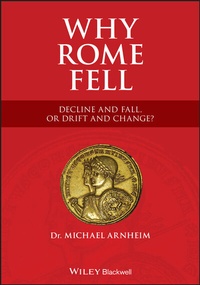
Why Rome Fell
Description

In Why Rome Fell: Decline and Fall, or Drift and Change?, celebrated scholar of Roman history Dr. Michael Arnheim delivers a fascinating and robust exploration of the causes of and reasons for Rome's fall in the West. Steeped in applications of elite theory to the later Roman Empire, the author discusses several interconnected issues that influenced the decline of Rome, including monarchy, power structure, social mobility, religion, and the aristocratic ethos.
Incisive comparisons of the situation in Rome to those in the Principate and the Byzantine Empire shed light on the relative lack of "indissoluble union and easy obedience" (in Gibbon's phrase) in the later Roman Empire. Instead, the book reveals the divided loyalties of a fractured society that characterized Rome in its later years. Why Rome Fell also includes:
* A thorough introduction to the transition from the ancient to the medieval world, including discussions of monarchy, Diocletian and his relationship to the aristocracy, and Constantine's reforms
* Comprehensive explorations of the rise of the Roman Christian empire and Constantine's role
* Practical discussions of conflicting theories of what caused the fall of the Roman empire, including the Pirenne thesis, the malaria hypothesis, Gibbon's 'decline and fall' theory, and the role played by religion
An indispensable resource for students, scholars and the general reader with an inquiring mind about history, Why Rome Fell deserves a place on the bookshelves of anyone with an interest in a sophisticated and original take on historical continuity and change.
More details
Other editions
Additional editions
Person
Content
Preface xii
Introduction 1
Part I:Transition From The Ancient To The Medieval World And Beyond 11
1. Rome: From Monarchy to Monarchy 13
2. Diocletian: Hammer of the Aristocracy 60
3. Constantine the Reformer 83
4. The Christian Empire 118
5. Continuity and Change 149
6. Two Models of Government 197
Part II:Conflicting Theories 261
Prologue to Part II 263
7. Varieties of History 273
8. Gibbon's The Decline and Fall of the Roman Empire 299
9. The Malaria Hypothesis 308
10. The Role of Religion 315
11. The Pirenne Thesis 344
12. "Late Antiquity" 357
13. Assassination or Accommodation? 379
Part III:Envoi 409
14. Conclusion 411
Glossary 433
List of Primary Sources and Abbreviations 435
Select Bibliography 439
Index 452
Introduction
Only a handful of Roman emperors are household names, and, of those, two, Augustus and Constantine, are pre-eminent but for very different reasons. Augustus established a form of government that would last for nigh on three centuries, and become a byword for stability, justice, and peace.
Constantine cast a long shadow by embracing Christianity and by establishing a new capital in Constantinople. Less well known, but long-lasting nevertheless, were his administrative and military reforms, including in particular his appointment to high civil (but not military) office in the West members of the senatorial aristocracy, who had been virtually excluded from any appointments under Diocletian.
A comparative thematic view will clarify the issues to be tackled in this study:
- Monarchy: From Augustus's victory over Antony in 31 BCE, Rome was a monarchy: First, the so-called Principate, which lasted until 284 then the "Dominate" under Diocletian and early Constantine until 312 in the empire as a whole and perpetuated in the East, or Byzantine Empire, until 1453, and, in the West, the new Constantinian model of monarchy, from around 312 until the fall of the western empire, conventionally dated to 476, and beyond, in the "barbarian" successor states in the West.
- Power structure: There is a natural antipathy between monarchy and aristocracy or oligarchy. Strong monarchy ideally needs support from the lower classes against the aristocracy, which, however, should not be unduly antagonized.
- This was well understood by Augustus, who cultivated the support of the Roman plebs urbana, which he had inherited from his adoptive father Julius Caesar, together with that of the army, and the equites (the second class in the state), while conciliating the senatorial aristocracy by allowing them to retain the bulk of provincial governorships.
- The power of the emperor in the Dominate, as established by Diocletian, depended largely on the army and, also to some extent, on eunuch chamberlains. As perpetuated in Byzantium, the emperor came to be dependent on eunuch chamberlains and on the Church, with which he had a symbiotic relationship (sometimes inaccurately characterized as caesaropapism).
- The model of government introduced by Constantine in the West had strict separation between civil and military officials. As far as the army was concerned, the emperor came to depend increasingly on "barbarian" military officials. On the civil side, members of the senatorial aristocracy exercised renewed influence through imperial appointments right up to the level of praetorian prefect-albeit mostly only for intermittent short periods-which, however, enabled them to combine office, landholding, and wealth in the same areas, and, to some extent, develop into a centrifugal force. The enhanced position of the aristocracy did not, however, rise to the level of power-sharing with the emperor (and later "barbarian" kings), let alone a hybrid power structure or oligarchy of any kind.
- Social Mobility: From the early Principate onward, the emperor elevated "new men," first from around Italy, and then from the provinces, to senatorial status. In the late third century this stopped, and emperors started appointing equestrians directly to governorships without bothering to make them senators first. This culminated under Diocletian, when the senatorial career became a cul-de-sac. This was reversed by Constantine, who not only appointed men of senatorial birth to office again, but also made a number of previously equestrian posts carry automatic senatorial status. But contrary to a common impression, this did not actually create "fusion," the creation of a "service aristocracy," or an "aristocracy of office" in the West, though it did have this effect in the East. The difference was that the West already had a traditional hereditary senatorial aristocracy, which the East lacked. A high proportion of men appointed to senatorial posts in the West were of noble origin already, and in any case, they formed a proud caste, which in the fifth century added influential bishoprics (especially in Gaul) to their existing clutch of office, land, and wealth.
- Aristocratic Ethos: Stratified or hierarchical societies, which have always been the norm in most periods, have given rise to a general sense that people are unequal, and that birth and pedigrees matter. Four hundred and fifty years of aristocratic rule under the Roman Republic inculcated this aristocratic ethos into the very marrow of society, and it was not dispelled by the monarchical regime that followed it, down to the Middle Ages, and even into the West of today with its supposedly egalitarian ethos.
Why Did the West Fall?
At various points during the fifth century the western empire was gradually dismembered, and reconfigured as a shifting mosaic of "barbarian" kingdoms. How and why did this happen? In helping us to tackle this question we have two comparators: the Principate and the Byzantine Empire. Though under severe pressure, both internal and external, the Principate never succumbed. Secondly, though the western empire dissolved, the East survived for a thousand years, until 1453.
"Indissoluble Union and Easy Obedience"
How do these two comparisons help? In his inimitable rolling prose, and without undue exaggeration, Edward Gibbon (1737-94) pointed to "the indissoluble union and easy obedience that pervaded the government of Augustus and the Antonines." (Gibbon, Ch. 51.) Contrary to the special pleading of some modern writers, these two crucial cementing factors were absent in the later Roman Empire.
Tacitus (c.56-c.120) puts into the mouth of a Caledonian (Scottish) chieftain what has become a well-known indictment of Roman rule: "Robbery, slaughter, and plunder, they describe in lying words as empire, and where they make a desert, they call it peace" (Tac. Agric., 29 f., tr. M. Arnheim). It is, of course, more than likely, that leaders of conquered peoples would not have thanked the Romans for depriving them of their liberty, and we know of several hard-fought conquests over the years. Yet, before long, the benefits of Roman rule came to be appreciated, especially when the Romans opened up their own senate and, indeed, the imperial purple itself, to provincials. Gibbon's point is brought home all the more forcefully when it is recognized that, whatever happened to the Roman Empire, it did not suffer the fate of the modern British, French, Portuguese, and Dutch colonial empires, which all came to an end as a result of local nationalist resistance. Roman citizenship was highly prized. Civis Romanus sum (I am a Roman citizen), famously proclaimed Paul of Tarsus in asserting his right to be tried before the emperor; and peregrini (free provincial subjects) would serve for twenty-five years in the Roman army in order to earn the coveted title of Roman citizen.
Lower down in the social scale, the Principate also epitomized social mobility. Unlike in the Greek city-states, for example, in Rome manumitted slaves or freedmen-liberti or libertini (for the distinction between them, see Mouritsen 2011, p. 65)-automatically became Roman citizens, with no bar on their owning property or amassing great wealth, or even holding responsible posts in government, as occurred particularly under Claudius. Successful freedmen were rewarded for their patriotism by being given a minor priesthood in the imperial cult as seviri Augustales, which even entitled them, like high magistrates, to be attended by a lictor. Trimalchio, the fictitious anti-hero freedman of Petronius's Satyricon, is inordinately proud of this honor, quite likely a true reflection of real life.
Caracalla's extension of citizenship to all free male inhabitants of the empire in 212 (though apparently done for tax reasons) is yet another illustration of Rome's policy of inclusiveness, which had already resulted in most emperors from Trajan (r. 98-117) onward being provincials.
Universal citizenship, however, had an adverse effect on military recruitment. Without an incentive for provincials to enlist, more "barbarians" were recruited than ever before, and conscription, introduced under Diocletian, continued as long as the western empire survived.
But Caracalla's policy of inclusiveness stopped short of inviting whole "barbarian" tribes to settle. In 213, for example, the highly Romanized Alemanni broke through the northern frontier of the Roman Empire with a view to settlement. Far from welcoming these would-be migrants, Caracalla pushed them back and strengthened the frontier against them. Why was the imperial government unable to hold back the "barbarians" who were similarly attracted to Roman civilization in the fourth and fifth centuries? And why did the West fall while the East survived?
The answer lies partly in the sheer strength of numbers involved in these later "barbarian" incursions, possibly driven by pressure on themselves by a westward push from the Huns. Deterred by Constantinople's strong strategic position and fortifications, the "barbarians" diverted their efforts to the West.
Divided Loyalties in a Fractured Society
However, the answer to our question must be sought largely in internal factors, and, in particular, in the divided loyalties of...
